

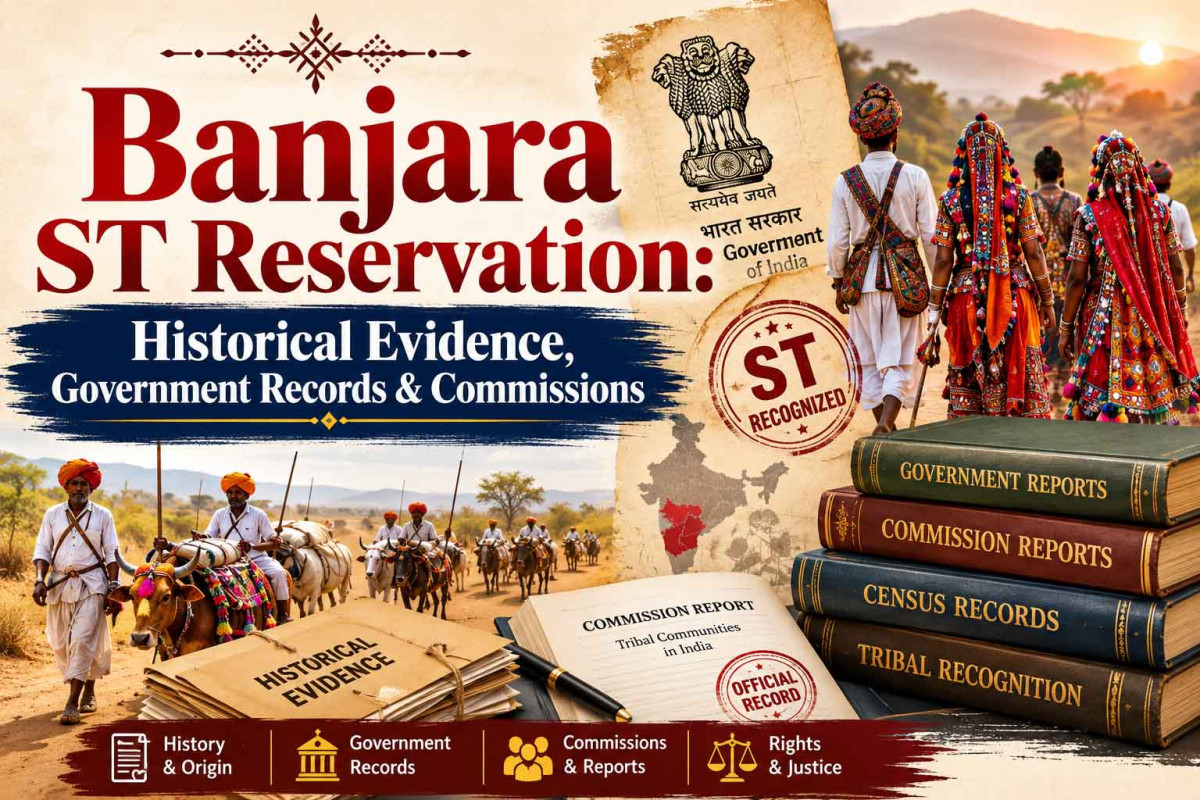
Banjara ST Reservation: Historical Evidence, Government Records & Commissions
Explore the historical documents, government records, commission recommendations, and constitutional evidence supporting the Banjara community's demand for Scheduled Tribe (ST) reservation.

Demand for Separate Reservation Instead of the 7% Tribal Reservation
A detailed account of the historical evidence regarding the Banjara community's demand for Scheduled Tribe (ST) status, including important government documents, historical records, records from the British period, recommendations made by various commissions, and the history of protests, agitations, and hunger strikes carried out by the Banjara community.
Reference Book:
History of Reservation – Yadikar Punjabrao Chavan.
Today, in Maharashtra, the Banjara community has risen in large numbers demanding that Scheduled Tribe reservation be granted to them in accordance with the Hyderabad Gazette. Massive rallies involving lakhs of people are being organized at various places. As a result, some tribal leaders, members of the tribal community, and sections of the media have raised questions about whether the Banjara community's demand for ST reservation is constitutional. Such questions are natural. I would like to tell all the tribal brothers and sisters of Maharashtra, as well as the media, that the Banjara community's demand for ST reservation is constitutional and is not at all from within the existing 7% reservation provided to Scheduled Tribes. The demand is to restore the same reservation that the Banjara community enjoyed before 1956 and to create a separate B Category for the Banjara community with separate reservation.
Everyone should keep this in mind. A study of historical evidence, important government documents from the British period, recommendations made by various commissions after Independence, the recommendations of the Lokur Committee under the States Reorganisation framework, and other government records proves that the Banjara community is 100% tribal. However, no one is willing to acknowledge this, and the debates being conducted in the media appear to lack in-depth study. If genuine researchers are given an opportunity by the media, it can be established that the Banjara community is indeed tribal. Therefore, this article is an effort to urge the Government of Maharashtra to examine all the documents listed below and grant ST reservation to the Banjara community.
1935 List of Castes and Tribes
During British rule, under the Government of India Act, 1935, a list of castes and tribes was published in 1936. According to this list, only the following three categories were considered backward in India:
- Scheduled Castes.
- Scheduled Tribes.
- Criminal Tribes.
Among these, the Constitution granted reservation to Scheduled Castes and Scheduled Tribes. However, the Criminal Tribes did not receive reservation because they were classified as criminal communities.
Historical Records
- 1305 – Fasli and other records mention Tribes.
- 1314 – Fasli and other records mention Tribes.
- 1590 – The Ain-i-Akbari records the Gor Banjara as a primitive tribe.
- 1793 – British surveys recorded the Banjara as a tribe. According to reports by anthropologists W. Crooke (1886), Edgar Thurston (1909), Russell and Hiralal (1996), Ibbetson (1996), and Enthoven (1922), criminal and nomadic tribes were originally tribal communities.
- 1985–1992 – The report of the Institute of Advanced Studies, Shimla, records the Banjara as a tribal community.
- 1960 – Maharashtra school textbooks record Gormati, Kolami, and Kokru as traditional dialects of the tribal communities of Maharashtra.
Records from the British Period
- 1860 – The Indian Penal Code records the Banjara as a Tribe.
- 1871 – The Banjara community was recorded as a Criminal Tribe.
- 1872 – Recorded as a Tribe in the Criminal Procedure Code (CRPC).
- 1916 – Indian Legislative Committee (Sir Henry Commission) recorded them as a Depressed Class.
- 1917 – Southborough Franchise Committee recorded them as a Depressed Class.
- 1921 – The Madras Presidency Reservation Act granted 44% reservation to non-Brahmins.
- 1925 – Muddiman Commission recorded them as Backward Classes / Depressed Classes.
- 1928 – The Bombay Government appointed the O.H.B. Start Committee for backward classes, which recommended three groups.
- 1928 – Hartang Committee recommended Depressed Classes, Tribal Forest Communities, and Criminal Tribes.
- 1929 – Indian Central Committee recorded them under Tribal / Criminal Tribes.
- 1931 – Census recorded them as Scheduled Tribes.
- 1932 – Indian Franchise Committee (study of non-Dwij or pure castes).
- 1935 – Backward classes divided into three groups: Scheduled Castes, Scheduled Tribes, and Criminal Tribes.
- 1936 – List of Depressed Tribes published.
- 1939 – Criminal Enquiry Committee, Bombay, recorded them as Scheduled Tribes.
- 1947 – Criminal Inquiry Committee.
- 1948 – Hyderabad Gazette recorded them at Serial No. 4 as Scheduled Tribes. The CP & Berar Gazette also recorded them as Scheduled Tribes.
- 1940–1949 – The Criminal Tribes Inquiry Committee recommended providing special opportunities to the Banjara community.
Recommendations of Reservation-Related Commissions in Independent India
- 1949 – Criminal Tribes Enquiry Committee.
- 1950 – Constitution came into force. Under Article 15, the Right to Equality was guaranteed. Under Article 15(4), if any community is socially and economically backward, the State Government may recommend it for inclusion in the SC/ST categories.
- 1950 – Criminal Tribes Inquiry Report, Delhi.
- 1950 – Antaronikar Commission Report recorded the Banjara community as Scheduled Tribe.
- 10 January 1950 – The Gazette published by the Central Provinces and Berar Government included the Banjara community as Scheduled Tribe at Serial No. 4.
- 1951 – The First Constitutional Amendment empowered the State to make special provisions for the advancement of socially and economically backward classes.
- 1952 – The Banjara community was recorded as a Denotified Tribe.
- 1952 – Criminal Tribes Social Bulletin India by K.M. Kapadia.
- 1953 – Kalelkar Commission recommended the Banjara community as an Extremely Backward Class.
- 1956 – SC/ST Modification Order.
- 1957 – Criminal Tribes Inquiry Committee, Uttar Pradesh.
- 1959 – Phate Committee.
- 1959 – Elwin Committee.
- 1960 – Dhebar Commission.
- 1961 – Dhande Committee recommended that the Banjara community be given facilities and concessions similar to those provided to Scheduled Tribes.
- 1965 – Lokur Committee recommended the inclusion of the Banjara community in the Scheduled Tribe category.
- 1967 – Bibliography on Scheduled Castes, Scheduled Tribes and Minority Communities (Reference for caste identification).
- 1969 – Shiku Commission.
- 1971 – Ethnographic Notes (A. Chandrasekhar).
- 1975 – Criminal Tribes Policy and Programme Report on Backward Classes in India (N. N. Dubey).
- 1976 – SC/ST Modification Order.
- 1976 – Parliament removed area restrictions applicable to Scheduled Castes and Scheduled Tribes.
- 1976 – The Ministry of Tribal Affairs recommended through the Removal of Area Restriction Amendment Act that if people from even one tehsil of a community are issued Scheduled Tribe certificates, then the entire community in that State should be granted Scheduled Tribe certificates.
- 1979 – Mandal Commission highlighted the backwardness of the community.
- 1982 – Mandal Commission member L. R. Naik, in his dissent note, recommended extending the benefits of Scheduled Castes/Scheduled Tribes to the community.
- 31 March 1989 – Maharashtra Government Report.
- Recommendations of the Third Five-Year Plan.
- 10 August 1993 – Dr. D. C. Wadhwa Commission recommended constitutional reservation.
- 2002 – Venkatachaliah Commission.
- 2004 – Renke Commission.
- 2004 – Justice Bapat Commission recommended the inclusion of Denotified Tribes in the Scheduled Tribe category.
- 2006 – Sachar Commission recorded the severe backwardness of Muslim Banjaras.
- 2007 – Dr. Ganesh Devy Technical Advisory Committee.
- 2009 – Dr. Narendra Jadhav Study Group Committee.
- 2010 – TAG Commission.
- 2011 – NAC Committee Report.
- 2014 – Bhatia Commission.
- 2015 – Bhiku Dada Idate Commission recommended the inclusion of the Banjara community in the Scheduled Tribe category.
- 2015 – Establishment of the National Commission for Backward Classes.
- The Bhatia Commission recommended that the Creamy Layer condition should not apply to the Banjara community because of its social and economic backwardness.
- Recommendations of the National Commission for Nomadic and Denotified Tribes.
- Repeated recommendations made by the National Commission for Scheduled Tribes.
- 2017 – Justice Rohini Commission.
- 1 April 2018 – Parliament passed a decision stating that communities fulfilling five prescribed criteria should be recommended by the Tribal Commission and forwarded by the Government to the National Commission for Scheduled Tribes.
- 19 June 2018 – The Ministry of Tribal Affairs, New Delhi, sent a letter to the Principal Secretary, Tribal Affairs Department, Mumbai, directing that the name of the Banjara community be included in the Scheduled Tribe list and recommended to the Central Government.
- 28 August 2018 – Following the above letter, the Principal Secretary, Tribal Affairs Department, Mumbai, issued a letter to the Commissioner, Tribal Research and Training Institute, Pune-1, seeking recommendations.
- 30 August 2024 – The Supreme Court approved sub-classification within the Scheduled Castes and Scheduled Tribes.
Inclusion in the Scheduled Tribe Category Under the Scheduled Tribes Order, 1950 (State-wise)
- Andhra Pradesh – Sugali, Lambadi, and Banjara included at Serial No. 28.
- Central Provinces & Berar – Included at Serial No. 4.
- Orissa – Included at Serial No. 3.
1956 – Victims of Linguistic Reorganisation of States
Before 1960, Marathwada was part of the Hyderabad State, while Vidarbha was part of Madhya Pradesh. The Nomadic and Denotified Tribes living in the 16 districts of Marathwada and the 8 districts of Vidarbha resided within a specific geographical region. However, due to the linguistic reorganisation of states, the 8 districts of CP & Berar became part of Maharashtra, and 5 of the 16 districts of the Hyderabad State were also merged into Maharashtra. Thus, in 1960, the State of Maharashtra was formed by combining Konkan, Mumbai, Vidarbha, and Marathwada.
Of the Hyderabad State, 3 districts became part of Andhra Pradesh, where they received Scheduled Tribe reservation. Eight districts became part of Karnataka, where they received Scheduled Caste reservation. However, the remaining 5 districts, along with the 8 districts of CP & Berar that became part of Maharashtra, did not receive reservation under the provisions applicable from 1956. Although they belonged to the same community, spoke the same language, wore the same traditional attire, followed the same customs and lifestyle, and maintained marital relations across Karnataka and Andhra Pradesh as one community, the Nomadic and Denotified Tribes in Maharashtra became victims of linguistic reorganisation. It is expected that the Government should rectify this serious mistake.
Provisions of the States Reorganisation Act – 1 November 1956
On 29 October 1956, Schedule One and Schedule Two were prepared. The following provisions were clearly laid down:
- Any caste or tribe shall continue to receive in the new State the same benefits that it was receiving in the previous State. For example, the reservation enjoyed by the Banjara or Labhan tribe as a Scheduled Tribe in the Hyderabad State should likewise have been granted in the Bombay State.
- Recommendations were made to exclude certain tribes from the Scheduled Tribe category. However, the Banjara, Labhan, or Sugali tribes were not included in that list. This indicates that the Banjara community was recognized as a tribal community.
1965 – Recommendations of the Lokur Committee
The Government of India established the Lokur Committee in 1965 with the objective of revising, reviewing, and prescribing standards for the lists of Scheduled Tribes and Scheduled Castes. Accordingly, the Committee prescribed the following five criteria for inclusion in the Scheduled Tribe list. In addition, Article 366(25) of the Constitution recognizes certain criteria, and only those communities fulfilling them are entitled to constitutional safeguards. The Nomadic and Denotified Tribes of Maharashtra fulfill all these criteria.
1. Primitive Traits
Nomadic and Denotified Tribes exhibit all the characteristics of an ancient primitive culture and way of life. Traces of their existence have been found in the Harappa and Mohenjo-daro civilizations. Even today, they live in groups, engage in hunting, worship nature, perform animal sacrifices, practice tattooing, wear horns on their heads (as seen among Banjara women), and continue the tradition of caste panchayats (Nashab).
2. Distinct Culture
The ancient culture of India has been preserved by the Nomadic and Denotified Tribes. They have their own independent dialects and even coded forms of communication. Their folk songs, folk music, customs, traditions, deities, food habits, lifestyle, dress, and social practices are distinct from those of other communities. Their rites and rituals, from birth to death, are different, and they are easily identified by their traditional attire. Their cultural distinctiveness continues to be visible even today.
3. Geographical Isolation
These tribes have traditionally lived in close association with nature. Even today, their settlements are found near forests. Their habitations are known as Tandas and Pals. They continue to live in geographical isolation.
4. Shyness of Contact
These tribes generally do not integrate with mainstream society and maintain an independent way of life. Even today, there is a tendency among them to remain socially distant from other communities. They often perceive themselves as small or weak and remain concerned about how others may judge their way of living and behavior. Due to the loss of self-confidence and determination over generations, they have become more dependent on fate.
5. Backwardness and Poverty
These tribes remain backward in every sphere of life. They are educationally, politically, economically, and occupationally disadvantaged. Their nomadic way of life is still visible today. A mindset of "let us mind our own lives" has developed among them. Modern civilization and urban culture have had very little impact on their lives. Even today, their Tandas remain far removed from development. A large number of Nomadic Tribes continue to migrate for six months every year as sugarcane harvest labourers, leaving their villages behind. Their backwardness and economic poverty continue to be evident.
These are not the only criteria. In addition to the constitutional criteria, two more characteristics are also found among these tribes.
6. Nomadism
Even today, many members of the Banjara community migrate to cities such as Pune and Mumbai in search of livelihood, working as daily wage labourers or sugarcane harvest workers. Since they do not possess sufficient material resources to sustain themselves in one place, they continue to migrate carrying the burden of survival. Hundreds of such families can still be seen wandering across the State. The Renke Commission also referred to this fact in its report.
7. Stigma of Criminality
The Criminal Tribes law has not been completely abolished; rather, it has been modified. Consequently, whenever theft occurs, people from these communities are still viewed with suspicion by the police. They are often subjected to arbitrary harassment, and society's traditional perception of them has not completely changed. Although there are exceptions, many families continue to bear the stigma of criminality.
Therefore, the Criminal Tribes Inquiry Committee, in its reports of 1940 and 1949, independently recommended to the Central Government that these communities should be provided with special opportunities.
Bills Introduced in Parliament for Granting Scheduled Tribe Reservation to the Banjara Community
- 1969 – Bill No. 19.
- 1972 –
- 1976 –
Reservation Status of the Banjara Community in Different States
- 1950 – Odisha – Scheduled Tribe (ST)
- 1950 – Karnataka – Scheduled Caste (SC)
- 1950 – Punjab – Other Backward Class (OBC)
- 1956 – Andhra Pradesh – Scheduled Tribe (ST) in certain districts; after 1976, Scheduled Tribe (ST) status throughout the State.
- 1956 – Bihar – Scheduled Caste (SC)
- 1956 – Delhi – Scheduled Caste (SC)
- 1966 – Haryana – Other Backward Class (OBC)
- 1971 – Himachal Pradesh – Scheduled Caste (SC)
- 2002 – Jharkhand – Scheduled Tribe (ST)
- 2014 – Telangana – Scheduled Tribe (ST)
- West Bengal – Other Backward Class (OBC)
- Gujarat – Other Backward Class (OBC)
- Rajasthan – Other Backward Class (OBC)
- Maharashtra – VJNT
- Tamil Nadu – Denotified Tribe (DNT)
- Uttar Pradesh – Other Backward Class (OBC)
- Madhya Pradesh – Other Backward Class (OBC)
- Kerala – No Reservation
- Jammu & Kashmir – Other Backward Class (OBC)
- Arunachal Pradesh – Open Category
- Dadra & Nagar Haveli – Scheduled Tribe (ST)
- Goa – Other Backward Class (OBC)
- Tripura – Other Backward Class (OBC)
- Uttaranchal – Other Backward Class (OBC)
- Puducherry – Other Backward Class (OBC)
- Uttarakhand – Other Backward Class (OBC)
Accordingly, the Banjara community is distributed across different reservation categories in various States: Scheduled Tribe (ST) in 5 States, Scheduled Caste (SC) in 4 States, Other Backward Class (OBC) in 13 States, Denotified Tribe (DNT) in 2 States, VJNT in 1 State, and the Open Category in 1 State. This disparity needs to be addressed.
What's Your Reaction?
 Like
0
Like
0
 Dislike
0
Dislike
0
 Love
0
Love
0
 Funny
0
Funny
0
 Wow
0
Wow
0
 Sad
0
Sad
0
 Angry
0
Angry
0





Comments (0)