

Major Festivals of the Gor Banjara Community: Teej, Diwali, Holi & Cultural Traditions
Discover the vibrant festivals of the Banjara community, including Teej, Diwali, Holi, Godhan Puja, Dhund ceremony, and Gor Banjara cultural traditions.

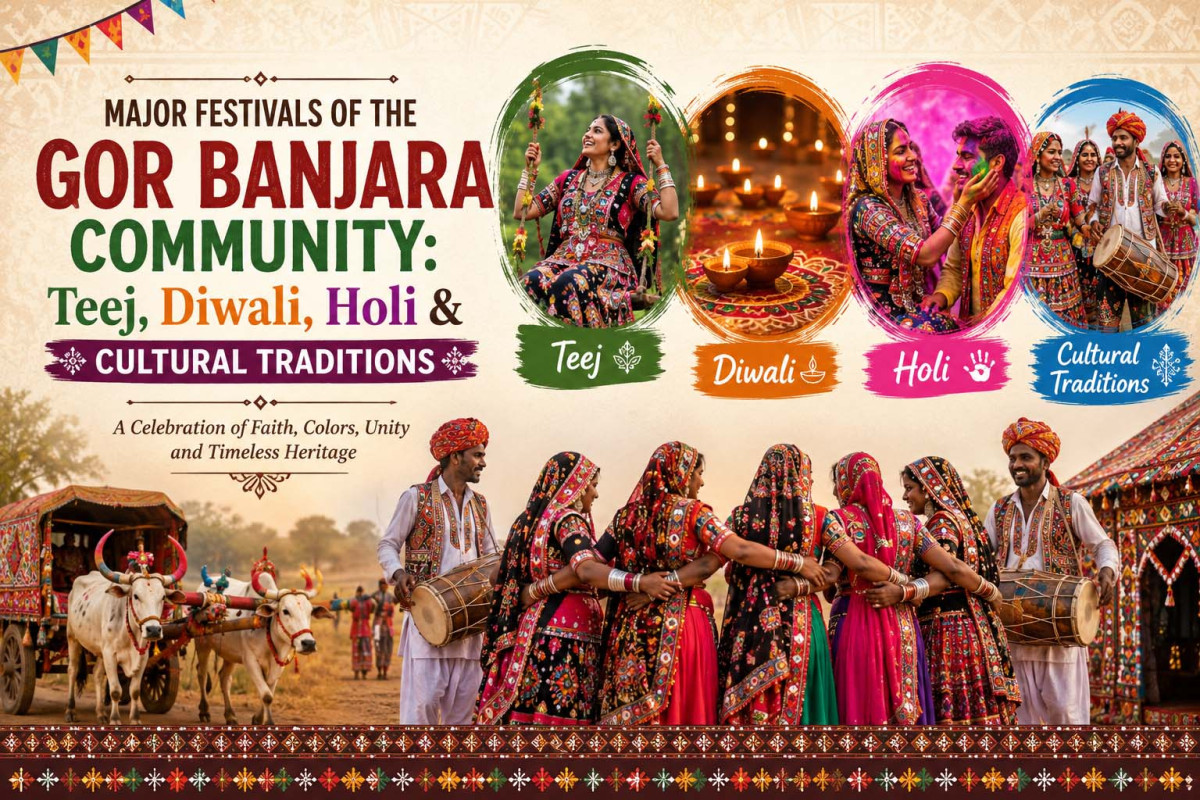
The Banjara community, also known as Gor Banjara, Lambani, Lambadi, Sugali, Vanjara, and Labhana in different regions of India, possesses one of the richest cultural traditions among India's tribal communities. For centuries, Banjaras have preserved their identity through colorful attire, folk songs, traditional dances, oral literature, customs, and above all, their vibrant festivals.
Festivals are not merely occasions for celebration in Banjara society; they represent the living heritage of generations. Every festival reflects the community's deep connection with nature, livestock, agriculture, ancestors, and divine powers. Through music, dance, rituals, fasting, and communal gatherings, Banjaras continue to pass their traditions from elders to younger generations.
Although Banjaras now live across Maharashtra, Telangana, Karnataka, Andhra Pradesh, Madhya Pradesh, Rajasthan, Gujarat, Chhattisgarh, and several other states, their festivals still preserve many elements of their ancient nomadic lifestyle. At the same time, regional influences have enriched these celebrations, creating a unique blend of indigenous Banjara customs and local Hindu traditions.
This article explores the major festivals celebrated by the Banjara community, their historical origins, cultural significance, rituals, songs, dances, and the values they continue to uphold in modern society.
The Historical Background of Banjara Festivals
The history of the Banjara community stretches back many centuries. Historians generally believe that the Banjaras originated from the Mewar region of Rajasthan before migrating across different parts of India. During ancient and medieval times, they were renowned traders who transported salt, grains, spices, metals, and military supplies using large caravans of bullocks.
Because they constantly travelled through forests, mountains, deserts, and kingdoms, the Banjaras developed a lifestyle deeply connected with nature. Their festivals naturally reflected this environment. Instead of elaborate temples, forests became sacred spaces. Rivers, hills, animals, and trees became symbols of divine blessings.
As migrations continued toward the Deccan Plateau after the decline of Rajput kingdoms, Banjaras carried their festivals with them. Even today, communities living hundreds of kilometers apart celebrate many of the same traditions, demonstrating the remarkable continuity of Banjara culture.
Why Festivals Hold Great Importance in Banjara Society
Unlike many urban celebrations, Banjara festivals are community-centered rather than individual-centered.
Every celebration strengthens relationships between:
- Families
- Relatives
- The entire Tanda (settlement)
- Nature
- Livestock
- Ancestors
- Village leaders
- Community youth
Festivals are also occasions for teaching children traditional songs, folk dances, rituals, respect for elders, and the Gor Boli language.
The Tanda becomes a place of collective happiness where everyone participates regardless of economic status.
Music and Dance: The Soul of Every Festival
No Banjara festival is complete without music.
Traditional instruments include:
- Dhol
- Dholak
- Nagara
- Khanjari
- Manjira
- Tasha
Women perform graceful circular dances wearing heavily embroidered Ghagras decorated with mirrors, shells, silver ornaments, and colorful threads.
Men participate with energetic group dances accompanied by rhythmic singing.
Unlike stage performances, these dances emerge naturally from community participation.
Traditional songs express:
- Love
- Devotion
- Nature
- Heroism
- Marriage
- Agriculture
- Family values
- Saints
- Social unity
Many songs have survived only through oral tradition for hundreds of years.
The Cultural Calendar of Banjara Festivals
Throughout the year Banjaras celebrate numerous festivals, including:
- Teej
- Holi
- Diwali
- Dussehra
- Nag Panchami
- Raksha Bandhan
- Makar Sankranti
- Mahashivratri
- Pongal (southern regions)
- Regional harvest festivals
Among these, Teej, Diwali, and Holi are regarded as the three most important festivals of the community.
Teej: The Most Sacred Festival for Unmarried Banjara Girls
Among all Banjara festivals, Teej occupies a special position.
Celebrated during the holy month of Shravan (August), Teej symbolizes hope, fertility, prosperity, devotion, and future happiness.
While Teej is celebrated across Rajasthan and northern India, the Banjara version retains several unique customs that distinguish it from other communities. The festival continues to be celebrated with remarkable enthusiasm in Banjara Tandas throughout Maharashtra, Telangana, Karnataka, and neighboring states.
Beginning of Teej Festival
Preparations begin several days before the festival.
The unmarried girls of the Tanda approach the Nayak (traditional headman) seeking permission to celebrate Teej.
This ritual demonstrates the importance of community leadership and collective participation.
After receiving the Nayak's blessing, the entire Tanda begins preparations.
Songs of gratitude are sung in honor of the Nayak, reflecting respect for traditional authority.
Collecting Sacred Soil
One of the most fascinating customs of Teej involves collecting fertile soil from anthills.
Groups of girls walk together toward nearby forests singing traditional songs.
According to custom, boys playfully attempt to stop their path.
After cheerful interaction, the girls eventually succeed in bringing back the sacred soil.
This ritual symbolizes determination, courage, cooperation, and the victory of good intentions.
The soil is believed to possess divine fertility and becomes the foundation for the Teej ceremony.
Sowing Wheat Seeds
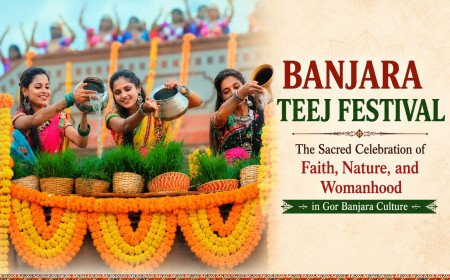
After returning from the forest, wheat seeds are sown inside beautifully decorated bamboo baskets.
The baskets are placed at a respected location inside the Tanda.
Every morning and evening the girls carefully water the seeds.
For the next seven to nine days, everyone eagerly watches the growth of the green shoots.
Healthy, tall, and thick sprouts are considered highly auspicious.
Traditionally, they symbolize:
- A happy married life
- A virtuous husband
- Family prosperity
- Fertility
- Good fortune
This simple agricultural ritual beautifully connects human life with the cycles of nature.
Daily Worship During Teej
Throughout the festival the girls gather twice daily around the bamboo baskets.
Together they:
- Sing devotional songs
- Dance in circles
- Offer prayers
- Observe fasting
- Worship Lord Krishna
- Seek blessings for their future
These gatherings strengthen friendships among young women while preserving centuries-old songs that might otherwise disappear.
Unlike modern entertainment, these celebrations emphasize participation rather than performance.
The Final Day of the Teej Festival
After seven to nine days of caring for the sacred wheat sprouts, the most emotional day of the Teej festival finally arrives. During these days, the green seedlings have become more than just plants—they symbolize the hopes, prayers, and dreams of every unmarried Banjara girl.
The final day begins early in the morning. Girls wake before sunrise, bathe, wear their finest traditional Banjara dresses, decorate themselves with silver ornaments, colorful bangles, nose rings, necklaces, anklets, and embroidered garments. The entire Tanda becomes lively as songs echo through every household.
The Nayak (traditional headman) and village elders gather to supervise the concluding rituals. Families prepare offerings while women clean and decorate the surroundings with traditional designs.
The bamboo baskets containing the lush green wheat shoots are placed in the center of the gathering. Girls surround them while singing ancient folk songs passed down from generation to generation. These songs express gratitude to nature, devotion to the divine, and hope for a prosperous future.
Unlike many festivals where celebrations end with fireworks or feasts, Teej concludes with a deeply emotional farewell. The girls have nurtured these seedlings for several days, treating them almost like members of their own family. Saying goodbye to them represents accepting the natural cycle of life—growth, fulfillment, and letting go.
According to traditional belief, the healthy growth of the seedlings is considered a sign of future happiness and good fortune. Families often observe the condition of the sprouts with great interest, believing that they carry symbolic messages about the coming year.
Immersion of the Sacred Teej
One of the most touching moments of the festival is the immersion ceremony.
The girls form a procession carrying the bamboo baskets on their heads while singing devotional songs. Elderly women bless them, wishing them long lives, good health, loving husbands, and prosperous families.
The procession moves toward a nearby river, lake, pond, or stream.
Throughout the journey, traditional songs continue without interruption. Some songs express joy, while others carry emotions of separation similar to the farewell songs sung during weddings.
Finally, the wheat seedlings are immersed in water.
This ritual symbolizes:
- Gratitude toward Mother Nature
- Acceptance of life's changing seasons
- Completion of prayers
- Beginning of a new phase of life
- Faith in divine blessings
After immersion, the girls return to the Tanda with renewed hope and happiness.
Symbolism Behind Wheat Sprouts
The wheat seedlings used during Teej hold deep symbolic meaning.
They represent:
- Fertility
- Prosperity
- Agricultural abundance
- New beginnings
- Spiritual growth
- Purity
- Positive energy
For unmarried girls, the growing sprouts symbolize their own future lives.
Just as the seedlings require regular care, patience, and nourishment to flourish, a successful family life also requires dedication, love, understanding, and responsibility.
This simple agricultural ritual beautifully connects human existence with the rhythms of nature.
Community Participation During Teej
Although Teej is primarily associated with unmarried girls, the entire Tanda participates enthusiastically.
Different members contribute in different ways.
Elders:
- Guide rituals
- Narrate traditional stories
- Bless participants
- Preserve customs
Women:
- Prepare traditional food
- Teach folk songs
- Help decorate the festival area
- Support younger girls
Men:
- Arrange festival grounds
- Assist with logistics
- Provide security during processions
- Participate in community celebrations
Children:
- Learn songs and customs
- Observe rituals
- Join dances
- Understand their cultural heritage
This collective participation strengthens social unity and ensures that traditional knowledge passes naturally from one generation to another.
Folk Songs of Teej
Music is the heartbeat of the Teej festival.
Every stage of the celebration has its own songs.
Songs are sung while:
- Collecting sacred soil
- Bringing bamboo baskets
- Sowing wheat
- Watering the seedlings
- Dancing around Teej
- Observing fasts
- Carrying Teej for immersion
- Saying farewell
These songs are not merely entertainment.
They preserve:
- Community history
- Religious beliefs
- Ancient vocabulary
- Gor Boli language
- Family values
- Moral teachings
Many songs have survived for centuries without ever being written down.
Transition from Teej to Diwali
After the conclusion of Teej, the community gradually prepares for another major celebration—Diwali.
While Teej celebrates youth, fertility, and hope, Diwali represents prosperity, gratitude, family unity, and the victory of light over darkness.
Among Banjaras, Diwali possesses several customs that are different from those observed by neighboring communities.
Although influenced by mainstream Hindu traditions, Banjara Diwali has preserved its own unique identity over generations.
Diwali: The Festival of Light in Banjara Society
Diwali is regarded as one of the most joyful festivals of the Banjara community.
Preparation begins several days before the festival.
Homes are cleaned thoroughly.
Courtyards are decorated.
Traditional clothes are repaired or newly stitched.
Children eagerly await the celebrations.
Families prepare sweets using locally available ingredients.
Unlike urban celebrations centered around shopping and fireworks, Banjara Diwali focuses on family, community, livestock, and gratitude.
The atmosphere inside every Tanda becomes filled with excitement.
Decorating Homes
On the morning of Diwali, women wake before sunrise.
They clean the entrance of their homes and decorate the ground using cow dung and traditional patterns.
Fresh flowers collected from nearby forests are used for decoration.
Natural materials such as leaves, grass, clay, and flowers create a beautiful festive environment.
These decorations symbolize:
- Purity
- Prosperity
- Protection
- Divine blessings
- Harmony with nature
The emphasis on natural materials reflects the community's historical relationship with forests and rural life.
Godhan Puja: Worship of Cow Dung
One of the most distinctive features of Banjara Diwali is Godhan Puja.
Unlike many other communities that primarily worship Goddess Lakshmi, Banjaras also give special importance to cow dung as a sacred symbol.
Cow dung is carefully shaped and decorated with flowers before worship.
To outsiders, this may appear unusual, but within Banjara culture it carries profound spiritual meaning.
Cow dung represents:
- Fertility
- Agricultural prosperity
- Healthy livestock
- Rural abundance
- Mother Earth
- Purification
For generations, cattle formed the backbone of Banjara life.
Bullocks transported goods across India.
Cows provided milk.
Livestock represented wealth.
Therefore, honoring everything connected with cattle naturally became an important religious tradition.
The worship of cow dung is therefore not merely symbolic—it is an expression of gratitude toward the animals that sustained the community throughout history.
Girls Visit Every House
One of the most beautiful traditions during Banjara Diwali is the custom of unmarried girls visiting every house in the Tanda.
Groups of girls move from door to door singing blessings for each family.
Their songs pray for:
- Good health
- Prosperity
- Peace
- Happy children
- Healthy livestock
- Successful harvests
In return, each household offers small gifts.
Traditionally these include:
- Coins
- Food
- Grains
- Sweets
- Fruits
These offerings are not considered charity.
Rather, they symbolize affection, mutual respect, and community participation.
The tradition ensures that every family, regardless of wealth, becomes part of the collective celebration.
Fasting and Prayer
The second day of Diwali includes another important ritual.
Many girls observe a religious fast.
The fast is performed with sincerity and devotion while praying for the well-being of their future families.
Throughout the day they participate in prayers, songs, and rituals before finally concluding the fast after the completion of Godhan Puja.
The discipline involved teaches patience, self-control, and spiritual dedication.
The Sacred Bond Between Brother and Sister
Diwali also celebrates the loving relationship between brothers and sisters.
According to Banjara tradition, sisters ceremonially bathe their brothers and pray for their:
- Long life
- Good health
- Success
- Prosperity
- Protection from misfortune
After receiving these blessings, brothers express their affection by presenting gifts to their sisters.
These gifts need not be expensive.
Traditionally they symbolize gratitude, respect, and lifelong responsibility toward one another.
This custom strengthens family relationships and reminds every generation of the importance of mutual care within the family.
Community Unity Through Festivals
The greatest strength of Banjara festivals lies in their ability to unite people.
Regardless of economic condition, education, or occupation, every family participates.
Festivals remove social differences.
People:
- Eat together.
- Dance together.
- Sing together.
- Pray together.
- Celebrate together.
This sense of equality has helped preserve the Banjara community through centuries of migration, hardship, and social change.
Even today, many Banjaras living in cities return to their native Tandas during major festivals to reconnect with their roots, meet relatives, and pass cultural traditions to the younger generation.
Holi: The Most Energetic Festival of the Banjara Community
If Teej represents hope and Diwali symbolizes prosperity, Holi represents the spirit of unity, courage, joy, and unrestricted celebration in Banjara society. Among many Banjara families, Holi is considered the most eagerly awaited festival of the year. Preparations begin long before the arrival of the festival, and the excitement spreads throughout every Tanda (Banjara settlement).
Unlike urban Holi celebrations that often focus only on colors, music, and entertainment, the traditional Banjara Holi is a deeply cultural and spiritual event. It combines religious rituals, folk traditions, community gatherings, ancient songs, ceremonial dances, and customs that have been preserved for centuries.
The festival reflects the community's belief that happiness is best experienced collectively. Rich and poor, young and old, men and women—all participate equally, making Holi one of the strongest symbols of social unity within Banjara culture.
Historical Importance of Holi
The Banjara version of Holi carries influences from both Rajasthan, the traditional homeland of the Banjaras, and the regions where the community later settled across India.
Like other Hindu communities, Banjaras associate Holi with the victory of good over evil. However, they also maintain unique customs that distinguish their celebration from mainstream practices.
Traditionally, Holi marks:
- The end of winter
- The arrival of spring
- Renewal of community relationships
- Celebration of agricultural prosperity
- Removal of negative energies
- Beginning of a joyful season
For centuries, Holi has also served as an occasion for resolving misunderstandings among families and strengthening friendships within the Tanda.
Holika Dahan in Banjara Tradition
One of the central rituals of the festival is Holika Dahan, the ceremonial bonfire.
According to popular Hindu tradition, Holika Dahan commemorates the triumph of devotion represented by Prahlad over the evil intentions of Holika.
Within Banjara oral traditions, however, another legend is also remembered. It speaks of a demon named Dhunda, who troubled villages and frightened people. To protect the community, villagers lit sacred fires at the boundaries of their settlements. These fires symbolized the destruction of evil forces and the protection of society from harmful influences.
Whether associated with Holika or Dhunda, the message remains the same:
- Good ultimately triumphs over evil.
- Community unity defeats fear.
- Faith overcomes adversity.
A Different Timing from Mainstream Holi
One interesting difference between Banjara Holi and mainstream Hindu celebrations is the timing of the Holika bonfire.
While many Hindu communities light Holika on the full-moon night of Phalguna, traditional Banjara communities often perform the main Holi rituals on the following morning, following customs preserved through generations.
This distinction demonstrates how Banjaras have retained their own cultural identity while sharing broader Hindu religious traditions.
The Dhund Ceremony: Celebrating New Life
Among the most distinctive customs of Banjara Holi is the Dhund (Searching) Ceremony.
This ritual is performed when a child has been born in the family since the previous Holi.
The community believes that every newborn should symbolically "meet" Holi for the first time. Without this ceremony, many elders consider the family's Holi celebrations incomplete.
The ceremony is not merely a family function—it becomes a celebration for the entire Tanda.
Preparations for the Dhund Ceremony
As Holi approaches, relatives, neighbors, and friends gather at the house where the newborn lives.
The courtyard becomes the center of celebration.
Traditional musicians arrive with drums.
Women wear their finest embroidered dresses.
Men gather with great enthusiasm.
Throughout the evening, people sing humorous, devotional, and traditional songs while dancing late into the night.
These celebrations often continue until midnight or even dawn, creating an atmosphere filled with laughter and happiness.
Folk Songs During Holi
Holi songs occupy a unique place in Banjara oral literature.
They include many themes:
- Heroic stories
- Religious devotion
- Romantic expressions
- Friendly teasing
- Social satire
- Humorous conversations
- Community history
- Moral lessons
Some songs are playful.
Some are emotional.
Others contain satire intended purely for entertainment.
These songs preserve centuries of history without written records, allowing each generation to inherit the wisdom of its ancestors.
Dance Around the Holika
Once Holika is lit, people gather around the sacred fire.
Men begin singing energetic songs while dancing rhythmically around the bonfire.
After some time, women join the celebration.
Their graceful circular dances create a striking contrast with the energetic movements of the men.
Traditional musical instruments fill the night air.
The dance is not performed for spectators.
Everyone participates.
This collective participation reflects one of the strongest characteristics of Banjara culture—community over individuality.
Lengi Songs: The Voice of Devotion
Among the most treasured musical traditions during Holi are the Lengi songs.
These devotional folk songs are usually performed by women.
Unlike playful Holi songs, Lengi songs are deeply spiritual.
Many praise:
- Sant Sevalal Maharaj
- Nature
- Ancestors
- Community values
- Divine protection
As women sing together, they enter a state of collective devotion, expressing gratitude for life, family, and their cultural heritage.
The melodies have been transmitted orally for generations and remain among the most valuable treasures of Banjara folklore.
Sant Sevalal Maharaj and Holi
No discussion of Banjara festivals is complete without mentioning Sant Sevalal Maharaj, the revered spiritual guide of the Banjara community.
During Holi, many traditional songs remember his teachings.
Sant Sevalal emphasized:
- Truthfulness
- Compassion
- Unity
- Simplicity
- Service to society
- Respect for nature
- Moral living
His teachings continue to influence Banjara festivals, encouraging celebrations that strengthen social harmony rather than division.
For many families, remembering Sant Sevalal during Holi is both a religious duty and an expression of gratitude toward the community's greatest spiritual leader.
The Geria Tradition
One of the most exciting events during Banjara Holi is the Geria tradition, a playful contest between the young men and women of the Tanda.
After the Holika rituals, young men (known as Geria) attempt to uproot wooden sticks or seize a ceremonial earthen pitcher placed near the Holika.
However, the women are ready to defend it.
Holding sticks in their hands, they symbolically prevent the young men from succeeding.
The contest is playful rather than violent.
It demonstrates:
- Courage
- Teamwork
- Good humor
- Friendly competition
- Community participation
The event usually ends with laughter, songs, and renewed friendships.
Why Songs Are Essential to Every Festival
Music occupies a central position in Banjara culture.
Every festival has its own collection of songs.
There are songs for:
- Birth
- Marriage
- Festivals
- Agriculture
- Migration
- Heroism
- Religious worship
- Daily life
These songs serve as living history books.
Since the Banjara community traditionally relied on oral transmission rather than written literature, folk songs became the primary method of preserving historical memories and cultural identity.
Festivals as a Tool for Cultural Preservation
Modern life has transformed many aspects of Banjara society.
Education, urban migration, technology, and employment opportunities have changed lifestyles considerably.
However, festivals continue to preserve traditions that might otherwise disappear.
Through annual celebrations, younger generations learn:
- Gor Boli vocabulary
- Traditional dances
- Rituals
- Folk music
- Community history
- Family values
- Respect for elders
Without festivals, much of this knowledge could easily be lost within a few generations.
Regional Diversity in Banjara Festivals
Although the basic structure of festivals remains similar, regional differences exist across India.
For example:
- Maharashtra Banjaras celebrate with Marathi cultural influences.
- Telangana and Andhra Pradesh communities include regional devotional traditions.
- Karnataka Banjaras incorporate local folk music styles.
- Rajasthan preserves many of the oldest Teej customs.
- Southern states also celebrate Pongal alongside traditional Banjara festivals.
Despite these regional variations, the essential values remain unchanged.
Wherever Banjaras live, festivals continue to celebrate:
- Unity
- Respect
- Nature
- Family
- Devotion
- Cultural identity
Challenges in Preserving Traditional Festivals
Like many indigenous communities, the Banjaras face several challenges in preserving their cultural heritage.
These include:
- Urban migration
- Declining use of Gor Boli
- Reduced knowledge of traditional songs
- Influence of modern entertainment
- Loss of oral traditions
- Smaller community gatherings
- Changing lifestyles
Many young people now celebrate festivals in cities where traditional Tanda customs are difficult to organize.
As a result, certain rituals, songs, and ceremonies are gradually disappearing.
The Need for Cultural Documentation
To safeguard Banjara heritage, scholars, community organizations, and young people must work together to document:
- Folk songs
- Festival rituals
- Oral histories
- Traditional dances
- Sacred stories
- Community customs
- Gor Boli language
- Elderly people's memories
Digital platforms, books, documentaries, websites, and educational programs can play a significant role in ensuring that future generations remain connected to their roots.
Conclusion
The festivals of the Banjara community are much more than annual celebrations—they are living expressions of history, identity, faith, and resilience. Rooted in the community's nomadic past and enriched by centuries of cultural exchange, festivals such as Teej, Diwali, and Holi continue to preserve the unique traditions of the Gor Banjara people.
Each festival reflects a different aspect of Banjara life. Teej symbolizes hope, fertility, and the aspirations of young women. Diwali expresses gratitude, prosperity, and the importance of family and livestock through customs like Godhan Puja. Holi, with its vibrant songs, dances, Dhund ceremony, and Geria tradition, celebrates courage, unity, and the triumph of good over evil while honoring the teachings of Sant Sevalal Maharaj.
Despite the rapid pace of modernization, these festivals remain a powerful link between the present and the past. They preserve the Gor Boli language, transmit oral traditions, strengthen family and community bonds, and remind younger generations of their rich cultural inheritance.
Protecting these traditions is not only important for the Banjara community but also for India's diverse cultural heritage. By documenting, celebrating, and passing on these festivals, future generations can continue to take pride in one of the country's oldest and most vibrant tribal cultures.
Frequently Asked Questions
What's Your Reaction?
 Like
1
Like
1
 Dislike
0
Dislike
0
 Love
0
Love
0
 Funny
0
Funny
0
 Wow
0
Wow
0
 Sad
0
Sad
0
 Angry
0
Angry
0





Comments (0)