Swadesh Word List in Banjara Language: Preserving the Vocabulary of the Gor Banjara Community
Discover 100 essential Banjara (Gor Boli) words from the Swadesh Word List with English, Hindi, Devanagari, and IPA pronunciation. A valuable resource for learners, researchers, and the Gor Banjara community.

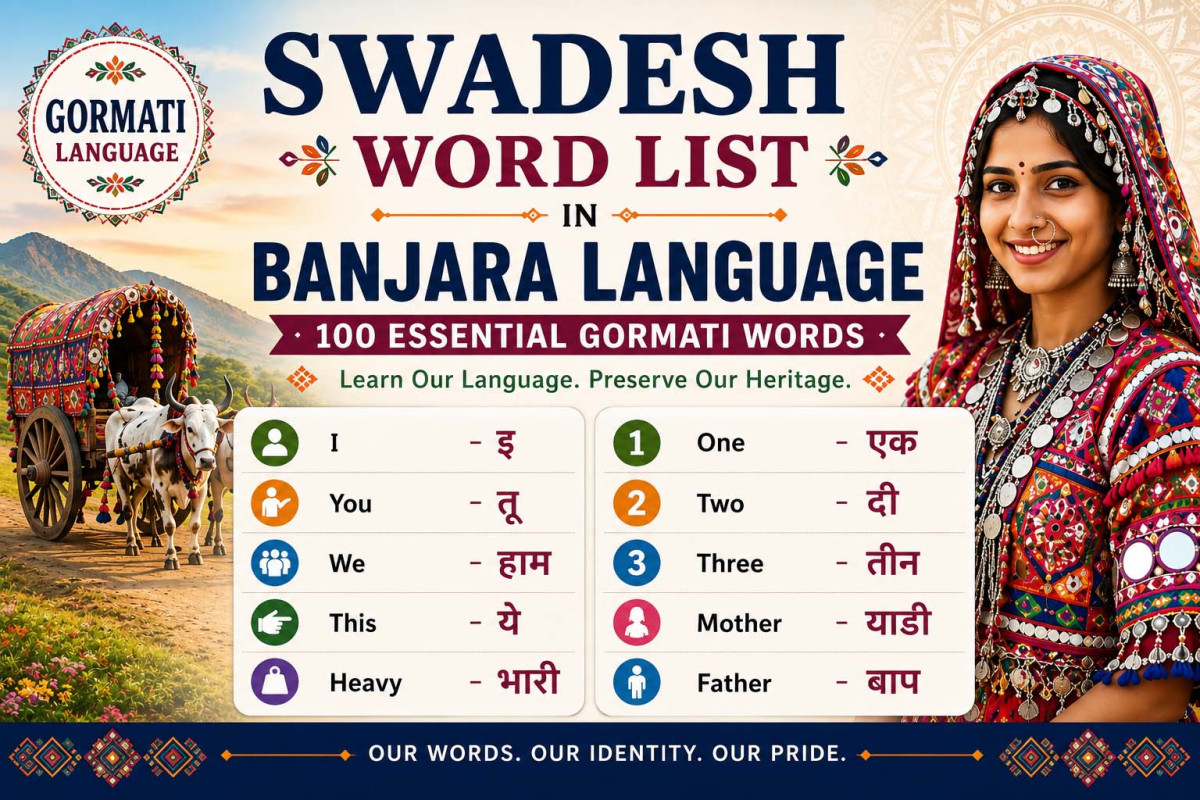
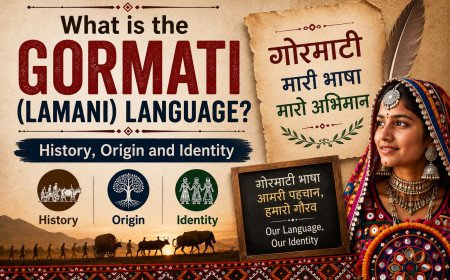
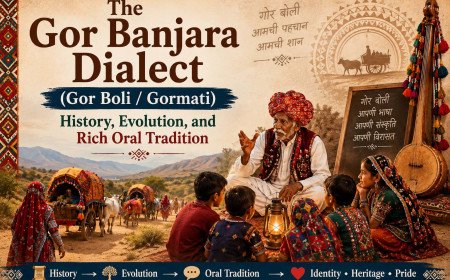
Language is much more than a way of communication—it is the identity, history, and cultural memory of a community. Among India's rich linguistic traditions, the Banjara language, also known as Gor Boli, Gormati, Lambadi, or Lamani, occupies a special place. Spoken by millions of Banjaras across India, the language reflects centuries of migration, trade, folklore, and cultural heritage.
One of the most important linguistic tools for studying any language is the Swadesh Word List. This standardized list contains basic everyday words that exist in nearly every language of the world. Since these words rarely change over time, linguists use them to compare languages, understand their historical development, and study relationships between language families.
The Swadesh Word List for the Banjara Language presents 100 essential words in four formats:
- English
- Hindi
- Banjara (Devanagari Script)
- IPA (International Phonetic Alphabet)
This vocabulary serves as an important resource for students, researchers, language learners, and members of the Banjara community who wish to preserve and promote their mother tongue.
What is the Swadesh Word List?
The Swadesh List was developed by American linguist Morris Swadesh during the mid-20th century. His objective was to identify a collection of words that are common across all human languages.
These words represent concepts that are fundamental to everyday life, including:
- Family members
- Numbers
- Pronouns
- Body parts
- Nature
- Animals
- Basic actions
- Common adjectives
Because these words are used frequently and are less likely to be borrowed from other languages, they are extremely useful for linguistic comparison.
Today, Swadesh Lists are used worldwide to:
- Compare languages
- Study language evolution
- Preserve endangered languages
- Develop dictionaries
- Create educational resources
The inclusion of the Banjara language in a Swadesh List is an important step toward documenting one of India's significant tribal languages.
Why is the Swadesh List Important for the Banjara Community?
The Banjara language has traditionally been an oral language. For centuries, knowledge was passed from generation to generation through songs, stories, festivals, and conversations rather than written literature.
Modern education and urbanization have increased the influence of regional languages such as:
- Marathi
- Hindi
- Telugu
- Kannada
- Gujarati
- Rajasthani
As a result, many young Banjaras today understand Gor Boli but do not speak it fluently.
The Swadesh Word List helps preserve the original vocabulary before it disappears.
Its importance includes:
Language Preservation
Recording authentic words ensures that future generations can learn their ancestral language.
Educational Resource
Teachers and students can use the vocabulary while learning Gor Boli.
Linguistic Research
Researchers can compare Banjara with related Indo-Aryan languages.
Digital Documentation
Websites, dictionaries, mobile apps, and educational platforms can use this vocabulary to build language-learning tools.
Personal Pronouns in the Banjara Language
One of the first things every language learner studies is pronouns.
The Swadesh List begins with these essential words.
| English | Banjara |
|---|---|
| I | म |
| You (Singular) | तू |
| He | वू |
| We | हाम |
| You (Plural) | तम |
| They | वो |
These words show that Banjara shares similarities with several Indo-Aryan languages while maintaining its own unique pronunciation and grammar.
Demonstrative Words
These words help identify objects and locations.
Examples include:
| English | Banjara |
|---|---|
| This | ये |
| That | वो |
| Here | आत |
| There | वोत |
These are among the most frequently used words in daily conversation.
Question Words
Question words form the basis of communication.
The Swadesh List records the following:
| English | Banjara |
|---|---|
| Who | कूं |
| What | काईं |
| Where | कत |
| When | कना |
| How Much | कतरा |
Learning these words enables learners to construct basic questions in Gor Boli.
Everyday Descriptive Words
The Swadesh vocabulary also contains common adjectives.
Examples include:
| English | Banjara |
|---|---|
| Big | मोटो |
| Long | लाम्बो |
| Wide | चौडो |
| Thick | जाडो |
| Heavy | भारी |
| Small | बारीक/बारक्या |
| Thin | पातळ |
These descriptive words are used daily while describing people, places, animals, and objects.
Counting Numbers in Banjara
Numbers are among the oldest words preserved in every language.
The Swadesh List includes:
| English | Banjara |
|---|---|
| One | एक |
| Two | दी |
| Three | तीन |
| Four | चार |
| Five | पाच |
These numbers closely resemble other Indo-Aryan languages, reflecting historical linguistic connections.
Family Vocabulary
Family relationships are central to Banjara culture.
The Swadesh List records words for immediate family members.
| English | Banjara |
|---|---|
| Mother | याडी |
| Father | बाप |
| Wife | तांडरी |
| Husband | तांडरो |
| Child | छीचार |
These words continue to be used in traditional Banjara households across many regions of India.
Vocabulary Related to Nature
Nature has always played an important role in Banjara life.
The vocabulary includes words for:
- Tree (झाड)
- Forest (डुंगर)
- Flower (फुल)
- Grass (खड)
- Leaf (पान)
- Root (जड)
- Seed (बी)
- Fruit (फळ)
These words reflect the historical lifestyle of Banjaras, who were traditionally connected with forests, trade routes, agriculture, and livestock.
Animal Names in the Swadesh List
Animals appear frequently in folklore, songs, and everyday speech.
Some examples include:
| English | Banjara |
|---|---|
| Dog | कतरा |
| Fish | माछळी |
| Bird | चलकोडी |
| Snake | जनावर |
| Worm | कीडो |
Although some regional variations exist, these words remain part of traditional Gor Boli vocabulary.
Body Parts Vocabulary in Banjara Language
Every language develops a rich vocabulary for describing the human body because these words are used every day. The Swadesh List includes many important body-part names in Banjara.
| English | Banjara |
|---|---|
| Head | माथो |
| Hair | लटा |
| Ear | कान |
| Eye | आंखी |
| Nose | नाक |
| Mouth | मूंडा |
| Tooth | दांत |
| Tongue | जीब |
| Neck | गद्द |
| Hand | हात |
| Foot | पुंजा |
| Leg | पग |
| Knee | घोडा |
| Belly | पेट |
| Heart | हिवडो |
| Liver | सत्तपडा |
| Back | मोर |
| Breast | सीना |
These words are still commonly spoken in many Banjara settlements across Maharashtra, Telangana, Karnataka, Andhra Pradesh, Madhya Pradesh, Rajasthan, Gujarat, and other states.
Internal Body Parts
The Swadesh List also records several internal body parts.
Examples include:
| English | Banjara |
|---|---|
| Blood | लोई |
| Bone | हाडका |
| Fat | सार/मास |
| Guts | आतडी |
Such vocabulary is useful not only in everyday conversations but also in traditional medicine and folk knowledge that has been passed down within the Banjara community for centuries.
Action Verbs in the Swadesh Word List
Verbs are the backbone of communication. Even with a small vocabulary, people can form meaningful sentences if they know common action words.
The Swadesh List includes the following essential verbs.
| English | Banjara |
|---|---|
| To Drink | पाळी |
| To Eat | बाटी |
| To Bite | काट ललयो |
| To Suck | चूंस ललयो |
| To Spit | थूंक ददयो |
| To Vomit | उल्टी |
| To Blow | फूंक |
| To Breathe | सांस |
| To Laugh | हेंस |
These words represent everyday actions that occur in all cultures, making them ideal for comparing languages around the world.
Importance of IPA (International Phonetic Alphabet)
One unique feature of the Swadesh Word List is the inclusion of IPA (International Phonetic Alphabet).
For example:
- म → /mə/
- तू → /tu/
- बडो → /bəɽo/
- पाच → /pɑc/
- आंखी → /ɑ̃kʰi/
IPA provides a standardized way to record pronunciation, allowing learners from any country to pronounce Banjara words more accurately. It is especially useful for researchers because pronunciation often varies across different regions, while IPA offers a common reference system.
Regional Variations in Banjara Vocabulary
The Banjara community is spread across many Indian states. As a result, the language has developed regional dialects.
Some words may differ slightly depending on whether speakers are from:
- Maharashtra
- Telangana
- Karnataka
- Andhra Pradesh
- Gujarat
- Rajasthan
- Madhya Pradesh
- Chhattisgarh
For example, a word used in one region may have a different pronunciation or spelling elsewhere, while still carrying the same meaning. This linguistic diversity is natural and reflects centuries of migration and interaction with local languages.
The Swadesh List should therefore be viewed as a valuable reference rather than the only accepted form of every Banjara word.
Similarities with Other Indo-Aryan Languages
Many words in the Swadesh List resemble those found in Hindi, Rajasthani, Gujarati, and Marathi.
Examples include:
| English | Hindi | Banjara |
|---|---|---|
| One | एक | एक |
| Three | तीन | तीन |
| Hair | बाल | लटा |
| Ear | कान | कान |
| Nose | नाक | नाक |
These similarities support the widely accepted view that Banjara belongs to the Indo-Aryan language family while retaining its own distinct vocabulary, pronunciation, and cultural identity.
Why Language Documentation Matters
Languages around the world are disappearing at an alarming rate. When a language is no longer spoken, the community loses more than words—it loses songs, oral history, folklore, traditional knowledge, and cultural identity.
Documenting the Banjara language through resources like the Swadesh Word List offers several benefits:
- Preserves traditional vocabulary.
- Helps younger generations learn Gor Boli.
- Supports linguistic research.
- Encourages the publication of dictionaries and grammar books.
- Strengthens cultural identity.
- Creates reliable material for schools and universities.
For a community with a strong oral tradition, written documentation is an important step toward long-term preservation.
Digital Preservation of Gor Boli
Technology offers new opportunities to keep the Banjara language alive. Digital initiatives can make Gor Boli (Gormati) more accessible to younger generations who primarily use smartphones and the internet.
Possible initiatives include:
- Online Banjara dictionaries.
- Mobile apps for vocabulary learning.
- Digital storybooks for children.
- Audio pronunciation guides.
- YouTube lessons in Gor Boli.
- Community-driven language archives.
- Educational websites featuring grammar and vocabulary.
- Unicode-compatible fonts and keyboards for writing Banjara.
These efforts can help ensure that the language remains relevant in the digital age while preserving its traditional roots.
How Students Can Use the Swadesh Word List
The Swadesh List is an excellent starting point for anyone learning Gor Boli. Students can:
- Memorize five to ten new words each day.
- Practice pronunciation using the IPA column.
- Compare Banjara words with Hindi or English.
- Create flashcards for revision.
- Form simple sentences using newly learned vocabulary.
- Record elders speaking these words to preserve authentic pronunciation.
Over time, this approach builds a strong foundation in the language.
Final Conclusion
The Swadesh Word List for the Banjara language is far more than a simple vocabulary chart. It is a valuable linguistic record that captures the core words used in everyday life by the Gor Banjara community. From personal pronouns and family relationships to body parts, nature, animals, and basic actions, these 100 words represent the foundation of one of India's important tribal languages.
As modernization and urbanization continue to influence speech patterns, documenting and teaching these words becomes increasingly important. Resources like the Swadesh List provide a bridge between generations, ensuring that young Banjaras can learn, speak, and celebrate their ancestral language with confidence.
Preserving Gor Boli (Gormati) is not only about protecting a language—it is about safeguarding the identity, traditions, oral history, and cultural heritage of the Banjara people. By using these words in daily life, supporting educational resources, and embracing digital tools, the community can ensure that its linguistic legacy continues to thrive for generations to come.
Frequently Asked Questions
What's Your Reaction?
 Like
0
Like
0
 Dislike
0
Dislike
0
 Love
0
Love
0
 Funny
0
Funny
0
 Wow
0
Wow
0
 Sad
0
Sad
0
 Angry
0
Angry
0


Comments (0)