The Gor Banjara Dialect (Gormati): History, Population & Origins
Explore the history, linguistic roots, and state-wise population distribution of India's 12.10 crore Gor Banjara community and their ancient dialect, Gor Boli (Gormati).

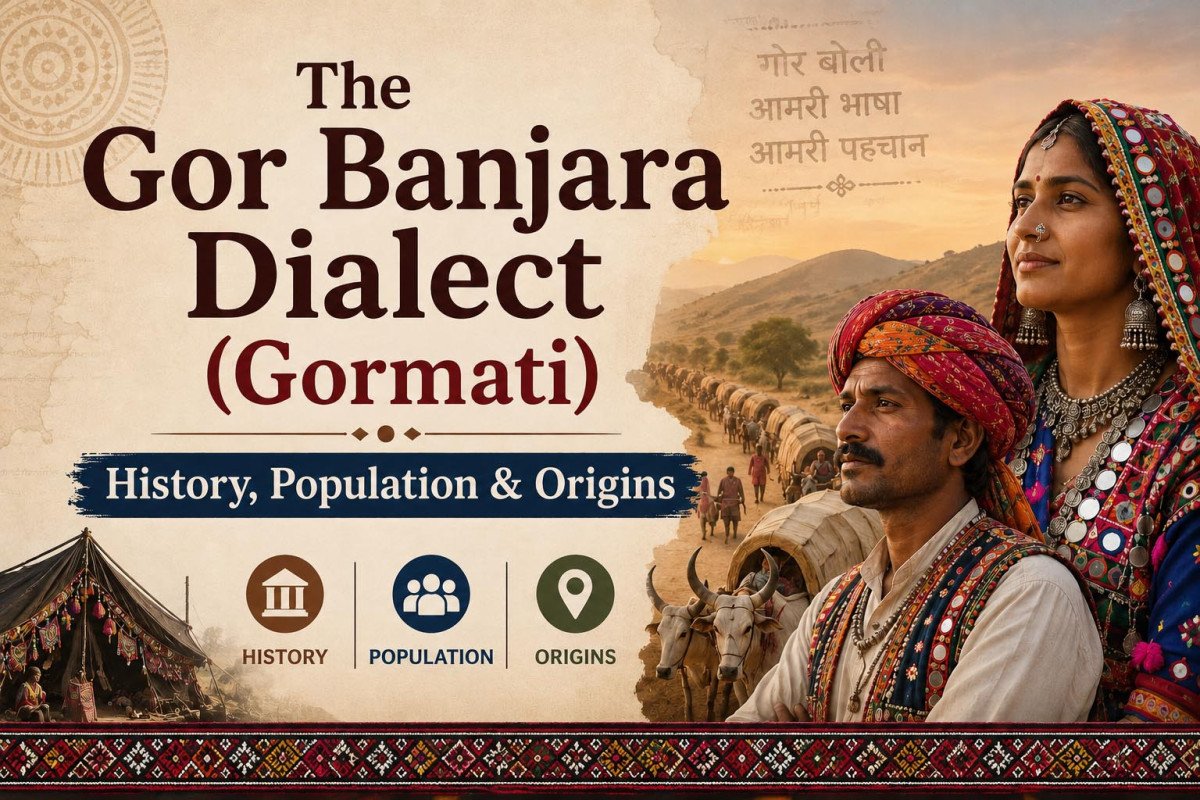
The Gor Banjara Dialect (Gormati): History, Linguistics, and Contemporary Status
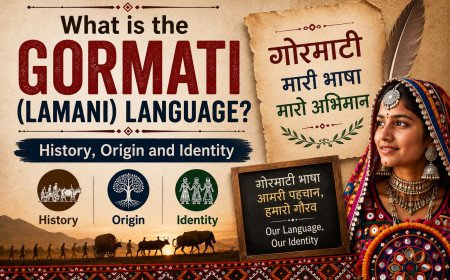
India is globally renowned for its immense linguistic diversity, boasting an estimated 179 languages and 544 dialects. Embedded deep within this rich heritage is the unique and historically profound language of the nomadic Gor Banjara community. Referred to endearingly by its speakers as Gor Boli or Gormati, this dialect stands as a living testament to cultural resilience—maintaining its distinct identity despite centuries of geographical displacement and socio-economic transitions.
1. Demographics and Geographical Footprint
According to authoritative sources such as Shankarrao Kharat’s book Bhatkya Vimukta Va Tyanche Prashna and the Banjara Calendar (2007, Beed), the total Banjara population in India has reached approximately 12 crore 10 lakhs (121 million). Distributed across various states, the community is recognized under different socio-economic and constitutional categories (such as SBC, VJ-A, SC, ST, OBC, and OPEN).
State-wise Population and Constitutional Classification:
-
Rajasthan (SBC): 2.5 Crore
-
Maharashtra (VJ-A): 1.3 Crore
-
Karnataka (SC): 1.2 Crore
-
Telangana (ST): 1.1 Crore
-
Andhra Pradesh (ST): 1.0 Crore
-
Madhya Pradesh (OBC): 1.0 Crore
-
Uttar Pradesh (OBC): 1.0 Crore
-
Gujarat (OBC): 95 Lakhs
-
Delhi (SC): 80 Lakhs
-
Haryana (OBC): 40 Lakhs
-
Tamil Nadu (VJ): 30 Lakhs
-
Bihar (ST): 29 Lakhs
-
Himachal Pradesh (SC): 25 Lakhs
-
West Bengal (OBC): 20 Lakhs
-
Orissa (ST): 20 Lakhs
-
Kerala (OPEN): 10 Lakhs
-
Jammu & Kashmir (OBC): 8 Lakhs
-
Arunachal Pradesh (OPEN): 7 Lakhs
A remarkable trait of the Gor Banjara people is their linguistic adaptability. While they seamlessly adopt the regional language of whichever province they reside in for external trade and livelihood, they strictly maintain Gor Boli (Gormati) as their primary medium for intra-community communication.
2. Origins, Etymology, and Affiliations
Gor Boli does not possess a dedicated, native script. Instead, it is written using regional scripts, most notably the Devanagari script.
Linguists categorize Gor Boli as an ancient dialect with linguistic roots tracing back to Sanskrit, Prakrit, and Shaurseni Apabhramsha. Because the Gorvamshiya community historically ruled and inhabited mountainous terrains bordering the Malwa and Nimad regions, their language absorbed deep structural influences from Marwari, Gujarati, and the literary Rajasthani Dingal-Pingal traditions.
The Malvi and Nimadi Connection
Folk literature reveals that Gor Boli shares a profound genetic relationship with the Malvi (Malawi) and Nimadi (Nemadi) languages. Extensive comparative analyses indicate that nearly 80% of vocabulary from Malvi and Nimadi has integrated into Gor Boli.
In his authoritative work Bhasha Shastra and Hindi Bhasha Ki Roopresha, Dr. Devendrakumar Shastri classifies 'Banjari' as a core sub-language of Nimadi, linking them both back to a variant of the ancient Avanti language. This confirms that the historical homeland of the Gors was rooted in the Malwa plateau, making Gor Boli a distinct sub-branch of the Western Rajasthani language family.
3. Linguistic Characteristics and Grammar
True to the classic Indian proverb—"Water changes every 4 Kos, while language alters every 10 Kos"—the pronunciation and localized styles of Gor Boli change across distances, yet the core semantic meaning remains unbroken.
Phonological Features
-
Strong Syllables: Influenced by the Dingal-Pingal dialect style, there is a heavy reliance on retroflex and aspirate sounds such as t (ट), th (ठ), d (ड), dh (ढ), na (ण), and la (ळ). Words like dungar (mountain) and dokra (old man) are foundational.
-
Nasalization: Nasal sounds originating from the vocal tract are highly prominent. For example, Pani (Water) becomes Panim, and Tonha (To you) becomes Tuzen.
-
Syllabic Stress: Certain words carry localized terminal stresses (e.g., in phrases like jem om jem), which can occasionally cause semantic distortion if read phonetically by individuals untrained in the dialect's spoken rhythm.
Vocabulary and Syntax
Interestingly, Gor Boli exhibits a lack of honorific or highly formal nouns for general society. Respectful registers are strictly reserved for parental in-laws (mother-in-law and father-in-law); all other individuals are addressed using common, egalitarian expressions.
-
Synonyms: The dialect features rich synonym variations for a single concept (e.g., Tandari, Goranli, and Beer all mean 'wife'; Dungar, Gatala, Kholla, Pahad, Tekada, and Tekadi all refer to 'forest/mountain').
-
Homonyms: Single words carry multiple meanings depending entirely on sentence construction. For instance, Katara can mean "a dog" or "for how much?".
-
Affixes of Endearment: The syllable 'd' (द/डा) is regularly appended to base words to signify affection or emphasis (e.g., Ladi → Ladali, Bhen → Bhenad, Veera → Veerada, Ya → Yadi).
4. Comparative Vocabulary Analysis
The close structural and lexical proximity between Nimadi, Gor Boli, Hindi, and English is clearly visible when examining daily vocabulary:
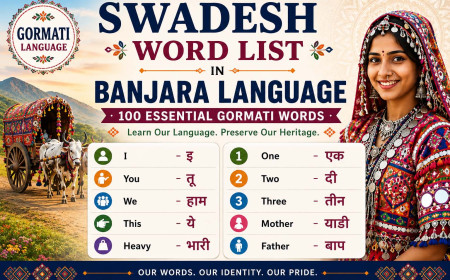
| Nimadi | Gor Boli | Hindi | English |
| स्याळो (Syalo) | सिंयाळो (Sinyalo) | ठंडकाल (Thandkaal) | Winter |
| उदाळो (Udalo) | उदाळो (Udalo) | धुपकाल (Dhupkaal) | Summer |
| आंगणो (Angno) | आंगळो (Anglo) | आँगन (Aangan) | Courtyard |
| घागरो (Ghagro) | घागरो (Ghagro) | लहंगा / पायजामा | Traditional Skirt / Pajama |
| शहर (Shahar) | शहर (Shahar) | शहर (Shahar) | City |
| महेल (Mahel) | मेल (Mel) | महल (Mahal) | Palace |
| भुक्या (Bhookya) | भुको (Bhooko) | भूखा (Bhookha) | Hungry |
| धापोज (Dhapoj) | धापगो (Dhapgo) | पेटभर (Petbhar) | Stomach full |
| वीरा (Veera) | वीरा (Veera) | भाई (Bhai) | Brother |
| धवळो (Dhawalo) | धोळो (Dholo) | सफेद (Safed) | White |
| अंगलाई (Anglai) | आंगळी (Angli) | उँगली (Ungli) | Finger |
| घणों (Ghanon) | घणों (Ghanon) | ज्यादा (Zyada) | More / Much |
| तातो (Tato) | तातो (Tato) | गरम (Garam) | Hot |
| अम्बे (Ambe) | आम्बा (Amba) | आम (Aam) | Mango |
| म्हारो (Mharo) | मारो (Maro) | मेरा (Mera) | Mine |
| थारो (Tharo) | तारो (Taro) | तेरा (Tera) | Your |
| छे (Chhe) | छ (Chha) | है (Hai) | Is |
| छेई (Chhei) | छेनी (Chheni) | नही (Nahi) | No / Is not |
5. Folklore Connections and Common Expressions
The kinship between Nimadi, Malvi, and Gor Boli is best preserved in nursery rhymes, folk tales, and songs.
-
Nimadi Child Song: ’हलो झुला हालोरो’ (Halo Jhula Haloro)
-
Gor Boli Counterpart: ’हालर गुलर खेतवाडी’ (Halar Gular Khetwadi)
Similarly, playful rhythmic word combinations like akulya-makulya, atkan-matkan, and chyaoo-myaoon are shared universally across these systems.
Everyday Sentences in Gor Boli (Gormati)
-
तार नाम काई छ? (Tar naam kai chha?) — What is your name?
-
तार वाया वेगो कांई? (Tar waya wego kain?) — Are you married?
-
तु केर काम करेछी। (Tu ker kaam karechhi.) — For whom do you work?
-
तारो उ कुळं छ। (Taro oo kulan chha.) — What is your relation with him/them?
-
गावडी आवगी। (Gawadi awagi.) — The cow has come.
-
कतरा भूकरोछ। (Katara bhookrochha.) — The dog is barking.
-
कुकडो बाँग देरोछ। (Kukdo baang derochha.) — The cock is giving a call.
-
कागला बोलरो छ। (Kagala bolaro chha.) — The crow is croaking.
6. Contemporary Status and Revitalization
In the past, Gor Boli survived purely as an oral tradition preserved within folk songs, proverbs, and daily domestic interactions. However, the contemporary era is witnessing a major literary shift.
Educated members of the massive 12-crore-strong Gor Banjara community are actively embracing Gor Boli as a definitive badge of their identity (Gor Vamsha). Today, the dialect is successfully breaking into print media. Multiple periodic publications are brought out in states like Maharashtra using the Devanagari script, providing a robust platform for local prose, poetry, and social commentary.
Far from being an exclusive tribal tongue, Gor Boli (Gormati) has evolved to the extent that wedding invitation cards, cultural brochures, and official community invitations are now proudly composed and printed in the dialect. This transition from a purely oral nomadic tongue to a documented, written medium ensures that the ancient legacy of Gor Boli continues to thrive in modern India.
Frequently Asked Questions
What's Your Reaction?
 Like
1
Like
1
 Dislike
0
Dislike
0
 Love
0
Love
0
 Funny
0
Funny
0
 Wow
0
Wow
0
 Sad
0
Sad
0
 Angry
0
Angry
0

Comments (0)