

Marathas and Gor Banjaras: A Historical Relationship of Trade, Warfare, and Mutual Trust
Discover the historical relationship between the Marathas and Gor Banjaras, including their role in Shivaji Maharaj's campaigns, Bajirao Peshwa's era, military logistics, trade, and their contributions to Indian history.

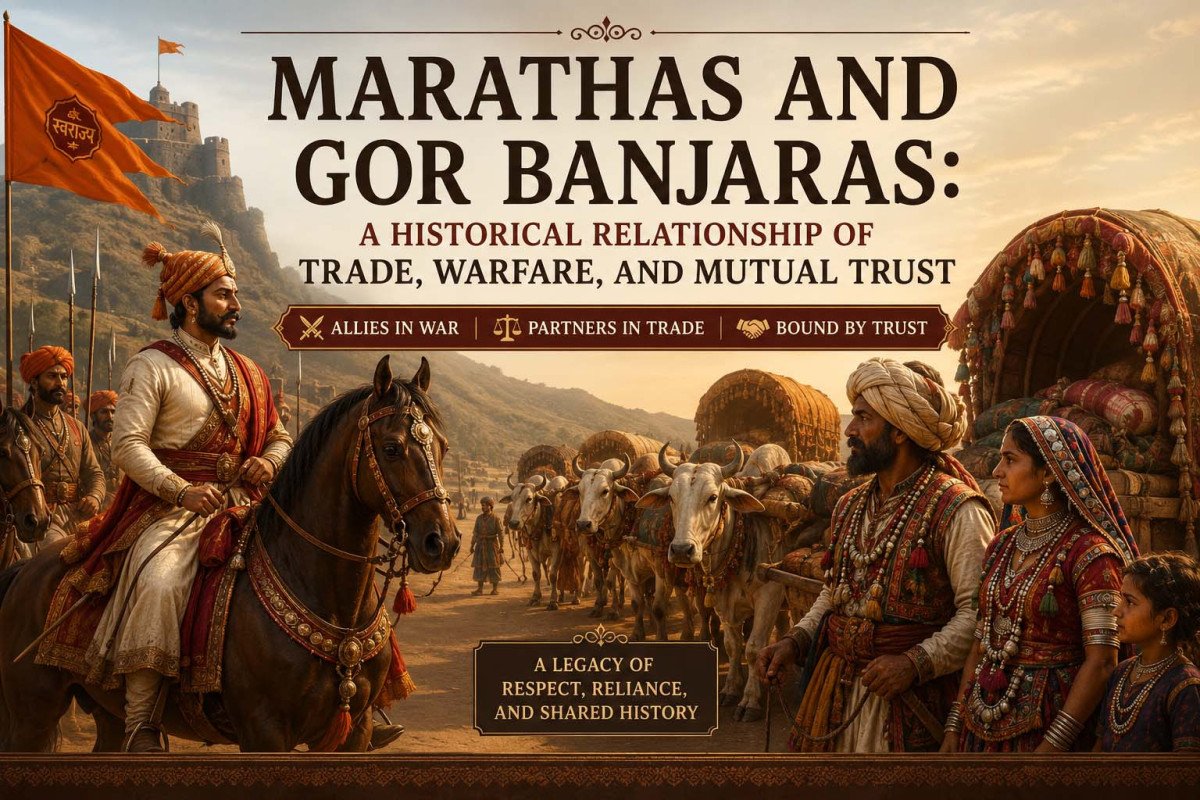
Marathas and Gor Banjaras
The history of the Gor Banjara community is deeply intertwined with the rise and expansion of several Indian kingdoms, including the Maratha Empire. While the Marathas are remembered for their military achievements under Chhatrapati Shivaji Maharaj, the Gor Banjaras played an equally significant but often overlooked role by ensuring the uninterrupted supply of food, weapons, cattle, and military provisions.
For centuries, Gor Banjaras served as India's greatest transporters and logistical experts. Long before modern roads and railways, they moved enormous quantities of grain, salt, cloth, metals, weapons, and army supplies across the subcontinent using thousands of bullocks. Their vast network of Tandas (settlements) and caravans connected kingdoms from Rajasthan and Gujarat to Maharashtra, Delhi, Punjab, and the Deccan.
The Maratha rulers recognized their importance and relied upon them during military campaigns. Their relationship was not merely commercial; it was built on trust, loyalty, and mutual respect.
The Backbone of Medieval Military Logistics
Before discussing the Maratha period, it is important to understand why every major Indian kingdom depended upon the Gor Banjaras.
In medieval India, an army could not survive without continuous supplies of:
- Food grains
- Fodder for horses
- Salt
- Weapons
- Gunpowder
- Clothing
- Medical supplies
- Camp equipment
Unlike today's military transport systems, there were no trucks, trains, or highways.
Only the Gor Banjaras possessed:
- Thousands of trained bullocks
- Experienced caravan leaders (Naiks)
- Knowledge of forests and mountain routes
- Ability to travel safely through dangerous territories
- Armed guards to protect caravans
Because of these strengths, kings across India employed Gor Banjaras to sustain their armies.
Shivaji Maharaj's Association with Gor Banjaras
One of the earliest recorded associations between the Marathas and Gor Banjaras comes during the reign of Chhatrapati Shivaji Maharaj.
Historical records state that when Shivaji Maharaj travelled to Agra in 1666 to meet the Mughal Emperor Aurangzeb, he was accompanied by:
- 500 bullocks
- Around 100 Gor Banjaras
These Banjaras were responsible for transporting essential supplies and protecting the convoy during the long journey from Maharashtra to Agra.
This demonstrates the high level of trust Shivaji Maharaj placed in the Gor Banjara community.
The Surat Campaigns
Shivaji Maharaj conducted two famous campaigns against Surat in:
- 1664
- 1670
These expeditions required a highly organized transportation system because enormous quantities of wealth, food, military equipment, and supplies had to be moved safely over long distances.
Historical accounts indicate that Shivaji Maharaj extensively used large herds of Banjara bullocks for transporting the collected goods.
Without such an efficient transport network, moving valuable cargo through forests and mountains would have been nearly impossible.
Banjara Warriors Alongside the Marathas
The Gor Banjaras were not merely transporters.
Whenever required, they also fought alongside the armies they served.
Their caravans frequently travelled through dangerous forests inhabited by bandits and enemy soldiers. Consequently, many Banjaras became skilled horsemen, archers, and swordsmen.
Historical references mention that the ancestors of Thakasingh Naik of Bushanpur served as personal bodyguards of Shivaji Maharaj.
This illustrates that the Maratha rulers considered the Gor Banjaras reliable warriors in addition to trusted logisticians.
Durgadas Banjara and Bajirao Peshwa
Another remarkable incident occurred during the time of Bajirao I Peshwa.
After returning from Delhi around 1730, Bajirao halted at Bhopal.
The Nizam surrounded the city and attempted to weaken Bajirao's forces by cutting off supplies.
However, Durgadas Banjara refused to transport goods for the Nizam.
Instead, he denied logistical support to the enemy.
Unable to maintain the siege without adequate supplies, the Nizam eventually lifted the blockade.
Bajirao Peshwa greatly appreciated Durgadas Banjara's loyalty.
Historical sources record that Bajirao invited him to Pune and honoured him publicly for his service.
This episode highlights the strategic influence that Gor Banjaras exercised in medieval warfare.
Gor Banjaras in Maratha Service
Throughout the Maratha period, numerous Gor Banjara groups worked in various capacities, including:
- Army transport
- Food supply
- Bullock caravan management
- Military escorts
- Camp logistics
- Intelligence gathering
- Trade administration
Their experience in navigating forests, hills, and difficult terrains made them indispensable during military campaigns.
Many Naiks became influential figures within Maratha territories.
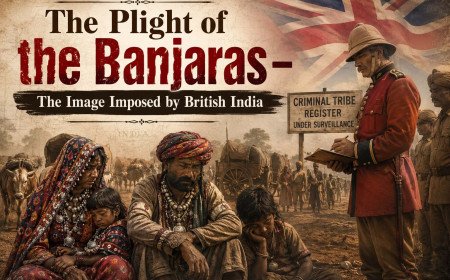
The British Period and the Decline of Military Transport
The arrival of the British East India Company fundamentally changed India's transport system.
As modern roads, carts, and later railways developed, the traditional profession of supplying armies gradually declined.
However, the Gor Banjaras successfully adapted to changing circumstances.
Many Naiks became:
- Farmers
- Landholders
- Revenue collectors
- Village administrators
- Police Patils
Waste Land Rules of 1865
The British introduced the Waste Land Rules of 1865, under which large areas of uncultivated land were granted for agricultural development.
Several Gor Banjara Naiks received rights to cultivate these lands.
Some Naiks were also authorized to collect agricultural taxes along with landlords.
Others were appointed to administrative positions such as Police Patils, demonstrating the confidence that British authorities placed in their leadership.
Gor Banjaras as Landlords and Jagirdars
Contrary to the misconception that Banjaras were merely wandering traders, historical evidence shows that many Gor Banjara families owned extensive landholdings.
Across Central India, North India, Gujarat, Rajasthan, Uttar Pradesh, and Punjab, Gor Naiks served as:
- Jagirdars
- Zamindars
- Local rulers
- Forest administrators
Their settlements became prosperous centres of trade and agriculture.
The Indukhi Kingdom
One notable example is the Gor rulers of Indukhi.
Historical records indicate that the Gor dynasty ruled the region for sixteen generations.
The Mughal Emperor granted them a Jagir of 52 villages, while Kriparam Gor governed the Indukhi territory.
Later, the Scindias (Shindes) conquered this Jagir, causing many Gor Tandas to migrate towards the Datia region.
These events are documented in regional historical manuscripts.
Delhi and the Legacy of Lakhishah Banjara
Perhaps the most famous Gor Banjara in North Indian history is Lakhishah Banjara.
His Tanda occupied extensive lands around:
- Paharganj
- Raisina
- Present-day Parliament area
- Secretariat region
When the ninth Sikh Guru, Guru Tegh Bahadur, was executed in 1675, Mughal authorities attempted to prevent his cremation.
According to Sikh tradition, Lakhishah Banjara courageously placed the Guru's body inside his house and deliberately set the structure on fire, allowing the Guru's cremation without attracting Mughal suspicion.
This act is remembered with immense respect in Sikh history.
The present-day Gurdwara Rakab Ganj Sahib commemorates this extraordinary sacrifice.
As a result, strong bonds developed between the Sikh community and the Gor Banjaras.
Several Gor Banjara families later embraced Sikhism.
Extensive Landholdings in North India
Historical records also mention Gor Banjara ownership of land in:
- Mahavir Nagar
- Najafgarh
- Bhadola
- Rana Pratap Bagh
- Paharganj
- Raisina
Much of this land later became part of modern Delhi following British expansion and urban development.
Regional Kingdoms of Gor Banjaras
Historical references describe several Gor rulers and influential Naiks across northern India.
Among them were:
- Arjun Naik, who governed approximately 155 villages until 1788.
- Piriya Banjara of Pilibhit, a prominent landlord credited with developing the region.
- Jahajor Naik, whose Tanda possessed more than 82,000 acres of forest land and regularly paid land revenue to the British administration.
- Kripa Singh Gor, who held authority over parts of the Satpura mountain region.
- King Vijay Singh Naik, whose palace in eastern Gujarat still survives as a reminder of Gor Banjara heritage.
Several towns, including Badshahpur, Banjarapur, and Tanda, preserve the memory of these historic settlements.
Were Gor Banjaras Nomadic?
A common misconception portrays Banjaras as permanently nomadic people.
Historical evidence suggests a more complex reality.
The Tanda was a permanent settlement where families lived, cultivated land, and raised cattle.
Only the trading groups travelled seasonally for commerce.
After completing their journeys, they returned to their home Tandas.
Thus, Gor Banjaras maintained stable social, economic, and cultural institutions rather than wandering continuously.
The Identity of the Gor Banjaras
Historical literature often presents Gor Banjaras as a unique community with a distinct identity.
They combined several occupations depending on changing circumstances:
- Cattle breeding
- Agriculture
- Long-distance trade
- Military logistics
- Forest administration
- Land management
- Local governance
Some historical writers argue that the Gor community possessed a Kshatriya tradition based on their military service and rulership. However, this remains a subject of historical interpretation and scholarly debate rather than an established consensus. Their identity has evolved over centuries through interactions with different kingdoms, regions, and cultures.
Legacy of the Maratha–Gor Banjara Relationship
The relationship between the Marathas and the Gor Banjaras demonstrates that great empires depended not only on brave kings and soldiers but also on communities capable of sustaining armies through efficient logistics.
From accompanying Shivaji Maharaj to Agra, transporting supplies during the Surat campaigns, supporting Bajirao Peshwa during the Bhopal conflict, and later serving as respected administrators and landholders, the Gor Banjaras contributed significantly to Indian history.
Their story reminds us that trade, transportation, courage, and loyalty were as essential to the success of kingdoms as victories on the battlefield.
Conclusion
The history of the Marathas and Gor Banjaras is one of cooperation, mutual trust, and strategic partnership. The Gor Banjaras were not merely traders; they were expert transporters, skilled caravan protectors, experienced administrators, and, at times, warriors who influenced the outcomes of military campaigns through their logistical support.
Although much of their contribution has remained outside mainstream historical narratives, available historical references reveal the vital role they played in strengthening the Maratha Empire and many other Indian kingdoms. Preserving and researching this heritage is essential for understanding the broader social and economic history of India.
References
- C.N. Luniya, Indian Culture.
- Dr. Ayodhya Prasad Pandey, Chandakaleen Bundelkhand, p.130.
- Dr. Kamani, Bundelkhand Ki Poorva Riyasatomein Pandulipiyonka Sarvekshan, p.24.
- Dr. Sharma, Banjara Samaj, pp.12, 17, 100.
- Historical traditions relating to Lakhishah Banjara and Gurdwara Rakab Ganj Sahib in Sikh history.
What's Your Reaction?
 Like
0
Like
0
 Dislike
0
Dislike
0
 Love
0
Love
0
 Funny
0
Funny
0
 Wow
0
Wow
0
 Sad
0
Sad
0
 Angry
0
Angry
0











Comments (0)