
Mohan Ganuji Nayak Rathod (Bhimaniputra) Biography | Gor Banjara Writer
Mohan Ganuji Nayak Rathod, popularly known as Bhimaniputra, is a renowned Gor Banjara writer, social reformer, and Gormati language activist from Chinchkhed, Kinwat, Maharashtra. Born on 2 April 1950, he has dedicated his life to preserving Gor Banjara culture, literature, and Gormati (Gor Boli) language.

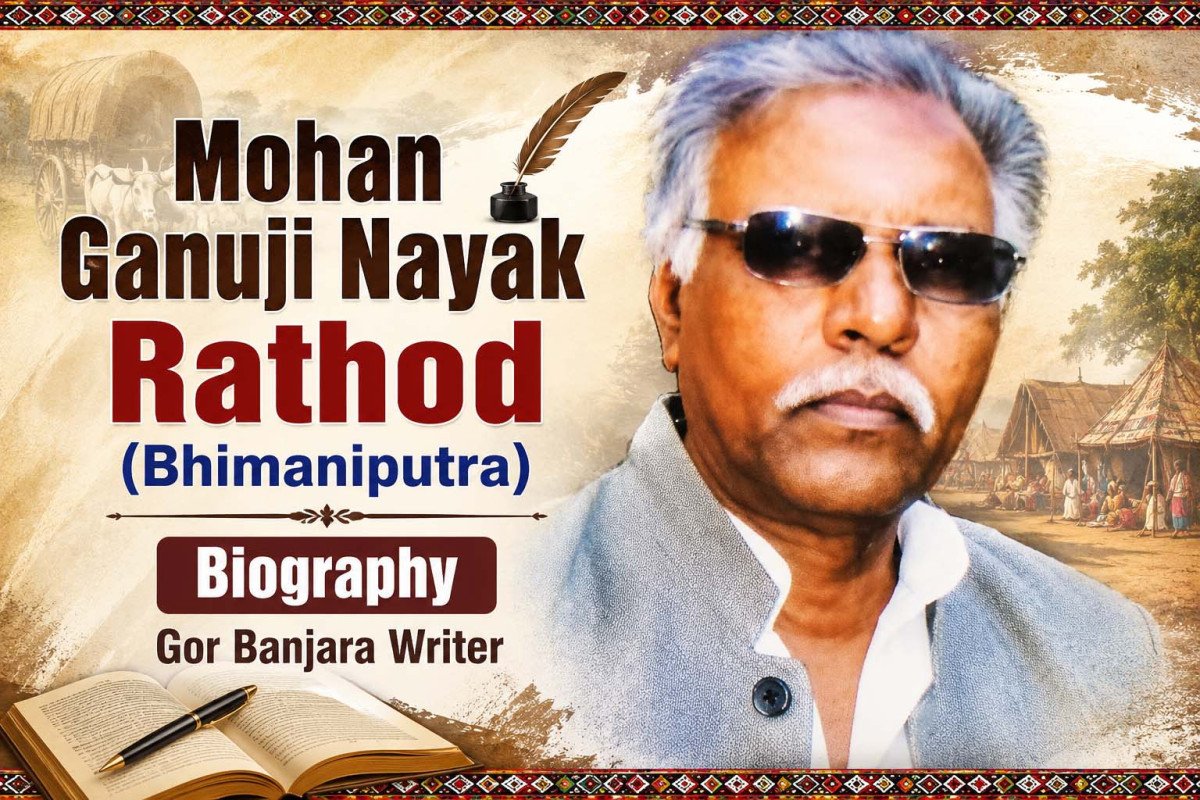
Mohan Ganuji Nayak Rathod, popularly known by his pen name "Bhimaniputra", is one of the most respected literary figures, social reformers, and cultural activists of the Gor Banjara community in India. For more than five decades, he has dedicated his life to preserving Gormati (Gor Boli) language, Banjara culture, literature, education, and social awareness. His relentless efforts in promoting the identity of the Gor Banjara community have earned him widespread respect across Maharashtra and India.
A prolific writer, organizer, speaker, and social worker, Bhimaniputra has authored numerous books, organized literary conferences, led social movements, and continuously worked for the constitutional recognition of Gormati (Gor Boli) as an independent language under the Eighth Schedule of the Constitution of India.
Personal Profile
- Full Name: Mohan Ganuji Nayak Rathod
- Pen Name: Bhimaniputra
- Date of Birth: 2 April 1950
- Birthplace: Chinchkhed, Kinwat Taluka, Nanded District, Maharashtra, India
- Address: Chinchkhed, Taluka Kinwat, District Nanded, Maharashtra
- Education: Bachelor of Arts (First Year)
- Occupation: Agriculture
- Interests: Social Service, Reading, Writing
Early Life and Family Background
Mohan Ganuji Nayak Rathod was born on 2 April 1950 into a hardworking farming family in Chinchkhed village of Kinwat Taluka, Nanded district.
His father was Ganuji Nayak Harawat, and his mother was Bhimanibai, originally from Singoda. Both were dedicated farmers who lived a simple and laborious life.
Tragedy struck early in his childhood. His mother passed away when he was barely one-and-a-half to two years old. Following her death, he was lovingly raised by his aunt Jhamibai Maniram, whose care and affection played a vital role in shaping his upbringing.
Born into a family of agricultural laborers and farmers, Bhimaniputra experienced rural life closely, which later became a major source of inspiration in his literary works and social activism.
Family
His wife is Shevanti Mohan Nayak, originally from Palaiguda, Mahur Taluka.
The family includes:
- Sister: Baby Pradeep Nayak of Daheli, wife of former MLA Pradeep Nayak.
- Daughter: Aradhana Tulshiram Chavan from Dhanki, Umarkhed Taluka. Her husband serves as a teacher.
- Daughter: Prof. Bharati Anil Mude, working as a professor in Kolhapur.
- Son: Advocate Chetankumar Nayak, practicing as a lawyer at the Civil Court, Mahur.
- Son: Dhiraj Nayak, engaged in agriculture.
Despite belonging to a humble working-class family, Bhimaniputra successfully inspired the next generation through education and public service.
Beginning of Social Work
His journey in social leadership began during his college days.
In 1972, he served as the Joint Secretary of the College Gathering Committee at Phulsing Naik College, Pusad, Yavatmal.
The same year, he became one of the founders of the Gram Sneh Sammelan, Chinchkhed, and remained its President for nearly twenty years.
Under his leadership, the annual Gram Sneh Sammelan evolved into a major rural cultural festival featuring:
- Kabaddi tournaments
- Volleyball competitions
- Wrestling events
- Rangoli competitions
- Healthy Baby Competitions
- Social seminars
- Kirtan programs
- Bhajan competitions
The Sammelan also promoted agriculture through:
- Bullock-cart races (Shankar Pat)
- Agricultural exhibitions
- Farmers' fairs
- Dairy competitions
These initiatives strengthened community participation while encouraging education, sports, agriculture, and cultural development.
Contribution to Theatre
Bhimaniputra was also actively involved in theatre.
He organized and staged several dramatic performances in his village.
Among his notable productions were:
- Shyamchi Aai
- Solavam Varis Dhokyacha
These plays were performed on 27–29 December 1987, featuring renowned Zadiboli actress Kumari Shobha Jogdev and Ragini Bedekar of Nagpur, with Bhimaniputra himself playing significant roles.
His theatrical work became another medium for spreading social awareness.
Leadership in the Banjara Reservation Movement
Bhimaniputra played an important role in the movement demanding the inclusion of the Banjara community in the Scheduled Tribe category.
On 21 November 1982, under the banner of the All India Banjara Seva Sangh, Kinwat Branch, he co-organized a historic Banjara Mela at Daheli Tanda.
The event was jointly organized by:
- Prof. Indrasing Rathod
- Dhanlal Nayak
- Bhimaniputra Mohan Ganuji Nayak
The program was inaugurated by Prof. Rajaram Rathod, presided over by Shamraoji Nayak, with Sudhakarraoji Nayak as the chief guest.
Later, on 3 November 1989, he again played an active role in organizing a massive Banjara convention at Umri (Bazar), Kinwat, under the chairmanship of Sant Ramrao Maharaj Poharagad, demanding Scheduled Tribe recognition.
Agricultural and Cooperative Leadership
Bhimaniputra also served as:
President, Govind Milk Cooperative Society, Chinchkhed
During his tenure:
- Loans were distributed for purchasing buffaloes to 25 Below Poverty Line (BPL) families on 25 September 1983.
- Veterinary health camps were organized for livestock owners.
His work greatly benefited rural farmers and dairy producers.
Fight for Farmers' Rights
Bhimaniputra actively participated in several farmers' movements.
Major agitations included:
- Jail Bharo Movement at Sindkhed Police Station (22 November 1983), where 1,257 people were arrested.
- Rasta Roko agitation (18 November 1983).
- Hunger strike before Kinwat Tehsil (14–16 November 1983).
These movements demanded justice and protection of farmers' rights.
Judicial Service
Recognizing his integrity and social standing, Bhimaniputra was appointed as a Panch (Mediator) in the Lok Adalat at Kinwat, contributing to peaceful dispute resolution.
Literary Conferences and Leadership
Bhimaniputra has chaired several prestigious literary conferences.
Notable milestones include:
- Active participant in the Dalit–Adivasi–Banjara Joint Literary Conference at Unkeshwar.
- President, First Gor Banjara Literary Conference, Umarkhed (11 January 2003).
- President, All India Banjara Parishad Literary Conference, Pune (2011).
- President, Fifth All India Gor Banjara Literary Conference, Dombivli, Mumbai (2018).
These conferences significantly strengthened Gor Banjara literature and intellectual discourse.
Campaign for Gormati Language
Perhaps Bhimaniputra's greatest contribution has been his lifelong campaign for the recognition of Gormati (Gor Boli).
Since 2003, he has continuously demanded that Gormati be recognized as an independent language under the Eighth Schedule of the Constitution.
As part of this mission, he submitted memoranda and copies of Gormati books to:
- The President of India
- The Prime Minister of India
- Sahitya Akademi
His movement remains one of the most important language preservation campaigns within the Gor Banjara community.
Gormati Language Book Movement
Bhimaniputra has actively promoted the Gormati Language Book Movement, encouraging writers to create literature in their mother tongue and preserve oral traditions for future generations.
He also serves as a Coordinator of Nangara Bhavan, Poharagad, Maharashtra, further strengthening literary and cultural activities.
Published Books
Bhimaniputra has authored or compiled numerous important works.
His published books include:
- Nasabi (Special Issue)
- Gormati Sanskriti Ani Sanket (Marathi)
- Kesula (Marathi Poetry Collection)
- Krantisingh Sevdas Todawalo (Marathi)
- Tukari (Marathi)
- Gorpan – Beauty of Language in Gor Boli (Marathi)
- Maroni (Gor Boli)
- Lavan (Gor Boli)
- Vate Munga Molari – Part 1 (Gor Boli)
- Vate Munga Molari – Part 2 (Edited by Advocate Chetan Nayak)
- Presidential Address (Gor Boli)
- Social Expressions and Folk Life of Gormati Language (2021), edited by Prof. Bharati A. Mude
- Gormati Language Literature and the Independent Aesthetics of Arts
Unpublished Manuscripts
His unpublished handwritten works include:
- Nakta: Distinctive Culture (Illustrated Gor Cultural Dictionary)
- Gormati Language: An Independent Literary Language (Gor Boli)
- Chaltu Cheda (Collection of Essays)
He has also written influential articles on the Vanjari–Banjari debate.
His famous newspaper columns include:
- Vate Munga Molari
- Kakadvanda
- Aanwal
- Thu
- Chaltu Cheda
These writings became important tools for social awareness in Gormati.
Awards and Honours
His contributions have been recognized with numerous awards:
- Samaj Bhushan Award (2002) – Bahujan Aghadi, Kinwat
- Vijnannishtha Award (2004) – "Ratta", Prof. Ashok Rana
- Chandrabai Rathod Rural Literature Award (2006) – Late Makkaji Nayak Literary Award Committee, Kamlewadi
- Banjara Bhushan Award (2006) – All India Banjara Seva Sangh, Maharashtra
- Jeevan Gaurav Award (2024) – Swachhand Bharari and Gorboli Radio, Khandesh (Founder: Eknath Gophane)
- Sahitya Seva Award (2026) – Jointly presented by Maharashtra Tourism Department and Nangara Bhavan
Academic Recognition
One of Bhimaniputra's stories, "Rupi Majhi Saksh", was included in the B.Com First Year syllabus of Rashtrasant Tukadoji Maharaj Nagpur University during the academic year 2020–2021.
This recognition reflects the academic value of his literary contribution.
Gormati Language Pride Day
Every year, 2 April, his birthday, is celebrated as "Gormati Bhasha Gaurav Din" (Gormati Language Pride Day) in recognition of his lifelong dedication to preserving and promoting the Gormati language.
Legacy
Mohan Ganuji Nayak Rathod "Bhimaniputra" is not merely a writer but a visionary who transformed literature into a movement. Through social service, cultural leadership, language preservation, theatre, agriculture, cooperative work, and literary excellence, he has inspired generations of the Gor Banjara community.
His life represents perseverance, grassroots leadership, and unwavering commitment to cultural identity. His books, speeches, social campaigns, and literary movements continue to shape the future of Gor Banjara literature and ensure that the Gormati language remains alive for generations to come.
His remarkable journey stands as a testament to how one determined individual can preserve an entire community's language, culture, and heritage through dedication and lifelong service.
Frequently Asked Questions
What's Your Reaction?
 Like
2
Like
2
 Dislike
0
Dislike
0
 Love
0
Love
0
 Funny
0
Funny
0
 Wow
0
Wow
0
 Sad
0
Sad
0
 Angry
0
Angry
0


Comments (0)