

The Story of Garasiya Bull: A Sacred Symbol in Banjara Tradition
The story of Garasiya Bull is one of the most inspiring episodes in the life of Sant Shri Sevalal Maharaj. From surviving the poisoned sweets sent by the Nizam to being rescued after the Bhil attack and remaining loyal until the saint's final moments, Garasiya Bull became a sacred symbol of faith, courage, loyalty, and divine protection in Banjara tradition.

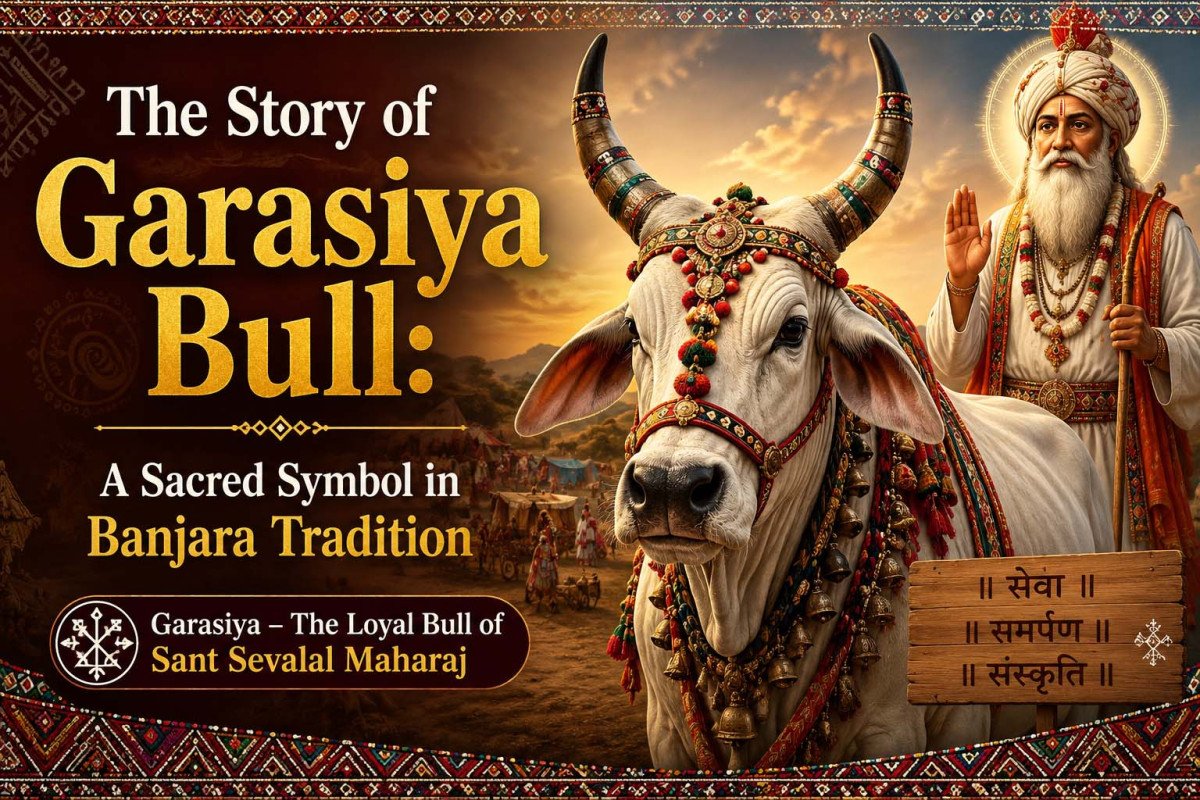
Among the many sacred stories associated with Sant Shri Sevalal Maharaj, none is more emotional and spiritually significant than the story of Garasiya Bull (Garashiya Nandi). In the Banjara tradition, Garasiya Bull was not merely an animal used for transportation; he was regarded as a faithful companion, protector, and sacred symbol of devotion. His life reflected the deep relationship between the Banjara community, their cattle, and their spiritual beliefs.
The Garasiya Bull appears repeatedly throughout the life of Sant Sevalal Maharaj. He protected the community, survived miraculous incidents, became a symbol of divine blessings, and remained beside Sevalal Maharaj until the saint's final moments. Today, Garasiya Bull is remembered with great respect in Banjara temples and folklore.
Importance of Cattle in Banjara Culture
To understand the importance of Garasiya Bull, one must first understand the lifestyle of the Banjaras.
For centuries, the Gor Banjaras were India's greatest transporters of food grains, salt, weapons, and essential goods. Before the arrival of railways and modern roads, thousands of bullocks carried supplies across forests, deserts, mountains, and kingdoms.
A Banjara family's wealth was not measured by gold or land but by the number of cattle they possessed.
Bhima Naik's family itself owned:
- Nearly 3,755 cattle
- Hundreds of horses
- Large herds of sheep and goats
These animals were considered members of the family rather than property. They received affection, protection, and religious respect.
Among all these animals, Garasiya Bull occupied a unique place.
Who Was Garasiya Bull?
Garasiya Bull was the most trusted and beloved bull accompanying Sant Sevalal Maharaj during his long spiritual journeys across South India.
He travelled with Sevalal Maharaj through:
- Karnataka
- Tamil Nadu
- Andhra Pradesh
- Telangana
- Maharashtra
wherever the Banjara caravans moved.
Unlike ordinary transport animals, Garasiya Bull gradually became a spiritual symbol because several miraculous events became associated with him.
People believed that the blessings of Jagadamba (Mariamma) constantly protected him.
Garasiya Bull and the Poisoned Sweets of Hyderabad
One of the earliest miracles connected with Garasiya Bull occurred during Sant Sevalal Maharaj's stay near Hyderabad.
At that time, local farmers complained to the Nizam that the Banjara cattle had grazed in their agricultural fields.
Angered by these complaints, the Nizam ordered his soldiers to bring Sevalal Maharaj before him.
When Sevalal refused to appear, the Nizam planned a deadly conspiracy.
He secretly instructed his soldiers to distribute sweets mixed with poison among the Banjaras.
The sweets were respectfully presented to Sevalal Maharaj.
However, according to the traditional account, Jagadamba appeared and warned Sevalal Maharaj not to allow anyone to eat the sweets immediately.
Instead, she instructed him to first mix the sweets with her sacred ash (prasada) and offer them to Garasiya Bull.
Sevalal Maharaj obeyed the divine instruction.
Everyone watched anxiously as Garasiya Bull consumed the poisoned sweets.
Nothing happened.
The bull remained perfectly healthy.
After witnessing this miracle, Sevalal Maharaj distributed the same sweets among his followers.
The poison was believed to have transformed into Panchamrit, a sacred offering.
Thousands of Banjaras safely consumed the sweets.
When news reached the Nizam, he was astonished.
This miracle completely changed his opinion about Sevalal Maharaj.
He began respecting him as a spiritually gifted saint.
Why Was Garasiya Bull Chosen?
The choice of Garasiya Bull carried deep symbolic meaning.
Within Banjara belief:
- Garasiya represented purity.
- He represented unwavering faith.
- He represented divine protection.
- He represented complete surrender to God.
The miracle demonstrated that divine grace protects those who live with truth and devotion.
Garasiya Bull therefore became more than an animal—he became living proof of Jagadamba's blessings.
The Journey Towards Penaganga
After completing their stay in Hyderabad, Sevalal Maharaj and his followers resumed their travels.
Their caravan moved towards:
- Nanded
- Penaganga River
- Forest regions occupied by various tribal groups
The Penaganga region was rich in forests and grazing lands, making it an ideal resting place for the Banjara caravans.
Several miraculous events occurred here.
One involved the recovery of a lost gold chain through prayer.
Another involved the famous story of Garasiya Bull.
The Bhil Attack
While travelling through the forests near Penaganga, a group of Bhils noticed the Banjara caravan.
The Bhils were known as skilled forest warriors.
Seeing the valuable cattle, they planned to steal the strongest and healthiest among them.
Their target became Garasiya Bull.
The bull was secretly taken away from the Banjara camp.
When the Banjaras discovered the theft, panic spread throughout the caravan.
Garasiya Bull was not just valuable livestock.
He was the sacred companion of Sant Sevalal Maharaj.
His loss deeply disturbed the entire community.
Sevalal Maharaj's Response
Instead of acting out of anger, Sant Sevalal Maharaj first prayed to Sri Jagadamba.
He sought divine guidance rather than immediate revenge.
Only after prayer did he organize his followers to recover the stolen bull.
According to traditional accounts, a fierce confrontation followed between the Banjaras and the Bhils.
The Bhils were experienced forest fighters.
However, Sevalal Maharaj's followers believed they were fighting under the blessings of Jagadamba.
The battle became intense.
Ultimately, the Banjaras succeeded.
Garasiya Bull was safely recovered and brought back to the caravan.
The community regarded this victory not merely as military success but as another miracle granted through divine protection.
The Spiritual Meaning of Garasiya Bull
The story of Garasiya Bull is not simply about the recovery of a stolen animal. Within the Gor Banjara tradition, it represents a powerful message about faith, loyalty, courage, and the sacred bond between humans and animals.
For centuries, Banjaras depended entirely upon their cattle for survival. Their oxen transported food grains, salt, weapons, household goods, and trade commodities across forests, rivers, mountains, and kingdoms. Without cattle, the Banjara way of life would not have existed.
Because of this close relationship, cattle were regarded as members of the family rather than possessions.
Garasiya Bull became the finest example of this sacred relationship.
Unlike ordinary animals, Garasiya was remembered as a divine companion who shared every hardship, every journey, and every miracle alongside Sant Shri Sevalal Maharaj.
Garasiya Bull as a Symbol of Faith
The miracle of the poisoned sweets at Hyderabad established Garasiya Bull as a symbol of unwavering faith.
When the Nizam attempted to poison the Banjaras, Sant Sevalal Maharaj did not panic. Following the guidance of Sri Jagadamba, he first offered the sweets to Garasiya Bull after mixing them with the sacred ash (prasada).
The bull consumed the poisoned sweets without suffering any harm.
Only after witnessing Garasiya's safety did the Banjaras eat the sweets themselves.
According to tradition, the poison was transformed into Panchamrit through divine grace.
This incident taught several important lessons:
- Faith is stronger than fear.
- Divine blessings protect the truthful.
- Animals too become instruments of God's grace.
- Devotion requires complete trust.
Garasiya Bull thus became a living symbol of divine protection.
Garasiya Bull and Nandi
Many devotees compare Garasiya Bull with Nandi, the sacred bull of Lord Shiva.
The comparison is based on several similarities.
Like Nandi:
- Garasiya always remained close to a great saint.
- He represented loyalty and service.
- He became a symbol of righteousness.
- He participated in sacred events connected with spiritual miracles.
Although Garasiya Bull is not worshipped as Nandi himself, many Banjara devotees affectionately refer to him as Garashiya Nandi, emphasizing his sacred position in the life of Sant Sevalal Maharaj.
This comparison highlights the deep spiritual respect the community has for him.
A Lesson in Compassion Towards Animals
Throughout his life, Sant Sevalal Maharaj repeatedly taught kindness toward animals.
He discouraged unnecessary violence and hunting.
One well-known incident describes how a frightened peacock escaped from hunters and flew towards Sevalal Maharaj for protection.
The saint covered the bird with his cloth, protected it from the hunters, and advised them never to kill innocent animals unnecessarily.
Similarly, his affection toward Garasiya Bull reflected his belief that animals are living beings deserving love, respect, and protection.
His teachings inspired the Banjara community to value every animal that contributed to their livelihood.
The Final Days of Sant Sevalal Maharaj
The most emotional chapter in Garasiya Bull's story comes after the passing of Sant Sevalal Maharaj.
According to Banjara tradition, after long discussions with Sri Jagadamba regarding marriage and his mission in life, Sevalal Maharaj's soul journeyed to heaven while his body remained in meditation.
Eventually, after divine events unfolded, his earthly life came to an end.
News of his passing spread rapidly.
Thousands of Banjaras gathered from nearby tandas and villages to pay their final respects.
Everyone mourned the loss of their spiritual guide.
Yet no grief was greater than that shown by his closest companions.
Garasiya Bull's Grief
Traditional accounts describe an extraordinary scene.
As devotees cried before the body of Sant Sevalal Maharaj, his beloved companions also mourned.
His faithful white horse Tholaram shed tears.
Garasiya Bull also cried loudly beside his master.
For the Banjaras, this was not viewed as ordinary animal behaviour.
It symbolized the deep spiritual bond between the saint and the creatures who had travelled with him throughout his life.
Their grief reflected loyalty beyond words.
It demonstrated that true devotion is not limited to human beings alone.
Animals too recognize compassion, kindness, and love.
Burial at Poharagad
After Sant Sevalal Maharaj's passing, a disagreement arose regarding where his body should be buried.
The people of Ruigad wished to keep him there because he had left his earthly body in that place.
However, his brothers explained that Sevalal Maharaj himself had desired to be buried at Poharagad.
According to tradition, neither side could move the funeral bier until the people of Poharagad attempted to lift it.
Then, the bier became light and was carried effortlessly.
Some traditions even state that the bier moved toward Poharagad on its own through divine power.
Sant Sevalal Maharaj was finally buried at Poharagad according to Banjara customs, as unmarried persons are traditionally buried rather than cremated.
The Death of Garasiya Bull
The story of Garasiya Bull reaches its most touching conclusion at Poharagad.
Unable to bear the separation from his beloved master, Garasiya Bull continued to mourn.
Traditional accounts state that both:
- Tholaram, the white horse
- Garasiya Bull
cried bitterly after the burial of Sant Sevalal Maharaj.
Soon afterward, both companions also passed away.
Out of immense respect, they too were buried at Poharagad.
Their burial reflects the extraordinary place they held in the spiritual history of the Banjara community.
Even today, devotees remember them not simply as animals but as faithful companions who remained devoted to the saint until their final breath.
Legacy of Garasiya Bull
Today, Garasiya Bull continues to occupy an honoured place in Banjara tradition.
His story is narrated during religious gatherings, community meetings, and discussions about the life of Sant Sevalal Maharaj.
For devotees, Garasiya Bull represents:
- Unshakable faith in God.
- Loyalty to one's guru.
- Courage during adversity.
- Compassion toward animals.
- Divine protection through devotion.
The story also reminds future generations of the values that Sant Sevalal Maharaj taught throughout his life—truthfulness, humility, kindness, selfless service, and harmony between humans, nature, and animals.
Conclusion
The Story of Garasiya Bull is one of the most inspiring episodes in the life of Sant Shri Sevalal Maharaj. From surviving the poisoned sweets sent by the Nizam, to being rescued after the Bhil attack, and finally mourning beside his master's body, Garasiya Bull became far more than a transport animal. He emerged as a sacred symbol of loyalty, devotion, and divine grace.
For the Gor Banjara community, Garasiya Bull continues to embody the timeless teachings of Sant Sevalal Maharaj—that faith conquers fear, compassion is the highest virtue, and every living being deserves love and respect. His story remains an enduring reminder of the spiritual values that continue to guide generations of Banjaras across India.
Frequently Asked Questions
What's Your Reaction?
 Like
0
Like
0
 Dislike
0
Dislike
0
 Love
0
Love
0
 Funny
0
Funny
0
 Wow
0
Wow
0
 Sad
0
Sad
0
 Angry
0
Angry
0










Comments (0)