

Sant Sevalal Maharaj and Tirupati Balaji: The Story of the Mahant
Sant Sevalal Maharaj's visit to Tirupati is one of the most remarkable chapters in Banjara history. During his South Indian pilgrimage, he stayed at Hathiram Bawaji Ashram, served Lord Venkateswara (Sri Balaji) as a Mahant for nearly two years, and became known as Sevadas Maharaj. This article explores his journey, spiritual service, connection with Hathiram Bawaji, and the enduring relationship between Tirumala and the Gor Banjara community.

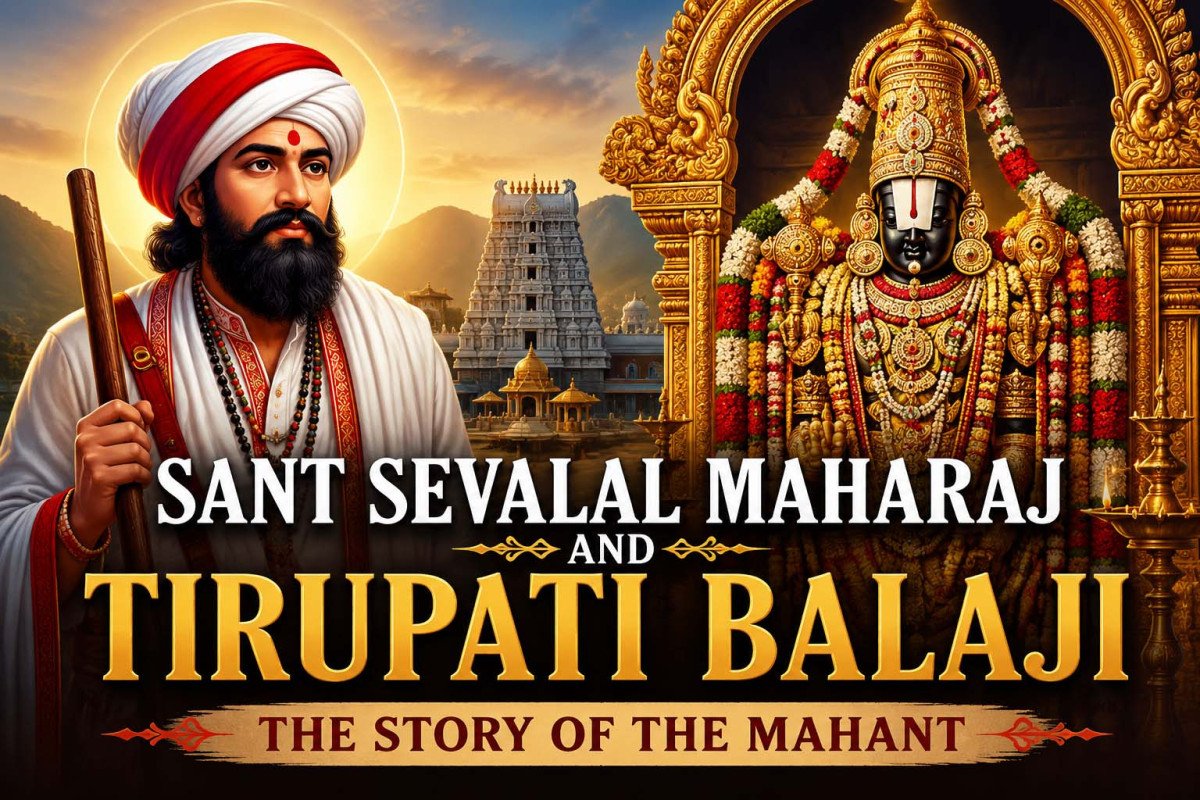
Among the many sacred journeys associated with Sant Sevalal Maharaj, his pilgrimage to Tirumala Tirupati holds a unique place in the spiritual history of the Gor Banjara community. While millions of devotees know Tirupati as the abode of Lord Venkateswara (Sri Balaji), very few are aware that one of the greatest spiritual leaders of the Banjara community spent significant time serving there as a Mahant (head priest and spiritual caretaker).
According to traditional Banjara history, Sant Sevalal Maharaj travelled across South India, visiting many famous temples before reaching Tirumala. During this journey he spread the message of devotion, righteousness, compassion towards animals, unity, and selfless service. His spiritual reputation had already spread across many kingdoms through his miracles, wisdom, and unwavering devotion to Jagadamba (Mariamma).
At Tirumala, Sant Sevalal Maharaj stayed at the famous Hathiram Bawaji Ashram, where he served Lord Venkateswara with complete dedication. The records preserved in the Hathiram Bawaji Math identify him as Sevadas Maharaj, a name by which he also became known among devotees. This important chapter establishes a deep historical and spiritual connection between the Banjara community and the Tirumala temple tradition.
This article explores the remarkable journey of Sant Sevalal Maharaj to Tirupati, his association with Hathiram Bawaji, his appointment as Mahant, and the lasting legacy of his service to Lord Balaji.
Sant Sevalal Maharaj's Pilgrimage Across South India
Sant Sevalal Maharaj never confined his spiritual mission to one village or one kingdom. Like the Banjara ancestors, who travelled across India for trade and transportation, Sevalal Maharaj also undertook long journeys that combined spiritual teaching with community leadership.
As leader of his people's caravan, he travelled with hundreds of Banjara families, cattle, horses, and companions through forests, kingdoms, and pilgrimage centres. Every destination became an opportunity to spread the values of honesty, devotion, courage, and compassion.
His journey towards Tirupati was not accidental. It formed part of a much larger spiritual pilgrimage through the sacred temples of South India.
From Mangalore to Mysore
After the famous incident at Mangalore, where Sevalal Maharaj is believed to have helped a merchant's ship resume its journey through divine blessings, the Banjara caravan continued toward the royal city of Mysore.
Mysore was already an important centre for commerce and culture. Here Sevalal Maharaj continued the traditional Banjara trade while maintaining his spiritual discipline.
The historical account records that he purchased valuable silk garments and other trading materials during his stay.
"Maisoore ma Reshma vasthra Kharido Sevabhaya."
This simple line reflects both the commercial traditions of the Banjaras and Sevalal Maharaj's practical leadership, balancing livelihood with devotion.
Different Historical Accounts of the Journey
Various Banjara historians have preserved slightly different routes taken by Sant Sevalal Maharaj after leaving Mysore.
According to Harilal Pawar, the caravan eventually travelled towards Hyderabad through Uravakonda, Gooty, Anantapur, and Guntakal.
However, Khemu Singh Jadhav records that the journey proceeded through Madakeri, Chennai, Chittoor, and then Tirupati.
Another respected researcher, Kalyan Naik, provides a more detailed route:
- Madakeri
- Mysore
- Madurai
- Thanjavur
- Chennai
- Tirupati
- Hyderabad
Although these routes differ slightly, all traditions agree that Sant Sevalal Maharaj ultimately reached Tirumala, where one of the most significant chapters of his life unfolded.
Worship at Madurai
From Mysore, the Banjara caravan travelled south to Madurai, one of India's oldest temple cities.
Madurai has been a centre of Hindu spirituality for thousands of years and is famous for the magnificent Meenakshi Amman Temple.
Historical records state that Sant Sevalal Maharaj spent several days here worshipping Goddess Meenakshi, meditating, and offering prayers.
This stop further demonstrates his deep respect for sacred places across India. Although he remained an ardent devotee of Sri Jagadamba (Mariamma), he never limited his devotion to a single shrine. Throughout his travels he offered worship at important temples dedicated to different manifestations of the Divine.
His pilgrimage reflected the inclusive spiritual traditions of the Banjara community, where reverence for all manifestations of God formed an essential part of religious life.
The Thanjavur Episode
After leaving Madurai, the Banjara caravan reached Thanjavur, then ruled by a powerful Maharaja.
Initially, the local soldiers refused permission for the Banjara families to stay. They also prevented the cattle from grazing and denied them access to water from the river.
Complaints were carried to the Maharaja, who summoned Sant Sevalal Maharaj for an explanation.
Rather than reacting with anger, Sevalal Maharaj calmly presented his case. Through wisdom and respectful dialogue, he convinced the king that the Banjara community required only temporary shelter and water for their travelling caravan.
Impressed by his intelligence and dignified conduct, the Maharaja granted permission for the Banjaras to remain for a few days.
The Battle Remembered in Tradition
Some traditional accounts preserved by Kalyan Naik describe another dramatic event during the Thanjavur stay.
According to this version, conflict eventually arose between the Maharaja's soldiers and the followers of Sant Sevalal Maharaj. The Banjaras successfully defended themselves and emerged victorious through the blessings of Sri Mariamma.
This confrontation became known in tradition as the "Battle of Water" (Panika Ladai) because the original dispute centred on access to water for their cattle.
Kalyan Naik further mentions that references to this incident were preserved in the library of the Maharaja of Thanjavur, although this tradition requires further historical research.
Preparing for the Sacred Visit to Tirupati
By this stage of the journey, Sant Sevalal Maharaj had become the acknowledged Naik (leader) of his Banjara caravan.
After leaving Thanjavur, the caravan travelled towards Chennai (then known as Chinapatna).
Here Sevalal Maharaj made an important purchase that reflected both humility and devotion.
He bought a white ceremonial umbrella (Chatra/Chamara) with the intention of presenting it as an offering to Lord Venkateswara (Sri Balaji) at Tirumala.
In Hindu tradition, the white umbrella symbolizes reverence, royal honour, and surrender before the Divine. Carrying this sacred offering demonstrated the deep respect with which Sevalal Maharaj approached his pilgrimage.
The historical account also suggests that Sri Mariamma guided his travels, often appearing in dreams or in the form of Bhairavi, directing him towards his next destination.
With the white umbrella carefully preserved for Lord Balaji, Sant Sevalal Maharaj and his followers finally set out for the sacred hills of Tirumala, where one of the most remarkable chapters of his spiritual life was about to begin.
Arrival at the Sacred Hills of Tirumala
After completing his journey through Madurai, Thanjavur, and Chennai, Sant Sevalal Maharaj and his followers finally arrived at the sacred hills of Tirumala, one of the holiest pilgrimage centres in India. For centuries, devotees have climbed these hills to seek the blessings of Lord Venkateswara (Sri Balaji), whom millions regard as the protector of the Kali Yuga.
Sant Sevalal Maharaj did not come to Tirumala as a royal guest or a famous saint seeking recognition. He came as a humble devotee carrying a white ceremonial umbrella (Chatra) purchased in Chennai as an offering to Lord Balaji. His only desire was to serve God with complete devotion.
According to the historical account, his journey to Tirumala was guided by Sri Jagadamba (Mariamma), who appeared to him in dreams and divine visions, directing the path of his spiritual mission. After months of travelling across South India, the sacred hills of Tirumala became an important destination where his devotion reached a new stage.
Tirumala During the Time of Sant Sevalal Maharaj
During the eighteenth century, Tirumala was already one of the most respected centres of Hindu worship. Pilgrims from different regions of India visited the temple to offer prayers to Lord Venkateswara.
Temple administration at that time depended greatly upon saints, ascetics, Mahants, and religious institutions that dedicated their lives to serving pilgrims and maintaining temple traditions.
Among these institutions, the Hathiram Bawaji Ashram (Math) occupied a special place.
It was here that Sant Sevalal Maharaj would spend an important period of his life.
Hathiram Bawaji – The Great Saint of Tirumala
To understand Sant Sevalal Maharaj's connection with Tirupati, it is necessary to understand the remarkable life of Hathiram Bawaji.
According to Banjara tradition, Hathiram Bawaji was himself a great saint, philosopher, and social reformer who possessed extraordinary devotion towards Lord Venkateswara.
He established an ashram on the Tirumala Hills where he spent the final years of his life in continuous worship, meditation, and service.
Traditional accounts preserved in Banjara literature state that Lord Venkateswara loved Hathiram Bawaji's devotion so deeply that He would appear in human form, converse with him, and even play chess with the saint.
This beautiful story continues to be one of the most famous legends associated with Hathiram Bawaji and reflects the intimate bond between the devotee and the Divine.
The Hathiram Bawaji Ashram
The Ashram founded by Hathiram Bawaji became an important spiritual centre for pilgrims visiting Tirumala.
According to the historical record, the ashram welcomed devotees with generosity and compassion. It provided free lodging and boarding, especially for members of the Banjara community who travelled long distances to worship Lord Venkateswara.
This institution became not only a place of worship but also a centre of spiritual learning, charity, and community service.
Even today, the Hathiram Bawaji Math continues to preserve this tradition of hospitality, maintaining the legacy established by the great saint centuries ago.
Sant Sevalal Maharaj's Stay at Hathiram Bawaji Ashram
The historical account records that Sant Sevalal Maharaj stayed at the Hathiram Bawaji Ashram during his visit to Tirumala.
Unlike many pilgrims who remained for only a few days, Sevalal Maharaj stayed there for one to two years.
During this period, he devoted himself entirely to the worship of Lord Venkateswara.
His disciplined lifestyle, deep meditation, humility, and spiritual wisdom earned the admiration of the temple authorities as well as fellow devotees.
The Ashram became his spiritual home during this important phase of his life, allowing him to participate daily in temple worship and religious service.
Appointment as Mahant of Lord Venkateswara
One of the most significant events recorded in Banjara history is Sant Sevalal Maharaj's appointment as a Mahant at Tirumala.
A Mahant is not merely a priest. Traditionally, a Mahant serves as a spiritual guardian responsible for preserving religious discipline, guiding devotees, supervising worship, and protecting sacred traditions.
According to the historical record, Sant Sevalal Maharaj served as Mahant of Lord Venkateswara, performing daily worship and rendering devoted service inside the sacred environment of Tirumala.
His appointment reflected the immense respect that his spiritual character had earned.
Rather than seeking honour or authority, Sevalal Maharaj accepted this responsibility as another opportunity to serve God and humanity.
The records describe that during his stay, he worshipped Sri Balaji every day, dedicating himself completely to divine service.
Daily Worship of Lord Balaji
Every day at Tirumala began with prayer.
Sant Sevalal Maharaj participated in the worship of Lord Venkateswara, offering prayers with complete concentration and humility.
Although he had travelled through many kingdoms performing miracles and guiding his people, at Tirupati he lived simply as a servant of God.
His example demonstrated one of the greatest principles of Indian spirituality:
True greatness is found in service, not in power.
For Sevalal Maharaj, worship was not merely a ritual. It was an expression of complete surrender to the Divine.
His devotion inspired many devotees who visited Tirumala during that period.
Why Sant Sevalal Maharaj Was Known as "Sevadas Maharaj"
One of the fascinating historical details preserved in the Hathiram Bawaji tradition is that Sant Sevalal Maharaj was also known by another name—Sevadas Maharaj.
According to the historical record, this name appears in the records maintained by the Hathiram Bawaji Ashram at Tirumala.
Because of this documented association, many devotees and historians identify Sant Sevalal Maharaj as Sevadas Maharaj while describing his period of service at Tirupati.
The name itself beautifully reflects his personality:
- Seva means selfless service.
- Das means servant or devotee.
Thus, the name "Sevadas" perfectly represents the life he lived—a life completely dedicated to serving God and society.
A Spiritual Bridge Between the Banjaras and Tirupati
Sant Sevalal Maharaj's stay at Tirumala established a lasting spiritual connection between the Gor Banjara community and the Tirupati Balaji Temple.
For Banjaras, Tirupati is not only one of India's greatest pilgrimage centres but also a place where one of their most revered saints served as Mahant.
This relationship became an important part of Banjara religious history and continues to be remembered through oral traditions, community literature, and religious celebrations.
His life demonstrated that devotion transcends caste, region, and occupation. A leader of a travelling tribal community became one of the respected servants of Lord Venkateswara through faith, humility, and unwavering dedication.
Departure from Tirupati
After spending nearly one to two years in Tirumala serving Lord Venkateswara (Sri Balaji) as Mahant, Sant Sevalal Maharaj eventually continued his spiritual journey. His mission was never confined to one sacred place. As a spiritual guide of the Gor Banjara community, he believed in travelling among the people, awakening them through devotion, truth, unity, and righteous living.
The historical account records that after completing his service at Tirupati, Sant Sevalal Maharaj and his followers left the holy hills and proceeded towards Hyderabad. His departure from Tirumala marked the end of an important chapter in his life but not the end of his relationship with Lord Balaji. The spiritual bond established during his stay at Tirumala continued to inspire generations of Banjaras long after he had left the temple.
Tirupati to Hyderabad
From Tirupati, Sant Sevalal Maharaj's caravan travelled towards Hyderabad, where the Banjara community had already established settlements.
The area where the Banjaras stayed later came to be known as Banjara Hills, a name that many historians associate with the long stay of Banjara trading caravans in the region. At that time, the area provided open grazing lands, water sources, and sufficient space for hundreds of families and thousands of cattle.
It was in Hyderabad that Sant Sevalal Maharaj's spiritual influence reached the court of the Nizam, leading to several remarkable events that became part of Banjara history. These include the famous stories of the poisoned sweets, the miraculous protection of his followers, and his prayers during a devastating epidemic. These events belong to another chapter of his life but demonstrate how his reputation continued to grow after leaving Tirupati.
The Lasting Connection with Hathiram Bawaji Math
Although Sant Sevalal Maharaj moved on from Tirumala, his association with Hathiram Bawaji Math never faded from memory.
The historical record explains that the Math preserved his identity as Sevadas Maharaj, acknowledging the period during which he served Lord Venkateswara. This preserved tradition became one of the strongest historical links connecting the Gor Banjara community with Tirupati.
For generations, devotees visiting Tirumala have remembered that one of the greatest saints of the Banjara community lived and served within the sacred institution established by Hathiram Bawaji.
An Honoured Tradition That Continues Today
One of the most remarkable traditions described in the historical account still continues.
Every year, during the birth anniversary celebrations of Sant Sevalal Maharaj on 15 February at Sevagad (Gooty, Andhra Pradesh), representatives associated with the Mahant of Lord Venkateswara visit the temple.
They worship Sant Sevalal Maharaj and respectfully offer:
- Silk shawls (Silk Vasthra)
- Fruits
- Traditional honours
This annual ceremony symbolizes the enduring spiritual relationship between Tirumala and Sevagad. It is a living reminder that Sant Sevalal Maharaj's service at Tirupati is not merely a story preserved in folklore but a tradition remembered through continued religious observances.
Why This History Is Important
The story of Sant Sevalal Maharaj at Tirupati carries immense significance for the Gor Banjara community.
It demonstrates that Banjara history is deeply connected with some of India's greatest spiritual institutions. While the community is often remembered for its historic role in transportation, trade, and military logistics, the life of Sant Sevalal Maharaj reveals another dimension—its contribution to India's spiritual heritage.
His appointment as Mahant illustrates that devotion, wisdom, humility, and service transcend social status or occupation. A leader from a nomadic tribal community earned recognition in one of Hinduism's most revered temples through his spiritual character rather than worldly power.
The Spiritual Teachings Reflected in His Service
Sant Sevalal Maharaj's stay at Tirupati was not simply an administrative responsibility. It reflected the values that guided his entire life.
Selfless Service (Seva)
He considered service to God and humanity to be the highest form of worship. Whether leading caravans, helping the poor, guiding his people, or serving Lord Venkateswara, every action reflected the spirit of selfless service.
Humility
Despite becoming a respected spiritual leader, Sant Sevalal Maharaj never sought wealth, titles, or political influence. His willingness to live simply at Tirumala demonstrates the humility that defined his character.
Discipline
Daily worship, meditation, and dedication to religious duties formed the foundation of his life. His disciplined routine inspired devotees who came into contact with him.
Universal Devotion
Throughout his travels, Sant Sevalal Maharaj worshipped many sacred forms of the Divine—Sri Jagadamba (Mariamma), Meenakshi Devi, Chennakesava, Shiva, and finally Lord Venkateswara. His life teaches that sincere devotion unites rather than divides.
Hathiram Bawaji and Sant Sevalal Maharaj: Two Great Saints
Although they belonged to different generations, Hathiram Bawaji and Sant Sevalal Maharaj are connected through their devotion to Lord Venkateswara.
Both dedicated their lives to spiritual practice rather than worldly ambitions.
Both emphasized humility before God.
Both became symbols of devotion for countless followers.
According to Banjara tradition, Hathiram Bawaji established the Ashram that later welcomed Sant Sevalal Maharaj. Through this connection, two of the most respected saints associated with the Banjara community became permanently linked with Tirumala's sacred history.
Lessons for Modern Society
The Tirupati chapter of Sant Sevalal Maharaj's life continues to offer timeless lessons.
- Serve before seeking recognition.
- Remain humble regardless of success.
- Faith becomes meaningful when expressed through action.
- Respect every place of worship and every sincere devotee.
- Leadership is measured by service, not authority.
- True spirituality unites communities through compassion and righteousness.
These principles remain as relevant today as they were during the eighteenth century.
Sant Sevalal Maharaj's Enduring Legacy at Tirupati
For millions of devotees, Tirupati represents faith in Lord Venkateswara. For the Gor Banjara community, it also represents the sacred memory of Sant Sevalal Maharaj, who devoted a significant period of his life to serving the Lord as Mahant.
His stay at Hathiram Bawaji Ashram, his daily worship of Lord Balaji, and his recognition as Sevadas Maharaj form an important chapter in the spiritual history of the Banjaras. The annual exchange of honours between Tirumala and Sevagad continues to strengthen this historic relationship and reminds future generations of their rich spiritual heritage.
Conclusion
The story of Sant Sevalal Maharaj and Tirupati Balaji is much more than a historical episode—it is a testament to unwavering faith, humility, and selfless service.
From carrying a ceremonial white umbrella for Lord Venkateswara to serving as Mahant at Tirumala, Sant Sevalal Maharaj demonstrated that genuine devotion is expressed through action rather than words. His stay at Hathiram Bawaji Ashram and his identification as Sevadas Maharaj remain treasured traditions within the Banjara community.
Today, every visit to Tirupati can remind devotees that one of the greatest saints of the Gor Banjara community once walked these sacred hills, offered daily prayers before Lord Balaji, and left behind a legacy of devotion that continues to inspire generations.
His life teaches that true greatness lies not in power or position, but in humility, faith, and the lifelong commitment to serving God and humanity.
Frequently Asked Questions
What's Your Reaction?
 Like
0
Like
0
 Dislike
0
Dislike
0
 Love
0
Love
0
 Funny
0
Funny
0
 Wow
0
Wow
0
 Sad
0
Sad
0
 Angry
0
Angry
0















Comments (0)