
Banjara Language and the Eighth Schedule: Preserving a Thousand-Year-Old Heritage and Securing Constitutional Recognition
Explore the rich history, unique linguistic features, and socio-political hurdles facing the Banjara language in its journey toward inclusion in the Eighth Schedule of the Indian Constitution. By Eknath Pawar Nayak.

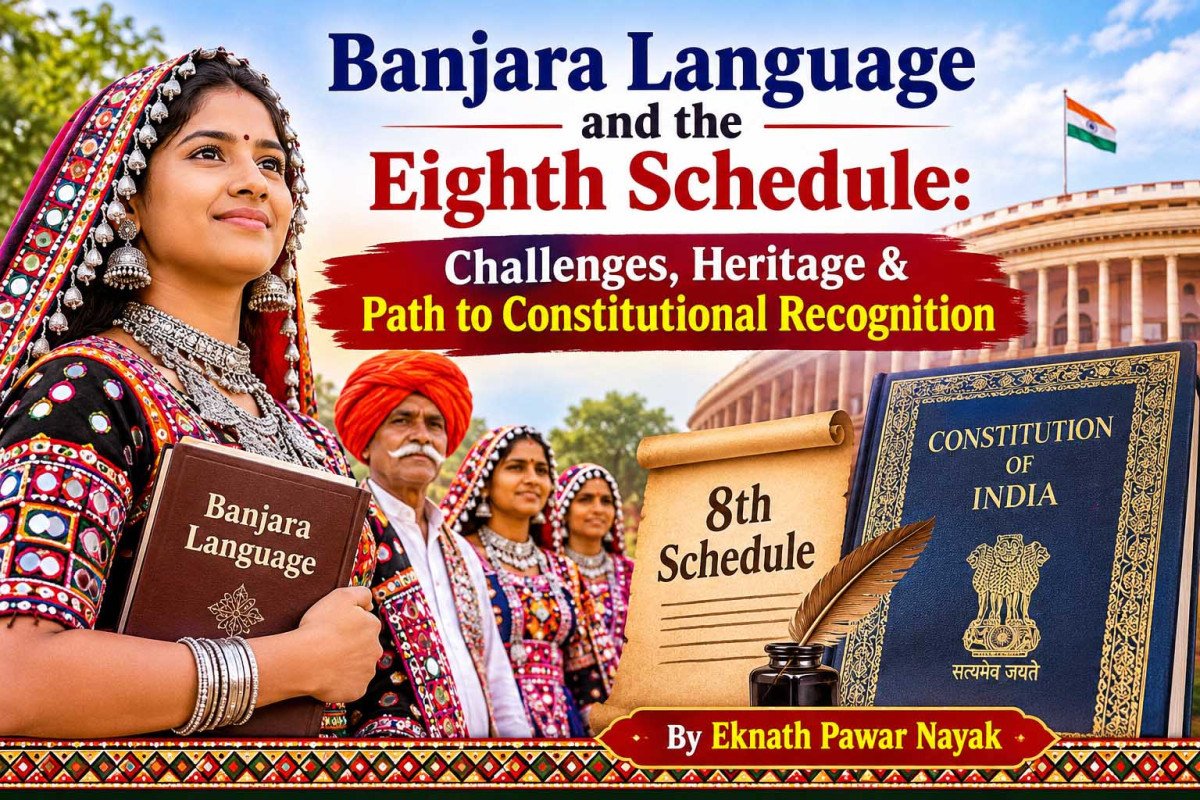
The Banjara language plays a vital role in preserving the cultural identity of its community while contributing significantly to India’s diversity and national unity. For centuries, it has been deeply intertwined with the community’s traditions, customs, and sense of belonging. Within Banjara society, the language serves as the primary medium for day-to-day communication and has greatly enriched India's linguistic landscape.
Historically, when the Banjara community traded with European nations, there was a vibrant exchange of Indian values and teachings alongside European culture and innovation. Through this rich historical legacy, Banjara culture has exemplified the essence of global citizenship via its mother tongue. Despite boasting a history and heritage spanning thousands of years, the Banjara language—which needs to be included in the Eighth Schedule of the Indian Constitution to enrich the nation's diversity—remains deprived of official language status, facing numerous hurdles on its path to constitutional recognition.
Key Challenges Hindering Eighth Schedule Inclusion
1. Lack of Standardization and Institutional Infrastructure
One of the primary obstacles to including the Banjara language in the Eighth Schedule is the absence of a standardized script. Although the language encompasses regional variations, no single script has been universally accepted, making it difficult to standardize it for educational and official purposes.
Currently, the Banjara community often uses the Devanagari or Roman scripts to write the language, but it has not yet been formalized into a consistent, widely recognized writing system. Furthermore, Banjara is rarely utilized in formal setups such as government administration, mainstream education, and mass media, which severely limits its visibility and institutional support. Because it remains primarily an oral language with limited emphasis on written documentation, it lacks the foundational infrastructure—such as standardized textbooks and official records—required for Eighth Schedule inclusion.
2. Socio-Economic Neglect and Weak Political Advocacy
Traditionally viewed as a nomadic and wandering group, the Banjara community frequently confronts socio-economic challenges. This historical marginalization has resulted in far less advocacy for the inclusion of their language compared to other, more dominant linguistic groups. The community’s primary focus on survival and basic welfare, rather than cultural or linguistic preservation, has also inadvertently contributed to the neglect of language promotion.
In contrast, the Banjara language lacks a strong, unified political lobby or mass movement pushing for its constitutional recognition. Other major languages benefit from more vocal and well-funded campaigns, often overshadowing languages like Banjara, which operate from a less organized linguistic base.
3. Demographic Dispersion and the Struggle for Attention
Spoken by various subgroups of Banjara people across states such as Maharashtra, Telangana, Andhra Pradesh, Karnataka, and Rajasthan, the language does not hold a concentrated majority of speakers in any single geographical region. The scattered nature of the community and the regional nuances of the tongue complicate efforts to build a cohesive demand for recognition.
Following the linguistic reorganization of Indian states, despite being a numerically massive community, the Banjara people were deprived of official language status. With numerous languages vying for a place in the Eighth Schedule, tongues spoken by larger concentrated populations or backed by strong formal institutions—such as Tamil, Telugu, and Marathi—often overshadow Banjara. Additionally, languages with greater economic and cultural clout, like Hindi, English, and major state languages, dominate official spheres, leaving lesser-known indigenous languages struggling for attention.
4. Issues of Linguistic Identity and Nomenclature
There is often a lack of internal consensus within the Banjara community regarding the strategic promotion of the language. In some instances, disagreements arise over whether Banjara should be classified as an independent language or as a dialect of another regional tongue.
This mother tongue, spoken by the entire Banjara community, deserves to be addressed by a single, unified name. Just as Banjaras are referred to by different names across different states, using multiple names for their language undermines its standing as a major, unified linguistic entity. Across the entirety of India, it must be recognized under one common name.
Inclusion in the Eighth Schedule is ultimately driven by a combination of linguistic, political, and social factors. The absence of proactive policy initiatives from both state and central governments to safeguard smaller languages makes it difficult for Banjara to gain momentum.
The Need for a Multi-Dimensional Approach
Including a language in the Eighth Schedule of the Indian Constitution requires meeting specific official and technical criteria. With an estimated population of nearly 150 million (15 crore) stretching from Kashmir to Kanyakumari, the Banjara community is today producing literature in both written and digital formats on a massive scale. However, translating this cultural output into constitutional recognition requires a strategic, multi-dimensional approach.
Advocacy, Leadership, and Policy Formulation
The Banjara language is an independent and ancient tongue. Therefore, its preservation and recognition demand strong initiatives from the fields of literature, culture, and social organizations.
-
Parliamentary & Legislative Efforts: Members of Parliament such as Haribhau Rathod, Rajeev Satav, Umesh Jadhav, Kavita Naik, Pratibha Dhanorkar, and Sanjay Deshmukh have raised the demand for official status for the Banjara language in Parliament. Similarly, Banjara MLAs in the state assemblies of Maharashtra and Telangana have consistently voiced this demand.
-
Organizational & Grassroots Mobilization: Social organizations like the All India Banjara Seva Sangh have worked tirelessly toward this cause for decades. Eknath Pawar Nayak, an expert on Banjara language, literature, and culture, initiated the first-ever signature campaign in Maharashtra and met with the Governor to advocate for the Banjara language and a dedicated Banjara Sahitya Akademi.
-
Literary Champions: Numerous Banjara litterateurs and social activists—including Baliram Patil, Atmaram Rathod, Motiraj Rathod, Mohan Naik, Ramesh Arya, Maheshchandra Banjara, Vira Rathod, Punjab Chavan, Eknath Pawar, Govardhan Banjara, and Nilesh Rathod—have played a vital role in raising their voices for recognition.
While All-India level literary conferences are a welcome step, building a massive grassroots public movement around these demands is equally essential. Proactive steps must be taken to align with MPs and MLAs invested in the community's welfare to champion this cause in Parliament. Because Eighth Schedule inclusion typically requires formal recommendations from the Linguistic Survey of India or specialized government committees, involving accredited linguists and experts to formally document the unique features, dialects, and historical significance of the Banjara language will lend crucial academic credibility to the movement.
Standardization and Digital Empowerment
There is an urgent need to standardize the script of the Banjara language. Adopting a unified, recognized script—whether by formalizing Devanagari or Roman, or establishing an agreed-upon orthography—will help formalize the language for academic and official use. Simultaneously, the creation of digital content, reference books, dictionaries, websites, and educational resources in Banjara must be actively accelerated.
Accessible digital and educational resources will encourage the younger generation to learn the language and integrate it into their daily lives. Promoting the language through cultural programs, folk music, and storytelling can spark wider public interest, while increased media exposure will boost its visibility and demonstrate its relevance in modern society.
The Role of Writers, Linguists, and Cultural Ambassadors
Banjara literary works, regardless of volume, serve as a powerful vehicle for cultural preservation. Collaborating with other linguistic communities from similar socio-cultural backgrounds that have successfully fought for Eighth Schedule recognition can provide a strategic blueprint.
-
Documentation & Research: Gathering historical records, cultural documents, and community testimonies—alongside conducting ethnographic studies—will build a compelling case for Banjara's inclusion in national policy.
-
Preserving Oral Traditions: Because Banjara is primarily an oral language, experts play a critical role in transcribing folk songs, stories, and historical narratives, ensuring these records survive for future generations.
-
Academic Frameworks: Linguists must establish a standard grammatical framework—defining rules for syntax, morphology, and sentence structure—and develop textbooks, worksheets, and dictionaries suitable for formal classrooms.
Acting as cultural ambassadors, language experts and writers must continue organizing literary festivals and cultural gatherings to instill pride among native speakers and showcase the contemporary vitality of the language.
Unique Linguistic Features and Cultural Significance of Banjara
The Banjara language is a truly unique mother tongue that imparts the foundational lessons of global citizenship. Free from malice and rooted in tolerance, it is a language of the heart that nurtures human relationships. Blossoming in the lap of nature, it is cherished by every Banjara as dearly as their own mother.
Cultural and Regional Variations
Banjara is not a monolithic tongue, but rather a rich tapestry of dialects spoken across Maharashtra, Telangana, Andhra Pradesh, Karnataka, Gujarat, Goa, and Rajasthan. While these dialects reflect local influences from Telugu, Marathi, Hindi, Gujarati, and Kannada, the core language retains a specialized vocabulary rooted in the community’s nomadic and pastoral heritage—containing distinct terms related to trade, travel, and animal husbandry rarely found in mainstream Indian languages.
Preservation of Cultural Identity
Through oral traditions, folklore, proverbs, songs, and stories, the Banjara language carries centuries-old wisdom, beliefs, and values. Speaking the language fosters a strong sense of collective identity, binding individuals together across state borders through a shared historical and cultural thread. More than a mere communication tool, it is a distinct marker of identity that safeguards the community's uniqueness.
Historical and Oral Traditions
The vast majority of Banjara literature exists in vibrant oral forms, including songs, ballads, and epics. These traditions chronicle the community’s historical journey, their migrations across India, their struggles, and their harmony with nature—ensuring future generations understand their ancestral past and contributions to national history.
Social, Moral, and Spiritual Values
The proverbs, maxims, and moral teachings embedded in the Banjara language shape core ethical principles regarding family, relationships, and respect for elders. Furthermore, the language is the spiritual anchor of the community; countless devotional songs, prayers, and bhajans performed during religious rituals and festivals are composed in Banjara, reinforcing the community's spiritual fabric.
Language as a Tool for Social Empowerment
In a rapidly modernizing world, the Banjara mother tongue acts as a shield against cultural erosion and linguistic assimilation. A revitalized language movement draws critical attention to systemic issues faced by the community, such as social marginalization and the lack of mother-tongue education. By enriching India's multilingual fabric, Banjara underscores the national imperative to safeguard indigenous languages as vital streams of Indian heritage.
Conclusion
Securing official recognition for the Banjara language requires strategic and sustained efforts across multiple fronts. By combining grassroots mobilization and cultural promotion with institutional support and political advocacy, the language can be positioned for broader recognition and eventual inclusion in the Eighth Schedule of the Indian Constitution. Achieving this milestone demands unwavering commitment from both the Banjara community and allies passionate about linguistic diversity.
Despite hurdles such as the lack of a standardized script, limited institutional backing, and competition from dominant regional tongues, Banjara stands as an independent, vibrant linguistic entity. Today, Banjara writers, litterateurs, and especially Banjara women are acting as frontline cultural ambassadors—revitalizing and modernizing the language for the 21st century. Far more than a means of communication, the Banjara language enriches India's diversity while spreading a message of universal brotherhood and global citizenship. Protecting this legacy is a collective responsibility, making the inclusion of the Banjara language in the Eighth Schedule an absolute necessity.
By Eknath Pawar Nayak
Banjara Language and Culture Expert & Litterateur, Nagpur, Maharashtra
Frequently Asked Questions
What's Your Reaction?
 Like
3
 Dislike
0
 Love
0
 Funny
0
 Wow
0
 Sad
0
 Angry
0




Comments (0)