
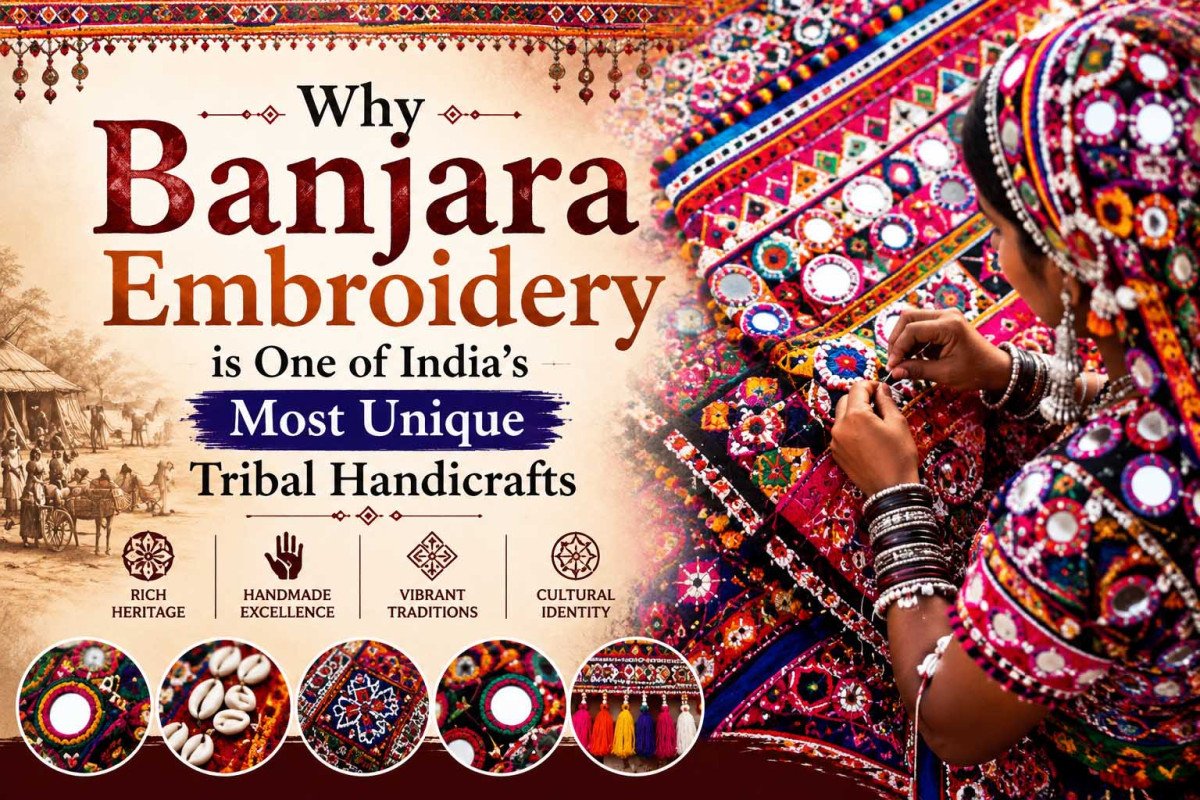
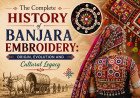
Why Banjara Embroidery is One of India's Most Unique Tribal Handicrafts
Discover the vibrant craft of Banjara embroidery—from backless Kachali blouses to intricate geometric needlework and shell embellishments.

History, Origin, and Cultural Identity
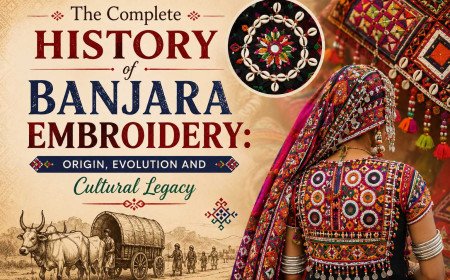
The Banjara embroidery craft is inseparably blended with the history of the Banjara people, whose original homeland was Rajasthan
Historical Evolution:
Nomadic Goods Carriers (Rajasthan Homeland) ➔ Mogul Army Supply/Trade ➔ Loss of Trade to Transport/Railways ➔ Sedentary Tanda Settlements
Identity and National Uniformity
A unique characteristic of the Banjara community is their identical national pattern of dress and ornamentation, which allows a Banjara to be recognized in any part of the country regardless of domicile
Place in Indian Tribal Handicrafts
Unlike settled communities that produce monumental or mass-manufactured craft items for commercial trade, Banjara handicraft is distinct because it is non-commercial, personal, and portable. It is stressed almost entirely on their personal dresses, ornaments, and transport bags. The craft was traditionally sustained not as a commercial trade or full-time vocation, but as a cherished household tradition, a way of life, and a vital symbol of community identity maintained in isolated tanda settlements.
Artistic Features, Motifs, and Traditional Items
Unique Artistic and Decorative Features
Banjara embroidery exhibits striking visual elements
-
Color Palette: Predominantly uses bright, contrasting primary colors—chiefly red and black—along with multi-colored threads.
-
Embellishments: Integrates cowrie sea shells (kawadya), hollow frustum-shaped zinc/metal pieces (pari), lead rings, metallic coins, and colorful woolen yarn balls attached along the borders and edges
-
Stitch Techniques: Uses manual hand-needle work incorporating cross stitches alongside traditional geometrical line/border stitches.
-
Figurative & Geometric Motifs: Incorporates stylized animal and bird figures (e.g., peacocks, dogs) alongside traditional geometric patterns such as bangadi bharat, hathphool, rumali bhat, bajori akada, balori bhat, ghoderkhur, and kundalu akada.
Traditional Attire and Everyday Articles
| Item Name | Description & Artistic Purpose |
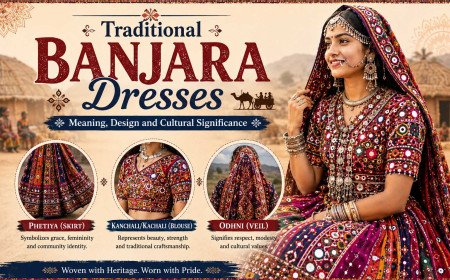
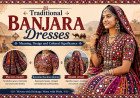
| Kachali | A backless blouse for married women featuring three front sections (chhati, peti, bahi) designed to eliminate the need for modern undergarments. Fastened across the neck and back with strings (dari) and embellished with kawadya, coins, and lead. Fancier bridal variants incorporate mirrors. |
| Phetiya | A heavy, traditional skirt-like garment comprising four sections: the embroidered waist belt (lepo), two contrasting color middle pieces (ghero), printed cotton fabric (sabab/chhit), and a masterfully embroidered bottom border (lawan). |
| Zolana | An exquisitely embroidered shoulder bag with a long strap, trimmed with wool yarn balls and cowrie shells (kawadya) along its edges. |
| Chunchi | A multi-pouch bag (3–4 pouches) designed to carry pan, betel nut (supari), and tobacco. |
| Khalchi & Kothali | Khalchi is a square embroidered bag for storing flatbreads (bhakari). Kothali is a small money and utility bag used by elderly women. |
| Darani & Gadano | Darani is a decorated cloth used for wheat flour dough preparation during festive occasions. Gadano is an embroidered dish/pot cover. |
| Pat & Kothalo | Pat is an embroidered cloth board used for indoor chess-like games. Kothalo is a large embroidered shopping sack. |
Manufacturing Overview (Brief Summary)
Process, Materials, and Tools
The manufacturing process relies on simple hand tools and execution during household leisure hours:
-
Tools: A basic hand-sewing needle (costing under 50 paise) for embroidery and a traditional short sickle used to cut fabric pieces to size.
-
Raw Materials: Coarse thick cotton fabric (chhatya cloth from 60-count yarn) forms the base, lined with printed or plain cotton fabric (mangji cloth). Embellishments include colored cotton and woolen threads, cowrie shells (kawadya), metal rings, and zinc pieces (pari).
-
Kachali Assembly: Involves cutting specific panels (chhati, peti, chirma, khadapa, khuppa, bahi), executing hand-stitched embroidered motifs over individual panels, adding lining, joining the pieces, piping the edges with mangji cloth (katta), and attaching woolen pom-poms and tie strings (dari).
Assembly Flow of Kachali:
Cutting Cloth Panels (Sickle) ➔ Needle Embroidery on Panels ➔ Adding Lining Cloth ➔ Joining Sections ➔ Edge Piping (Katta) ➔ Attaching Strings & Embellishments
Transmission of Knowledge and Training
Intergenerational Transmission
Historically, Banjara embroidery knowledge was passed down strictly within the family from mother to daughter. Young girls observed their mothers at work in the house veranda, developing an intuitive understanding and perfecting their craftsmanship under motherly and grandmotherly guidance before marriage.
Government Training Initiatives
To prevent the craft from vanishing, formal training programs were introduced:
-
Sponsoring Bodies: The All India Handicrafts Board (Development Commissioner for Handicrafts, Ministry of Commerce, Govt. of India) and the Maharashtra State Directorate of Industries.
-
Class Structure: Conducted locally in village tandas (such as Ichchhapur, Ghodegaon, Vasantnagar, Rajdehere, and Patane). Batches typically consist of 10 female trainees under 1 master craftsperson instructress.
-
Stipends & Remuneration: Trainees receive a monthly stipend of ₹100, while instructresses receive a monthly remuneration ranging from ₹300 to ₹600.
-
Outcome: Survey data shows trainees generally already knew basic embroidery from their elders; the formal training classes primarily served to refine and perfect their technical skill.
Economic Status, Challenges, and Preservation
Socio-Economic Reality of Artisans
Survey data from Jalgaon district reveals that Banjara embroidery is not practiced as a regular commercial household industry or primary income source. Artisans are primarily agricultural cultivators or farm workers. The craft is performed without formal workshop spaces, using open house verandas during seasonal agricultural off-times (especially April–May).
+-----------------------------------------------------------------------------------+
|                            KEY CHALLENGES FACING THE CRAFT                        |
+-----------------------------------------------------------------------------------+
| 1. High Production Cost vs. Cheap Mass Market Substitutes                         |
|    (e.g., A Banjara Zolana costs ~₹75 to make vs. market bags at 1/4th the price)  |
+-----------------------------------------------------------------------------------+
| 2. Shift in Generational Preferences                                              |
|    (Younger women prefer lighter, modern dresses like saris, skirts, and blouses) |
+-----------------------------------------------------------------------------------+
| 3. Labor-Intensive & Time-Consuming Handwork                                      |
|    (Requires days or months of painstaking needlework per item)                    |
+-----------------------------------------------------------------------------------+
| 4. Declining Cultural Taboos & Lack of Dedicated Marketing Channels               |
|    (Traditional costume taboos weakening; absence of commercial outlets)          |
+-----------------------------------------------------------------------------------+
Threat of Extinction
The craft faces severe threats due to several interrelated factors:
-
High Material & Time Costs: High prices of raw fabrics/materials combined with lengthy manual labor make items expensive. For instance, a hand-embroidered zolana shoulder bag costs approximately ₹75 to produce, whereas commercial market substitutes sell for a fraction of that price.
-
Generational Shift: Younger generations view traditional attire as heavy, unhygienic, unsuited for fast modern life, or unfashionable, opting instead for modern saris, skirts, and blouses.
-
Lack of Marketing Infrastructure: Products are not mass-produced, lack ready commercial markets, and rely almost entirely on occasional government exhibition stalls where items are purchased merely as antiques or decorative showpieces by high-income buyers.
Rejuvenation and Future Prospects
To ensure the survival and economic viability of Banjara embroidery, structural interventions are essential:
-
Fashion Adaptation: Adapting traditional designs—especially the multi-colored kachali—into modern ethnic fashion garments, designer blouses, and western apparel to tap into commercial domestic and export markets.
-
Commercialization & Cooperatives: Establishing dedicated marketing facilities, permanent production centers, cooperative societies, and broad publicity campaigns supported by government handicraft boards.
-
Economic Vocation: Transforming a purely traditional, leisure-time hobby into a structured, revenue-generating livelihood for rural Banjara women.
Frequently Asked Questions
What's Your Reaction?
 Like
0
Like
0
 Dislike
0
Dislike
0
 Love
0
Love
0
 Funny
0
Funny
0
 Wow
0
Wow
0
 Sad
0
Sad
0
 Angry
0
Angry
0

Comments (0)