

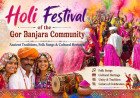
Holi Festival of the Gor Banjara Community: Ancient Traditions, Folk Songs & Cultural Heritage
The Holi Festival of the Gor Banjara Community is one of the oldest and most vibrant tribal celebrations in India, reflecting the rich cultural heritage, oral traditions, and social unity of the Gor Banjaras. Unlike the common Holi celebrations, Banjara Holi is deeply rooted in ancient customs, beginning with the Wajana ceremony, where the community seeks permission from the Naik (traditional chief) to commence the festivities.

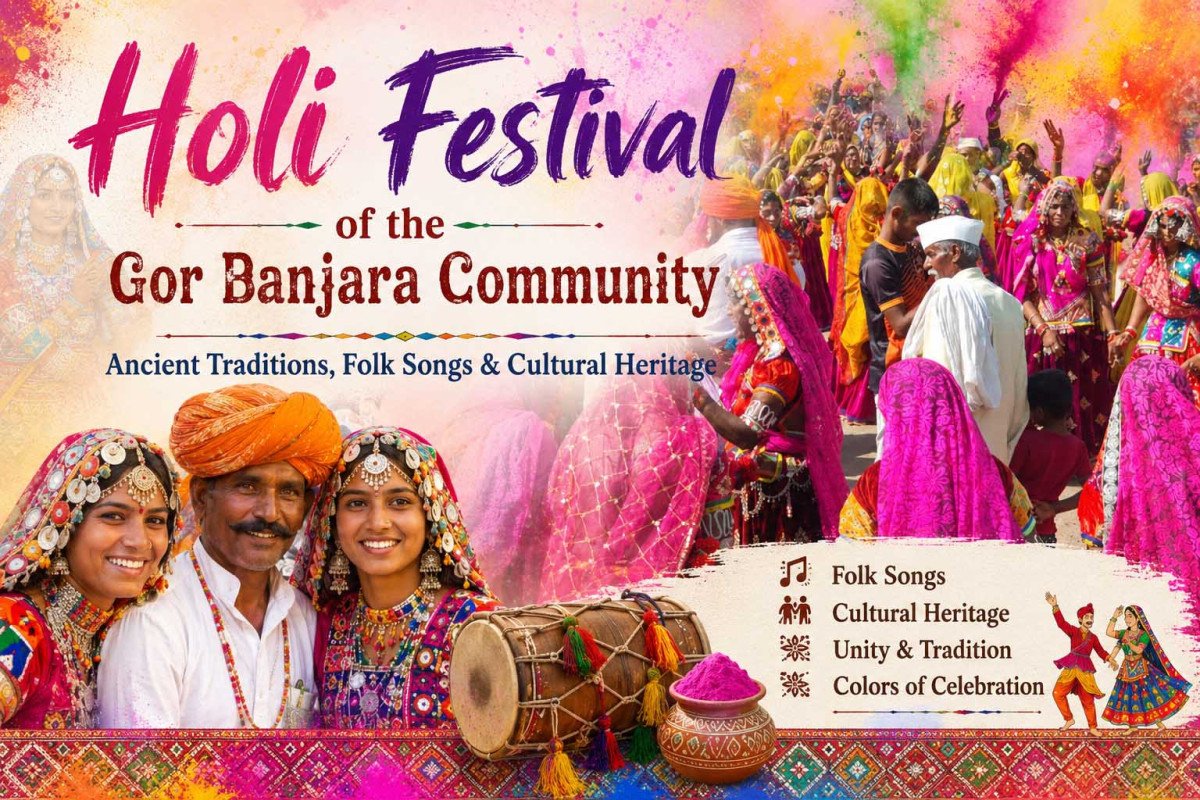
Among all the festivals celebrated by the Gor Banjara community, Holi occupies the highest place of honour. While Holi is popularly known throughout India as the festival of colours, for the Gor Banjaras it is much more than a colourful celebration. It is a festival that preserves the community's history, oral literature, folk music, traditional governance, and social unity.
The Gor Banjaras, one of India's oldest tribal communities, have maintained their distinct identity through their customs, songs, dances, and rituals. Their Holi celebrations are unlike those seen elsewhere in the country. Every ritual—from seeking the Naik's permission to the all-night singing of Lengi songs—is deeply rooted in centuries-old traditions.
Holi is not merely celebrated for one day. The excitement begins nearly two months before the festival, when the rhythmic sound of the Daf (traditional drum) starts echoing across the Tanda. Every evening, young men gather to rehearse songs, women prepare for Gerani performances, elders discuss community arrangements, and the entire settlement gradually transforms into a centre of music and celebration.
For the Gor Banjaras, Holi is not only a religious festival but also an occasion to renew friendships, strengthen family bonds, remember ancestors, and pass cultural traditions from one generation to another.
Why Holi is the Greatest Festival of the Gor Banjaras
The Gor Banjaras are known for their love of music, dance, and community celebrations. No festival expresses these qualities more vividly than Holi.
Young and old, men and women, everyone participates enthusiastically. During Holi, ordinary life comes to a halt as the entire Tanda immerses itself in celebration.
Traditional Mahua flower liquor is prepared for the occasion. According to tribal belief, it refreshes the body and mind, helping people forget their worries and participate wholeheartedly in dancing and singing. The entire atmosphere becomes filled with joy, laughter, and the rhythmic beat of drums.
Unlike many modern celebrations, Holi in a Banjara Tanda is completely community-centred. There are no spectators—every person becomes a participant.
The Legend of Dhundya – The Origin of Banjara Holi
Every ancient tradition has a story behind it, and the Holi celebration of the Gor Banjaras is closely associated with the legend of a demon named Dhundya.
According to oral tradition, Dhundya was a terrifying demon who preyed upon small children. His attacks created fear throughout the Tandas.
To protect their children, the people decided to remain awake throughout the full moon night of Holi.
Armed with:
- sticks,
- swords,
- traditional weapons,
the villagers guarded every corner of the settlement.
To avoid falling asleep, they spent the entire night:
- singing,
- dancing,
- beating drums,
- drinking Mahua,
- and celebrating together.
Thus, the practice of staying awake on Holi night became an important community tradition.
The Demoness Enters the Naik's House
The legend continues with an unexpected incident.
Despite the vigilance of the villagers, a demoness secretly entered the house of the Naik, the traditional chief of the Tanda.
Unaware of her true identity, the Naik allowed her to remain inside.
When the villagers discovered this, they immediately gathered in front of his house.
Together they dragged the demoness outside, killed her, and celebrated their victory by singing and dancing throughout the night.
The following morning they carried her body outside the Tanda and burned it.
This symbolic burning later became associated with the Holika bonfire, representing the destruction of evil.
The Symbolic Fine of One Rupee
The story of the demoness also explains one of the most unique customs of Banjara Holi.
Since the Naik unknowingly sheltered the demoness, the community imposed a symbolic fine of one Rupee upon him.
Even today, many Tandas continue this tradition.
Although the amount is insignificant, the custom teaches an important lesson:
- Every member of society is accountable.
- Even the Naik must accept responsibility.
- Community welfare is above individual status.
This simple ritual demonstrates the democratic spirit that has existed within Banjara society for generations.
Celebrating Children's Birthdays on Holi
Another remarkable custom connected with Holi is the collective celebration of children's birthdays.
Traditionally, children born between two Diwali festivals celebrate their birthdays during Holi rather than on their actual birth dates.
This custom developed during the Banjaras' nomadic period, when maintaining written birth records was difficult.
Holi therefore became the annual occasion to bless all children born during the year.
The ceremony strengthens community ties because every child receives blessings not only from family members but from the entire Tanda.
Wajana – Seeking Permission from the Naik
The official beginning of Holi celebrations is marked by a ceremony known as Wajana.
On the evening of the full moon, enthusiastic boys, girls, and respected elders known as Daisane gather before the Naik's residence.
No Holi celebration begins without his permission.
During this ceremony, a traditional folk song is sung.
Original Gor Boli Folk Song
"अनभाई, हारे थाके एक गेरीया उतरे अनभाई,
नायकन दिनों एक रपीया पाचजो।
पाचन माणे एक पचीस तम जाणणो
ओरी गोरीन दिनी छळहाल बोकडो
पडी तुकारी बो बो…."
English Meaning
The song says that the tired Geriyas have arrived in the Tanda and assembled before the Naik's Darbar (court). The Naik offers them a coin worth one Rupee, but the singers happily accept it as though it were worth many times more. The Naik also gifts a healthy goat to the community. The song concludes by praising the generosity of the Naik and wishing prosperity for the Tanda.
The song demonstrates the respect that the Gor Banjaras traditionally show towards their community leader.
Meaning of the Word "Ger"
The word Ger originally comes from the Nimadi language, where it refers to a group or team of men.
Within the Gor dialect, the word gradually evolved into Geriya, referring to the group of men who sing, dance, and lead Holi celebrations.
Similarly, the women's group is called Gerani.
These terms remain central to Holi traditions even today.
Choosing the Sacred Place for Holi
Once permission has been granted, the Naik and the entire Tanda proceed together to select the location for the Holi bonfire.
During this procession another traditional song is sung.
Original Folk Song
"चालो रे डायसांळे
होळी रे कुथा
चालो रे डायसांळे
आपण होळी खेला।"
English Meaning
The song invites everyone to walk together with the Naik and select the sacred place where Holi will be celebrated. It expresses unity, cooperation, and collective participation.
The entire Tanda joins the procession with music and dancing.
The Sacred Coin Ritual
After selecting the place, a small pit is dug.
Inside the pit the Naik buries a coin.
The buried coin symbolizes:
- prosperity,
- abundance,
- protection,
- blessings for the coming year.
Immediately after this ritual, another ancient song is sung.
Original Folk Song
"पेन्हा रेतेते डुंगरखोळो
अब आयों तांडा
तांडे मा बे नागा पुररो
नागा स्वामी, स्वामी छ आब धुत बे।"
English Meaning
The song recalls the community's earlier life in the hills and mountains before settling in Tandas. It welcomes Naga Swami from the hills near Nagapur (Udaipur region), inviting him to bless the Holi celebrations. The singers express that now the entire Tanda will celebrate together with great joy.
This song preserves historical memories of the Banjaras' migration and settlement.
Holi Songs – The Living Library of the Gor Banjaras
Every stage of the Holi celebration is accompanied by a specific folk song.
These songs preserve:
- tribal history,
- migration stories,
- religious beliefs,
- humour,
- romance,
- social customs,
- traditional governance,
- community values.
Long before books became common, these songs acted as the community's living archives.
Generation after generation has memorized and transmitted them through Holi celebrations.
For researchers of tribal culture, these songs represent one of the richest examples of India's oral literary traditions.
Visiting Families Affected by Tragedy
Unlike many festivals that focus only on celebration, the Gor Banjaras believe that no family should remain isolated in grief during Holi.
After selecting the Holi ground, the Geriyas visit every household where a death has occurred during the previous year. Instead of beginning celebrations immediately, the community first shares the sorrow of the bereaved family.
Games are played gently to lift the family's spirits, and elders offer words of comfort. This tradition reflects the Gor Banjara belief that joy and sorrow belong to the entire Tanda, not just to individual families.
To console the grieving family, a deeply philosophical folk song is sung.
Folk Song of Consolation
Original Gor Boli Folk Song
"धरती तोपर अमर नहीरे कोई,
धरती तोपर अमर वेगे
एक चांदान सुर्या ओरे
नवलाख तारा।"
English Meaning
No human being is immortal upon this earth.
Everyone who is born must one day depart.
Only the eternal Sun, the Moon, and the countless stars continue to shine forever.
Therefore, leave behind your sorrow and join the community in celebrating Holi.
A Lesson Hidden in the Song
This short song contains profound philosophy.
It teaches that:
- Death is the natural destiny of every living being.
- Sorrow should be respected, but life must continue.
- The community stands beside every grieving family.
- Holi symbolizes renewal and hope.
This compassionate custom makes Banjara Holi unique among tribal festivals.
Formation of Geriya and Gerani
Once the mourning rituals conclude, the atmosphere gradually transforms into celebration.
The community divides into two traditional groups.
Geriya
The Geriya is the men's performing group.
Their responsibilities include:
- Singing Holi songs
- Dancing
- Playing traditional drums
- Leading processions
- Entertaining the entire Tanda
The Geriyas travel from house to house, ensuring every family becomes part of the celebrations.
Gerani
The women form the Gerani group.
Their participation is equally important.
The Geranis:
- Sing traditional folk songs.
- Dance rhythmically.
- Respond to the songs of the Geriyas.
- Preserve ancient oral traditions passed down by mothers and grandmothers.
Together, the Geriya and Gerani create a beautiful musical dialogue that continues throughout the night.
Lengi – The Soul of Banjara Holi
Among all Holi performances, Lengi occupies a special place.
Lengi is not simply a song.
It is a unique combination of:
- poetry,
- music,
- wit,
- rhythm,
- friendly competition,
- storytelling.
Groups challenge one another through beautifully composed verses.
A successful Lengi singer must possess:
- excellent memory,
- poetic ability,
- confidence,
- quick thinking,
- musical talent.
Even today, experienced singers are greatly respected within the community.
Three Traditional Types of Lengi
Banjara oral tradition recognizes three principal forms of Lengi.
1. Besan Boler
Usually performed while seated.
This style emphasizes poetic dialogue and clever responses.
2. Ubheti Boler
Performed while standing and dancing.
This style combines energetic movement with rhythmic singing.
3. Bhand Lengi
A humorous style full of jokes, satire, and dramatic acting.
Its purpose is to entertain the audience and create laughter throughout the Tanda.
The Magical Drum Song
One of the most famous Holi songs praises the power of the Daf (traditional drum).
Original Gor Boli Folk Song
"डप धीरो वजार तारी जानी ढळजा,
डप धीरो वजार।
डपडा रो धोर सळींल पाणी भरतु
वु तो फेक दीनी बेलो नाचेणं लगीर।
डप धीरो वजार...डप डारो घोर सणींर पोळी पोवतु
वु तो फेक दिनी लोया देखन लगीर।
डप धीरो वजार...
तारी जानी ढळजा..."
English Meaning
The singer lovingly requests the drummer:
"Dear friend, beat the drum slowly."
The rhythm of the drum is so enchanting that:
- A young woman carrying water throws away her water pot and begins dancing.
- Another girl preparing chapatis abandons the kitchen to watch the drummer.
- Everyone forgets their daily work after hearing the magical sound of the Daf.
The song humorously suggests that the drummer's music is powerful enough to make the entire Tanda dance.
A Friendly Musical Challenge
After one Lengi concludes, another group immediately responds.
The next singers announce:
Original Line
"ऐन जायदो दूसरी आ दो रसिया येन जायदोर।"
English Meaning
"Now stop this Lengi and let another beautiful song begin."
This simple line marks the beginning of another musical challenge between competing singers.
Throughout the night, dozens of such exchanges take place, making Holi a festival of continuous creativity.
The Beauty of the Ghorayo
The Ghorayo, or drummer, occupies a place of honour in the celebration.
His skill determines the energy of the dancers.
A famous Lengi praises both his appearance and musical talent.
Original Gor Boli Folk Song
"असे डफ वाळेर लंबे लंबे झलपा,
तारे झलपान देखन वर भाईर भाईर।भाईर डफ चालेदार,
असे डफे वाळेर हाथे माई कल्डा वा भाई।तारे कलडान देखन झुररी रसिया,
डफ चालेदार।असे डफे वाळेर लांबे लांबे जांगीया..."
English Meaning
The song describes the handsome drummer.
His long hairstyle (Zalpa) attracts everyone's attention.
The silver ornament (Kalda) on his hand enhances his appearance.
As the drum echoes across the Tanda, the young women admire his confidence, beauty, and masculine charm.
The song reflects youthful emotions expressed through poetry rather than direct conversation.
The Drum – The Heartbeat of Holi
Without the Daf, Holi celebrations cannot exist.
The drummer stands in the centre while dancers form a large circle around him.
Using a small stick called Chataki, he controls the rhythm of every movement.
As the tempo changes:
- dancers step forward,
- move backward,
- bend together,
- clap rhythmically,
- leap with excitement,
- and shout traditional cries.
Every beat unites the entire Tanda into one rhythmic circle.
Oral Literature Preserved Through Holi
Every Lengi preserves valuable knowledge.
Within these songs are hidden:
- historical memories,
- migration stories,
- humour,
- romance,
- tribal values,
- religious beliefs,
- social customs,
- descriptions of nature,
- admiration for beauty,
- respect for leadership.
Before books became common, these songs served as the living library of the Gor Banjara people.
Elders passed them to younger generations entirely through memory.
Many of these songs remain unchanged after hundreds of years.
Music as a Social Institution
For the Gor Banjaras, singing is not merely entertainment.
It strengthens:
- friendship,
- community unity,
- cultural identity,
- intergenerational learning,
- emotional well-being.
Young singers learn directly from experienced performers, ensuring that every generation inherits the musical traditions of its ancestors.
Thus, Holi functions not only as a festival but also as an annual cultural school where history, language, and values are taught through music.
Payee Song (Ubheti Lengi)
Among all Holi performances, the Payee Song, also known as Ubheti Lengi, occupies a special place in Gor Banjara folklore.
The Payee dance attracts both young men and women because it combines:
- Music
- Dance
- Drama
- Romance
- Poetry
- Storytelling
Unlike ordinary folk songs, the Payee narrates a complete story while the dancers perform synchronized movements to the rhythm of the Daf.
The Geriyas stand in a large circle holding one another's hands, while the Ghorayo (drummer) stands in the centre. Using a small wooden stick called Chataki, he beats the drum in perfect rhythm.
The dancers move:
- one step backward,
- one step forward,
- bend together,
- perform rhythmic sit-ups,
- wave colourful handkerchiefs,
- and raise joyful cries.
The dance requires remarkable coordination and stamina, making it one of the finest examples of tribal folk performance.
The Original Payee Song
The following is one of the best-known Payee songs sung during Holi.
Original Gor Boli Folk Song
"उठ परभातीन केकडा ये छोडी;
कादळ्या मारोये कान।
मान मनावतु लागी घळीं वेळा;
केकडी गे बगदान।रळक तलावडी न रायमल गुदळा;
केकडा गे धापन।
माथे पर झारीन हाते मांई फुलीया,
वलटो परती चाल।दन ऊंधाळो तावडो तपछ;
छाया देखन बेस।
काळो वावर छ खेचडी रो;
झाड छेंडी देखन बेस।तेडी तेडी पगडी मत बांधो ओ भीया;
भरमा भरचरे लोग।
तारो मारो मतरो एक छ ये ओ भीन;
माको लियेरे तोड।पाच सात भाई मारो काही करीये नी;
काही करीये लोग।
घेरी दिऊ ये छोड;
आठसे कराडी नवसे विजली
सोभिये आन पडे समनक..."
English Meaning of the Payee Song
The song tells the story of two young lovers from the Tanda.
Every morning they meet while taking their cattle to graze.
One day, a dog named Kadalya flutters its ears.
The girl immediately considers this a bad omen and becomes frightened.
She hesitates to go into the forest but eventually decides to meet her beloved.
Carrying a water pot upon her head and wearing a beautiful silver ornament (Phuliya), she walks gracefully towards the forest.
The song poetically compares her majestic walk to that of a royal elephant.
A Beautiful Description from Malwa Tradition
The graceful walk of the heroine is also remembered through a famous couplet from the Malwa region:
"येडी मारी चिकनी जैसे सतवा सुठ,
ऐसी चाल झुमती, रंडवा छाती कुठ।"
Meaning
Her beauty is delicate and graceful.
She walks with such elegance that everyone who watches her becomes captivated.
The comparison illustrates the admiration for feminine grace in tribal folk poetry.
Meeting Beneath the Khechadi Tree
The lovers finally meet beneath the cool shade of a Khechadi tree.
The summer sun burns fiercely overhead, but the tree offers comfort and privacy.
Here the young girl speaks anxiously.
She says:
"O Shobhiya, every day you tie your turban in a different style. The people of the Tanda have started noticing you. They are becoming suspicious of us."
Her words reveal the strict social customs that governed relationships in traditional Banjara society.
Shobhiya's Fearless Reply
The young man answers confidently.
He says:
"If our hearts have accepted each other, why should we fear what people think?"
His reply represents courage, determination, and unwavering love.
However, the girl remains worried.
She tells him:
"I have five or seven brothers. If they discover our love, they will kill you."
This conversation forms one of the most emotional moments in the Payee song.
The Warrior's Confidence
Shobhiya smiles.
He reassures her that he has mastered the traditional Gheri style of warfare.
He says he is fully capable of defending himself against anyone.
This reflects the martial traditions of the Gor Banjaras, who historically protected trade caravans across India.
Their bravery became a central theme in many folk songs.
The Lovers Are Surrounded
Suddenly, the girl's fears come true.
Her brothers, accompanied by other villagers, surround the lovers carrying:
- sticks,
- swords,
- traditional weapons.
The girl immediately remembers the warning given earlier by the dog.
She sadly tells Shobhiya:
"I did not want to come today because the dog gave a bad omen, but you persuaded me. Now everyone has surrounded us."
The Tragic End of the Love Story
A fierce battle begins.
Shobhiya fights with extraordinary courage.
According to the song:
- He defeats many of his attackers.
- His bravery astonishes everyone.
- The girl faints after witnessing the violent struggle.
When the fighting ends, Shobhiya gently sprinkles water from her pot onto her face and revives her.
He embraces her lovingly.
Together they attempt to escape deep into the forest.
However, destiny has another plan.
Eventually the lovers are captured.
Unable to live separately, they choose death together.
Their sacrifice transforms them into eternal lovers remembered through Holi songs even today.
The Cultural Importance of the Payee Song
The Payee is much more than a romantic tale.
It teaches timeless values:
- loyalty,
- courage,
- sacrifice,
- honour,
- devotion,
- determination.
The story has survived for generations without written manuscripts.
Its preservation through oral performance demonstrates the extraordinary richness of Gor Banjara folk literature.
Women's Holi Song
The women of the Tanda also sing beautiful songs celebrating love, affection, and happiness.
One popular example is:
Original Gor Boli Folk Song
"म तो मारे दोसत्यान दस्ती दराई ये…
ओढ ओढ दस्ती करच मस्ती,
म तो हसतीय।मैं तो हसती कवाड खोलती,
म तो मारे…"
English Meaning
The young woman joyfully says:
She has embroidered a beautiful handkerchief for her beloved.
Her heart overflows with happiness because he accepted her gift with great delight.
She keeps the door of her home open, eagerly waiting for his arrival.
The song beautifully expresses innocent love, hope, and youthful excitement.
A Night Filled with Music and Celebration
The singing and dancing continue throughout the entire night.
The Geriyas and Geranis visit different houses within the Tanda.
Every family welcomes them with:
- food,
- traditional sweets,
- Mahua drink,
- hospitality.
The chief organizer also selects one young man and one young woman to symbolically represent the Geriya and Gerani for the celebration.
Nobody notices how quickly the night passes.
Holika Dahan – Burning the Symbol of Evil
At the break of dawn, the Naik gives permission to light the Holi bonfire.
The fire represents the destruction of the demoness described in the ancient legend.
The entire Tanda gathers around the flames, celebrating:
- victory over evil,
- protection of children,
- purification,
- the beginning of a new agricultural season,
- unity of the community.
The burning Holi becomes the spiritual climax of the festival.
Birthday Ceremony of Children
Immediately after Holika Dahan, another unique Banjara custom is performed.
Children born during the year—traditionally those born between two Diwalis—celebrate their birthdays collectively.
The ritual is especially associated with the Ramanna Khola clan.
The child and mother are seated in the courtyard.
Four food items are placed around them in the four directions.
A long stick is gently placed upon the mother's head, while another stick lightly strikes it as part of the ceremonial blessing.
This ritual is also mentioned in Rajasthan Vaibhav by Triloknath Chaturvedi, showing that similar customs existed in parts of Rajasthan.
The entire Tanda blesses the child for:
- long life,
- good health,
- prosperity,
- protection from evil spirits.
Holi – A Living Museum of Gor Banjara Heritage
The Holi festival preserves almost every important element of Gor Banjara civilization.
It safeguards:
- Gor Boli language,
- oral literature,
- folk music,
- traditional dance,
- tribal governance,
- philosophy,
- martial traditions,
- romance,
- social harmony,
- religious beliefs.
Every song performed during Holi is a living historical document that connects today's generation with their ancestors.
Conclusion
The Holi festival of the Gor Banjaras is far more than a celebration of colours. It is a remarkable cultural institution that has preserved centuries of tribal history, music, folklore, language, and social values through oral tradition. From the legend of Dhundya and the sacred Wajana ceremony to the philosophical songs of consolation, the energetic Lengi performances, the moving love story of Shobhiya and Shobhani, and the unique birthday rituals for children, every custom reflects the richness of Gor Banjara civilization.
The original Gor Boli (Gormati) songs sung during Holi are not merely verses—they are living records of the community's identity. They preserve memories of migration, bravery, romance, devotion, and collective life in the Tanda. As modernization transforms traditional lifestyles, documenting and preserving these songs and rituals becomes increasingly important. By celebrating Holi in its traditional form and passing these customs to younger generations, the Gor Banjaras continue to keep their cultural heritage alive, ensuring that the voices, music, and wisdom of their ancestors endure for generations to come.
Frequently Asked Questions
What's Your Reaction?
 Like
0
 Dislike
0
 Love
0
 Funny
0
 Wow
0
 Sad
0
 Angry
0




Comments (0)