The Gor Banjara Dialect (Gor Boli / Gormati): History, Evolution, and Rich Oral Tradition
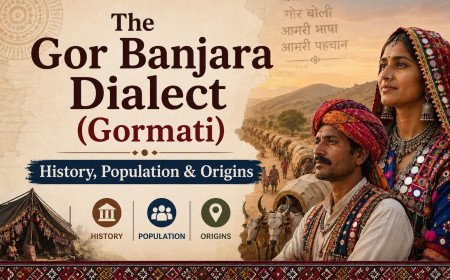
The Gor Banjara dialect, commonly known as Gor Boli or Gormati, is the traditional language of the Gor Banjara community and a vital part of its cultural identity. Rich in folk songs, ritual chants, proverbs, folktales, and oral traditions, the dialect has been preserved across generations despite the absence of a widely used written script. This article explores the history, possible origins, linguistic evolution, scholarly perspectives, and influences of languages such as Pashto, Paishachi, Rajasthani, Hindi, and Persian on Gor Boli. It also highlights why preserving this unique Indo-Aryan dialect is essential for safeguarding the heritage and identity of the Gor Banjara community.

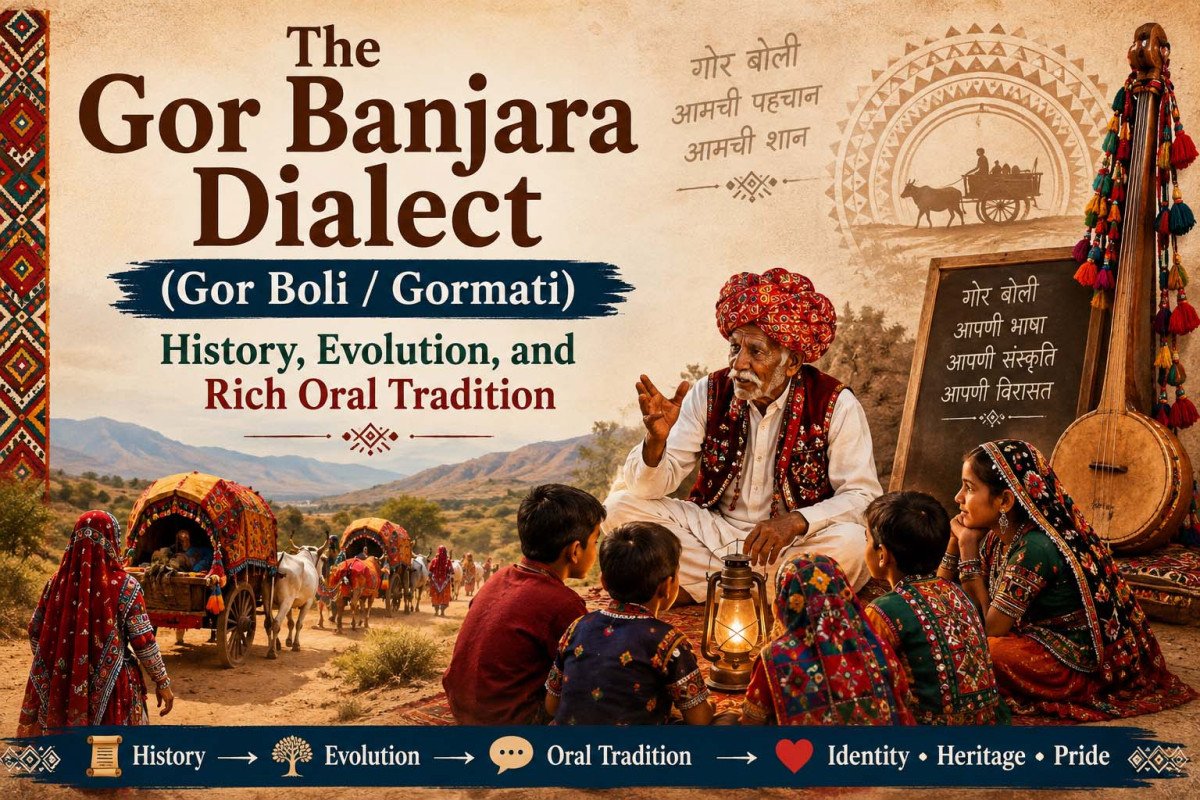
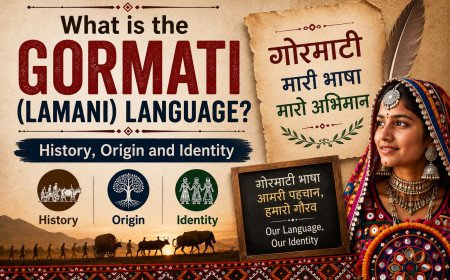
The Gor Banjara dialect, popularly known as Gor Boli, Gormati, Labhani, Lambani, or Gormati Boli, is one of the richest oral traditions preserved by the Gor Banjara community. For centuries, this language has served not only as a medium of communication but also as the guardian of the community's history, culture, traditions, beliefs, and collective memory.
Unlike many written languages, Gor Boli has survived primarily through oral transmission. Folk songs, ritual songs, proverbs, riddles, stories, legends, and traditional sayings have been passed from one generation to another without the support of a formal script. This remarkable continuity has enabled the language to preserve its identity despite the Banjaras living across different regions of India.
Today, Gor Banjaras are spread across more than twenty Indian states and speak several regional languages alongside Gor Boli. Yet, the community continues to recognize Gor Boli as the language that unites all Gors regardless of geographical boundaries.
The Rich Oral Literature of Gor Banjaras
One of the greatest strengths of the Gor dialect is its vast oral literature.
For generations, Gor Banjaras have preserved their history through spoken traditions rather than written records. These traditions include:
- Folk songs
- Marriage songs
- Festival songs
- Ritual songs
- Devotional hymns
- Heroic ballads
- Folktales
- Proverbs
- Idioms
- Riddles
- Blessings
- Traditional conversations
- Oral genealogies
These literary forms are not merely entertainment. They serve as educational tools that teach moral values, social customs, respect for elders, bravery, honesty, and devotion.
Even today, many elderly members of the community can narrate stories or sing traditional songs that have been transmitted for hundreds of years.
Ancient Roots of Gor Oral Tradition
Indian oral literature has existed since the Vedic period. Famous collections such as:
- Panchatantra
- Hitopadesha
- Arabian Nights (through later traditions)
represent the long history of storytelling across Asia.
According to traditional interpretations, several Gor Banjara folktales possess themes that resemble extremely ancient literary traditions.
An interesting comparison is often made with the Greek tragedy Oedipus Rex. Certain Gor Banjara folklore contains narrative elements that resemble the Greek legend. This similarity has encouraged researchers to explore possible cultural exchanges or shared ancient storytelling traditions.
Although such similarities do not necessarily prove direct historical connections, they indicate that the oral traditions of Gor Banjaras preserve narratives of remarkable antiquity.
An Ancient Independent Dialect
Languages do not develop overnight.
An independent dialect generally evolves over several centuries through continuous interaction among a community of speakers.
The existence of Gor Boli as a distinct linguistic system suggests that the Gor community possessed its own social identity long before the modern period.
The vocabulary, pronunciation, grammar, expressions, and oral traditions indicate that Gor Boli developed independently while continuously interacting with neighboring languages.
Its survival across centuries without a standardized writing system demonstrates the strength of community-based language preservation.
Gor Boli and the Aryan Dialects
Researchers studying Indo-Aryan languages often examine Gor Boli within the broader family of Aryan dialects.
Historian Will Durant, while discussing ancient Indian culture, observed that Sanskrit was primarily the language of priests and scholars. Even during the Vedic age, ordinary people did not all speak the same language.
Instead, different tribes possessed their own dialects.
This observation supports the possibility that ancient tribal communities maintained independent spoken languages alongside Sanskrit.
The Gor community is believed by some scholars to have preserved one such distinct dialect through centuries of migration and interaction.
Evidence from Linguistic Studies
The book "Bhashaonka Vigyanik Adhyayan" explains that Aryan clans entering India were divided into various tribal groups, each speaking its own dialect.
These groups, often called Kabilas, developed their own linguistic identities.
According to this perspective:
- Every Aryan clan maintained a unique dialect.
- Language served as an identity marker.
- Dialects evolved differently depending on migration and settlement.
The Gor community likewise preserved its own dialect, now known as Gormati or Gor Boli.
Why It Is Called Gormati
Among Gor Banjaras, a common question asked during the first meeting between strangers is:
"Ton Gormati awach kaiyee?"
Its meaning is:
"Do you speak the Gormati language?"
This simple greeting carries deep cultural significance.
Rather than asking about religion, occupation, or region, Gor Banjaras first recognize one another through their common language.
This reflects the strong emotional bond between the Gor identity and the Gormati dialect.
Gor Clan and Its Language
Language has always been one of the strongest symbols of Gor identity.
Although Banjaras today live across India, they continue to identify themselves through:
- Clan (Gotra)
- Customs
- Festivals
- Traditional dress
- Language
The shared language creates a feeling of unity among communities living thousands of kilometers apart.
Whether a Gor family lives in Rajasthan, Maharashtra, Karnataka, Telangana, Madhya Pradesh, Gujarat, or Andhra Pradesh, Gor Boli remains a recognizable cultural bond.
Climate and Language Development
Linguists have long observed that geographical conditions influence language.
Climate affects:
- Pronunciation
- Speech speed
- Vocabulary
- Accent
- Tone
Some scholars argue that languages spoken in colder regions tend to have softer or less distinct pronunciation, while languages of warmer regions often possess clearer articulation.
Similarly, environmental conditions influence vocabulary.
Communities create words based on:
- Forests
- Mountains
- Rivers
- Animals
- Agriculture
- Occupation
- Trade routes
Since Gor Banjaras historically traveled across diverse landscapes, their language naturally absorbed words associated with different regions.
The Famous Saying About Language Change
A well-known Hindi proverb says:
"Every four miles the taste of water changes, and every ten miles the language changes."
This saying beautifully describes the gradual evolution of dialects.
Gor Boli follows this linguistic pattern.
Different regions have developed slight variations in:
- Pronunciation
- Vocabulary
- Accent
- Sentence construction
Yet these differences remain minor.
Speakers from different states generally understand one another without major difficulty.
Influence of Pashto
Historical migration routes suggest that the ancestors of the Gor Banjaras spent considerable time in regions corresponding to present-day Afghanistan.
Some scholars believe that ancient Pashto, spoken approximately between 1500 BCE and 500 BCE, influenced the early development of the Gor dialect.
Possible areas of influence include:
- Vocabulary
- Pronunciation
- Sound patterns
- Certain grammatical features
Although further comparative research is required, similarities between Pashto and Gor Boli continue to attract scholarly interest.
Influence of Paishachi
Between approximately 500 BCE and 1000 CE, another language known as Paishachi is believed to have influenced Gor Boli.
Paishachi was once considered one of the ancient literary languages associated with northwestern and central regions of the Indian subcontinent.
Its influence may have enriched Gor vocabulary and expressions during centuries of migration.
Influence of Other Languages
As the Gor Banjaras traveled throughout the Indian subcontinent, their language absorbed words from many neighboring languages.
Among the most significant influences are:
- Arabic
- Persian
- Urdu
- Rajasthani
- Hindi
- Nimadi
- Malwi
- Marathi
- Gujarati
- Kannada
- Telugu
This process of borrowing vocabulary is common in every living language.
Despite these influences, Gor Boli retained its own grammatical identity and core vocabulary.
Spoken Across Twenty Indian States
Today, Gor Banjaras live in nearly every part of India.
Major populations are found in:
- Rajasthan
- Gujarat
- Maharashtra
- Madhya Pradesh
- Karnataka
- Telangana
- Andhra Pradesh
- Chhattisgarh
- Odisha
- Haryana
- Punjab
- Uttar Pradesh
- Bihar
- Tamil Nadu
- Kerala
and several other states.
Regional influences have naturally produced local varieties of Gor Boli.
Yet communication remains remarkably smooth among Gor speakers from different regions.
A Language That Preserved Its Core Identity
One of the most remarkable features of Gor Boli is its resilience.
Despite centuries of migration and contact with numerous regional languages, the dialect has retained:
- Core vocabulary
- Basic grammar
- Traditional expressions
- Kinship terms
- Cultural terminology
This continuity demonstrates the strong cultural identity of the Gor community.
Language has survived because it remained central to family life, community gatherings, festivals, marriages, and religious ceremonies.
Afghanistan and the Possible Origin of Gor Boli
Several researchers have suggested that the earliest stages of Gor language development may have occurred in the Afghanistan region.
This hypothesis is based on:
- Historical migration traditions
- Linguistic comparisons
- Similarities with ancient northwestern languages
According to some linguistic studies, many generations of the ancestors of Gor Banjaras may have lived in regions west of the Indus River before gradually moving into India.
Although additional archaeological and linguistic evidence is still needed, this remains an important field for future research.
Connection with Sanskrit
Sanskrit is generally regarded as one of the oldest classical languages of India and the ancestor of many modern Indo-Aryan languages.
Some linguistic scholars have argued that Sanskrit itself developed in regions west of the Indus River before spreading eastward.
If this historical model is accepted, it strengthens the possibility that Gor Boli also evolved within the broader linguistic environment of ancient northwestern South Asia before entering the Indian subcontinent.
This does not imply that Gor Boli is derived directly from Sanskrit; rather, both may share ancient Indo-Aryan roots while following different historical paths.
Linguistic Classification of Gor Boli
Language experts have offered different opinions regarding the classification of the Gor Banjara dialect.
Some notable viewpoints include:
Dr. George A. Grierson
The famous linguist Dr. George Abraham Grierson, during the Linguistic Survey of India, regarded the Labhani (Lambani) dialect as closely related to the Rajasthani language group.
Bholanath Tiwari
Language scholar Bholanath Tiwari considered Labhani as a dialect comparable with Nimadi and Malwi.
Dr. Uday Narayan Tiwari
He also viewed the Banjara dialect within the broader family of Indo-Aryan regional dialects.
Dr. Devendra Kumar Shastri
His research similarly treated Labhani alongside Nimadi and Malwi while recognizing its distinct characteristics.
These scholarly perspectives indicate that Gor Boli occupies a unique position within the Indo-Aryan language family.
Why Gor Boli Must Be Preserved
Like many indigenous languages, Gor Boli faces several modern challenges.
These include:
- Declining use among younger generations
- Preference for dominant regional languages
- Urban migration
- Lack of standardized education
- Limited written literature
- Digital language barriers
However, growing awareness has inspired many community organizations, writers, researchers, and digital platforms to preserve Gor Boli through books, websites, mobile apps, songs, dictionaries, and online educational resources.
Documentation, recording oral traditions, promoting children's education, and encouraging everyday use of Gor Boli are essential for safeguarding this invaluable cultural heritage.
Conclusion
The Gor Banjara dialect is much more than a means of communication—it is a living archive of the community's history, migrations, beliefs, and traditions. Enriched by folk songs, ritual chants, proverbs, legends, and oral narratives, Gor Boli has survived centuries of migration while retaining its distinctive identity. Although influenced over time by Pashto, Paishachi, Persian, Arabic, Rajasthani, Hindi, and several regional Indian languages, it continues to preserve its core linguistic structure and cultural essence.
Scholarly opinions differ regarding its exact historical origin and classification, but there is broad agreement that Gor Boli represents an important member of the Indo-Aryan linguistic tradition. Its continued use across numerous Indian states demonstrates the resilience of the Gor Banjara community and the enduring strength of its cultural heritage.
As modernization and language shift increasingly threaten indigenous dialects, preserving Gor Boli has become more important than ever. Recording oral literature, encouraging younger generations to speak the language, supporting linguistic research, and promoting digital resources can ensure that this remarkable dialect continues to thrive for future generations. Gor Boli is not merely the language of the Gor Banjaras—it is a priceless cultural treasure that deserves recognition, preservation, and celebration.
Frequently Asked Questions
What's Your Reaction?
 Like
0
Like
0
 Dislike
0
Dislike
0
 Love
0
Love
0
 Funny
0
Funny
0
 Wow
0
Wow
0
 Sad
0
Sad
0
 Angry
0
Angry
0
Comments (0)