

Banjara Wedding Songs: Bride, Groom, Haldi, Bidai & Marriage Rituals
Discover traditional Banjara wedding songs (Vayar Geed), including engagement, Haldi, bride, groom, Dhavlo, Haveli, Bidai, and seven phera songs with meanings.


Banjara Wedding Songs (Vayar Geed)
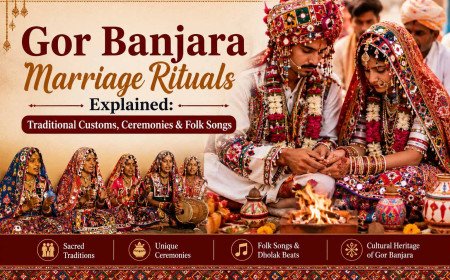
Marriage, known as "Vaya" in the Banjara language, is one of the most significant social and cultural institutions of the Banjara community. Traditionally, Banjara weddings were not merely family celebrations but community festivals filled with music, dance, customs, and emotionally rich folk songs. Every stage of the wedding—from engagement to the bride's farewell—is accompanied by songs that express happiness, blessings, satire, love, sorrow, and the cultural values of the community.
In earlier times, the Banjaras led a nomadic lifestyle and celebrated marriages wherever their groups gathered. Wedding ceremonies often lasted for several weeks, and after marriage the bridegroom remained at his in-laws' house for many months, proving his abilities by helping the family with daily work. Only after the bride's family was satisfied with him was the bride sent to her husband's home. Over time, modernization and urbanization shortened these elaborate ceremonies to one or two days, although many families still preserve the traditional rituals.
Historically, marriages were celebrated during the night and followed customs that had been observed for generations. Dowry also formed part of the tradition. In ancient times, young oxen were given as dowry, whereas today it is commonly presented in the form of cash and gold. Throughout every ceremony, groups of women sing traditional wedding songs, creating an atmosphere filled with devotion, celebration, humour, and deep emotion.
One of the most touching customs is Dhavalo, a unique style of ceremonial weeping taught to the bride before her departure. Through these sorrowful songs, the bride expresses her pain of leaving her parents, relatives, and the entire tanda while praying for their prosperity and happiness.
Traditionally, Banjara wedding songs are divided into two broad groups:
- Songs related to the bridegroom
- Songs related to the bride
The songs concerning the bridegroom include:
- Sagayi (Kan Saloi) – Engagement
- Vadayir Kadi – Baptism or initiation ceremony
- Vetadun Valayer Geed – Farewell to the bridegroom before leaving for the wedding
Songs of the Bridegroom
1. Sagayi or Kan Saloi (Engagement Ceremony)
In the Banjara language, engagement is called Kan Saloi. The word originates from Kan Samlai, meaning the public announcement of an engagement. Traditionally, engagements were conducted in the gardens of mango, banana, tamarind, orange, or coconut trees, symbolizing harmony between human life and nature.
Traditional Engagement Song
Kelare bagem kidere sagai
Ambare bagem khadere mithai
Mosambire bagem kider sagai
Amlire bagem khader saloi
Narlere bagem kider sagai
Narangire bagem khadere ghee poli.
Meaning
The song recalls the old custom of arranging marriages amidst nature. The engagement takes place in banana gardens, sweets are enjoyed in mango orchards, saloi (a traditional non-vegetarian dish) is eaten beneath tamarind trees, and delicious ghee poli is shared in orange gardens. The song beautifully reflects the close relationship between the Banjara people and nature during important social ceremonies.
The Engagement Ceremony
Today, when a marriage proposal is accepted, the parents of the bridegroom visit the bride's house along with respected elders. The Naik, Karbhari, and senior members of the tanda gather to witness the occasion. After both families agree to the marriage, they decide the wedding date and discuss the Karrar money, also known as the bride price or dowry. Once these decisions are finalized, the entire tanda recognizes the new relationship between the two families.
Kaslat – Traditional Dialogue Song
During the gathering, elders exchange greetings through a ceremonial song called Kaslat.
Song
Panch panchyat raja Bhojer sabha
Panchare lakh, anpachare sava lakh
Sag-Sagayi parakan kide, kide doyi bat
Upar kanta paramal mare
Mayi beto dudalor nayak
Doyi ghoder kan barobarar nayak
Aang khade khana, lar khade khobara
Doyim rach mitor nayak
Von toon madoyi khan rajeer nayak.
Meaning
The assembly is compared with the great court of King Bhoj, emphasizing its dignity and importance. The song explains that marriages should be arranged only after careful discussion and mutual understanding. It reminds both families that relationships are lifelong bonds built on trust rather than temporary associations. The comparison of wooden and leather ladders symbolizes that true relationships should remain strong despite hardships.
Golkhayero (Sharing Jaggery)
After the negotiations conclude successfully, jaggery is distributed among everyone present. This custom is called Golkhayero, literally meaning "eating jaggery." Sharing sweetness symbolizes the beginning of a sweet and lasting relationship between the two families.
Before the guests leave, members of the bride's family express their gratitude through another traditional song.
Song
Dungar the jab dur the, ab ho gai pahchan
Ta ki lagi prem ki, hira napje, khan
Saga aisa kijiy, jaisa resham sut
Ulze par sulze nahi, gant pade majbut
Soneri thali, na rupe jaisi bati
Sagati saga malge, shital vegi chati
Milna bhala, bichadna bura, bichdo mat koy
Sasna, ramna, khelna, ram kare so hoy.
Meaning
The song explains that before the engagement, the two families were strangers, but now they are united by affection and mutual respect. Relationships should be as soft and strong as silk, remaining firm even when difficulties arise. It reminds everyone that meeting is joyful while separation is painful and encourages both families to live with happiness, friendship, and faith in God's will.
2. Sadi Talno (Wedding Feast Before Departure)
The wedding rituals officially begin at the bridegroom's house. Before leaving for the bride's village, the bridegroom hosts a grand feast for all the people of the tanda. This gathering is known as Sadi Talno or Sadi Tanero. It represents gratitude toward the community and seeks blessings before the marriage procession begins.
Before this feast, another important ceremony known as Ghota Kadno is performed.
3. Ghota Kadno
Ghota Kadno is the first formal wedding ritual performed at the bridegroom's house, usually late at night. The atmosphere is filled with humour as women sing comic and satirical songs teasing each other and especially the bridegroom's relatives.
Song
O! chadlare kundema kaliy tali
O! vetduri bhenen lego budo dhadi
Kachi pakiy sapari sendapar
O vetduri bhen beti indapar
Kachi paki ye sapari heteti
Vo vetduri bhen peteti.
Meaning
The women from the bride's side jokingly tease the bridegroom's sisters. They humorously sing that an old bard has kidnapped the bridegroom's sister and that she is pregnant, creating laughter among everyone present. Such playful songs strengthen social interaction and add entertainment to the wedding celebrations.
4. Vadayir Kadi
Before leaving for the bride's house, the bridegroom undergoes an initiation ceremony known as Vadayir Kadi.
The word Vadayi means "to grow." This ceremony signifies that the young man has reached adulthood and is now ready to enter married life. Traditionally, the Naik or a religious leader marks the bridegroom's right shoulder with a needle and whispers the Guru Mantra into his ears, seeking divine blessings and protection.
Guru Mantra
Koli aav koli jav
Koli mai jag samav
Dholo ghodo hanslo
Pataliya asavar
Munge avada mogara
Thali avada ban
Maiz pooja, maiz pati
Maiz poojan har
Guru baba sada jan.
Meaning
The mantra reminds the bridegroom that life is full of obstacles, but with the blessings of Guru Baba he will overcome them. Riding the symbolic white horse represents courage, purity, and determination throughout married life. The song emphasizes faith, devotion, and divine guidance as essential qualities for a successful future.
5. Vetadun Valayer Geed (Farewell to the Bridegroom)
After completing the rituals at the bridegroom's house, the time arrives for him to leave for the bride's village. This farewell ceremony is known as Vetadun Valayer Geed or Kotlo Bhar Kadero. It is an emotional yet joyful occasion where relatives, elders, men, and women gather to bless the bridegroom before his journey.
The bridegroom does not travel alone. He is accompanied by his closest friend, called the Leriya, along with experienced elders of the tanda. The Leriya plays a very important role throughout the wedding. He speaks on behalf of the bridegroom, helps solve any misunderstandings, and guides him through the customs and ceremonies based on his own experience. Throughout this occasion, women sing traditional songs filled with blessings, advice, humour, and playful teasing.
Farewell Song for the Bridegroom
Bagema khado bagema suto
Chale chalau ghodo bhidore ha
Yadiro hatko bapero hatko
Na manore palkiya
Gorire karan chalo re ha
Nagari ma khado, nagari ma pido
Nari re karan chod chalo re ha
Nangari jagayo sari rataye yadi
Angacha tar sasuro zular
Hat jod binti kar
Panchamelu Baman.
Meaning
The song describes the bridegroom preparing for his journey after spending the night in the garden. He rides a trained horse towards the bride's village. Elderly women lovingly advise him to remain humble, respectful, and polite wherever he goes. They encourage him to greet everyone with folded hands and to honour his future in-laws. These songs are intended to bless the bridegroom with a safe journey and a successful marriage.
Humorous Songs About the Leriya
The Leriya becomes the target of humorous teasing by the women. Since he represents the bridegroom throughout the wedding, he is expected to tolerate every joke with patience and a smile.
Song
Leriya aangholi kariya khaliya
Leriya dhoti vata lego saliya
Leriya leriya sapari pheriya
Leriyar khich lau dohi khariya.
Meaning
The women jokingly tell the Leriya to go and bathe in the river, only to claim that a fox has stolen his dhoti. They further tease him by saying that he must distribute betel leaves and betel nuts to everyone who asks. These playful songs create laughter and strengthen the bond between both families before the marriage ceremony begins.
6. Kotlo Gharema Leno (Reception of the Bridegroom)
After arriving near the bride's village, the bridegroom and his companions cannot immediately enter the tanda. According to traditional Banjara customs, they must wait outside until the bride's family formally welcomes them.
The Naik, relatives, elders, women, children, and other members of the bride's tanda gather together to receive the wedding procession. During this reception, both sides exchange greetings through humorous songs that often include playful insults and friendly satire. These songs are not meant to offend anyone; instead, they strengthen relationships and make the atmosphere lively and entertaining.
Song Sung by the Bride's Side
Vetadu aayo vade vadeti
Wori bhenen meliyayo bhadeti
Vetduri bhene katriki cha?
Do hat gai, do ghat gai
Do dhagdya lekar bhag gayi
Vetadu vayan aayo
Tari yadin ka koni layo.
Meaning
The women from the bride's side welcome the bridegroom with teasing remarks. They jokingly ask how many sisters he has and humorously claim that some have gone to the market while others have run away with their lovers. Finally, they ask why he has come for marriage without bringing his mother. Such witty songs create laughter while welcoming the guests.
Song Comparing Jadhav and Rathod Families
Ye jadhaver lok kasen aayech?
Woto rathoderi galli zaden aayech
Ye jadhaver lok kasen aayech
Wo to rathoderer bhanda ghasen aayech.
Meaning
In this song, the bride belongs to the Rathod clan while the bridegroom belongs to the Jadhav clan. The bride's relatives jokingly ask why the Jadhavs have come, pretending that they have arrived only to sweep the Rathods' streets and wash their utensils. The humorous rivalry between clans adds excitement and entertainment to the wedding celebrations.
Song Sung by the Bridegroom's Side
The bridegroom's relatives immediately respond with their own playful song.
Haam aache gharer sagasenl ra
Tam chhaya paniri tayari karor
Haam aache gharer sagasel ra
Tam palang ghaleri tayari karor
Haam aache gharer sagasel ra.
Meaning
The bridegroom's relatives proudly declare that they belong to a respected family and should therefore be welcomed with honour. They jokingly ask the bride's family to prepare drinking water, tea, and comfortable beds for them. The exchange continues until everyone bursts into laughter, making the welcome ceremony one of the most enjoyable moments of the wedding.
Songs About the Bride
While the bridegroom's songs are filled with humour, the songs about the bride are generally more emotional and expressive. Most wedding rituals are performed at the bride's house, where the bride's family bears the responsibility for organizing the ceremony. Throughout these rituals, women sing songs that reflect the bride's happiness, fear, love for her family, and sorrow over leaving her childhood home.
The principal categories of songs about the bride are:
- Tiker Geed – Song sung while applying vermilion.
- Haladi Geed – Songs sung during the turmeric ceremony.
- Hangolir Geed – Songs during the ceremonial wedding bath.
- Sat Pherar Geed – Songs sung while taking seven sacred rounds.
- Dhavalo – Ceremonial songs of sorrow and farewell.
- Haveli Geed – Prayer-like farewell songs before departure.
In addition to these songs, several important rituals are performed at the bride's house, including:
- Vakeldi Dhokayero (saluting the dung hill)
- Dorano Bhandero (tying the sacred thread or mangal sutra)
- Mand Ramero (traditional dice game)
- Chudo Tipero (bangle ceremony)
- Tangadi Bhar Kadero (display of the bride's jewellery box)
The Bride's Emotional Song Before the Wedding
The bridegroom usually arrives at the bride's house one day before the wedding. At this moment, the bride realizes that her marriage is now inevitable. She expresses her emotions through a deeply symbolic song.
Song
Ye ba kalo kund nir bharo ba
Ye ba wom phandi nani moti machali yo ba
Ye ba wom feko zimbrayro jal
Ye ba ju tari beti fandai yo ba
Ye ba kalen vavreri sarali bamboli ba
Ye ba won lage kale pile phul ye ba
Ye ba phul karmau ju tari beti karmai ba.
Meaning
Addressing her father, the bride compares herself to a fish trapped in a fisherman's net. Just as a fish cannot escape after the net is cast, she feels she can no longer avoid her marriage. She also compares herself to the delicate flowers growing on a babool tree, fearing that after marriage she will lose the carefree freedom of her maiden life. Through these beautiful metaphors, the song expresses the emotional conflict between duty and the pain of leaving one's childhood home.
Tiker Geed (Sindur Song)
The Tiker Geed, also known as the Sindur Geed, is sung during one of the most emotional moments of a Banjara wedding. This ceremony takes place early on the wedding morning. The bride's brothers apply a vermilion (sindur) mark to the foreheads of both the bride and the bridegroom while women of the tanda sing traditional songs.
Although this ritual symbolizes the beginning of the bride's new life, it also marks the end of her carefree childhood. Realizing that she will soon leave her parents' home, the bride becomes deeply emotional. Through her song, she pleads with her brothers and friends not to complete the ceremony because she fears separation from her family.
Traditional Tiker Geed
Aater janjale mayi kajaye ghalelagi bhavajoye ahinya
Mataje kado bhavajoye mareje
Yadire hatero latilatayi garatani ahinya
Mataje kado bhavajoye mareje
Javanuvure hateri pani panayi lattari gutani ahinya
Sereri serayi topali ahinya.
Meaning
The bride asks her childhood companions not to push her into the confusion of marriage. She requests them not to take away the beautiful ornaments lovingly prepared by her mother or the elegant clothes given by her father. Every ornament reminds her of the affection she received in her parental home.
She realizes that her marriage can no longer be stopped, yet her heart refuses to accept the reality. The repeated expression "Ahinya" gives voice to her deep sorrow and emotional pain. This song beautifully portrays the emotional attachment between a daughter and her parents, making it one of the most touching wedding songs in the Banjara tradition.
The same emotional melody is often used during other bridal ceremonies such as applying henna, wearing bangles, and dressing the bride, although the words change according to each ritual.
Haladi Geed (Songs of the Turmeric Ceremony)
The Haladi (Haldi) ceremony is one of the most important and emotional rituals in a traditional Banjara wedding. Turmeric paste is applied to both the bride and the bridegroom three times during the wedding ceremonies.
Unlike many other Indian communities where Haldi songs celebrate joy and beauty, Banjara Haldi songs mainly express the bride's emotional struggle. She is unwilling to leave her parents, brothers, sisters, relatives, and childhood friends. Through these songs, she openly expresses her sorrow while women of the community join her in singing.
First Haldi Song
Mat je ghaso re virenla, par ghareri par jateri haldiro tiko
Aapne baperi chakari kariyoto, shabasi maliye virenla
Lali lowdiro kholo mandu, dasi aangliro hath jodu
Mat lagado haldiro tiko
Tamare haten sava lakheri angati kabul karu
Limbej chandneri hiye to latko dhab den chadu.
Meaning
The bride begs her brothers not to apply turmeric to her body because the turmeric has come from an unfamiliar family and an unfamiliar clan. Since she has never accepted anything from strangers, she feels hesitant to accept even this sacred turmeric associated with her future home.
She lovingly tells her brothers that she would happily gift them rings for every finger if only they would stop the ritual. Her words reveal her immense affection for her parents and siblings and her unwillingness to leave them. The Haldi ceremony therefore becomes an occasion where the entire family is overwhelmed with emotion and tears.
Second Haldi Song
Bai tari haldi savangi disach ye aaj
Ladki tari dadi rovach ye aaj
Ladki ton haldi savangi shobhach ye aaj
Ladki taro lakhopati dada rovach ye aaj.
Meaning
The women tell the bride that today both she and the turmeric appear exceptionally beautiful. Yet despite the festive atmosphere, her grandmother cannot stop crying. Even her wealthy grandfather sheds tears because no amount of wealth can reduce the pain of seeing a beloved granddaughter leave home.
The song reminds everyone that marriage is both a celebration and a moment of profound separation for the bride's family.
Third Haldi Song
Haldi lageduni kach ye najukeri nar
Wori haldi lagem gujar gai rat
Mendi lageduni kach ye najukeri nar
Wori mendi kadem gujar gai rat
Mandal bhareduni kach ye najukeri nar
Wori mandal bharem gujar gai raat.
Meaning
This song expresses the feelings of the bride herself. She is portrayed as a delicate young woman who is reluctant to have turmeric, henna, and other wedding rituals performed upon her. Every ceremony reminds her that her maiden life is coming to an end.
Although she cannot stop the marriage, her quiet resistance and emotional pain are beautifully expressed through this folk song.
Fourth Haldi Song
Haldi lagal ye ladi tu khul jayachi
Yeki haldim yadi baap bhul jayechi
Mehandi lagal ye ladi tu khul jayachi
Yeki mehandim dada dadi bhul jayechi
Haldi lagal ye ladi tu khul jayachi
Yeki haldim kaka kaki bhul jayechi.
Meaning
The women reassure the bride that turmeric and henna will make her even more beautiful. They gently tell her that once she enters married life, she will gradually become accustomed to her new family and responsibilities. In time, the memories of her childhood home will no longer dominate her daily life.
Rather than criticizing the bride, the song serves as gentle emotional preparation for her new journey, encouraging her to accept the changes that marriage brings.
Cultural Importance of Haladi Geed
The Haladi Geed occupies a special place in Banjara folk literature because it combines celebration with emotional expression. Instead of focusing only on beauty and festivity, these songs reveal the bride's deep attachment to her parents and her hesitation to leave the home where she was lovingly raised.
The repeated references to brothers, grandparents, parents, uncles, and aunts demonstrate that marriage in Banjara culture is not viewed merely as the union of two individuals. It is the emotional joining of two families while simultaneously marking the painful separation of a daughter from the people who nurtured her.
These songs preserve the collective memories, emotions, and values of the Banjara community and continue to be sung by women in groups during traditional weddings.
Wedding Bath (Vayar Hangoli)
The Wedding Bath, known as Vayar Hangoli, is one of the most sacred and symbolic ceremonies in a traditional Banjara wedding. After the Haldi ceremony, both the bride and the bridegroom are given a ceremonial public bath under the wedding pavilion (mandap). Throughout the ritual, groups of women sing emotional folk songs that reflect the bride's feelings as she prepares to leave behind her maiden life.
During this ceremony, the bride's friends and elderly women carefully remove the ornaments and attire she wore as an unmarried girl. Every ornament represents memories of her childhood, and parting with them becomes another emotional moment. Unable to control her feelings, the bride sings while weeping.
Wedding Bath Song (Hangoli Geed)
Sathlo munga molari dam chukai
Gartali mat todo
Shereri sherai gartali mat todo
Mare kunware paneri shobha, man redo sathlo
Mat chodo mari husi bhavjeri hateri
Valasi patali mat chodo ha hinya
Mare virari hateri gartali mat todo ha hinya.
Meaning
The bride requests her friends not to remove her beautiful ornaments such as the Gartali and Patali, as they symbolize her maidenhood. She explains that these precious ornaments were lovingly gifted by her brothers and sisters-in-law. Every ornament carries memories of her childhood and family affection.
Although the Banjaras have traditionally lived simple lives, they have always cherished their daughters and tried to provide them with the finest ornaments and comforts they could afford. The bride's reluctance to remove these ornaments reflects her unwillingness to leave behind the happy days she spent in her parents' home.
Doran Bandhno (Sacred Thread Ceremony)
After the ceremonial bath, an important ritual called Doran Bandhno is performed.
During this ceremony, a white raw cotton thread, called Dorlo, is tied around the necks of both the bride and the bridegroom. According to traditional belief, this sacred thread is prepared by winding it seven times around a water pot before it is tied around the couple's necks. It symbolizes purity, protection, and the lifelong bond of marriage.
Doran Bandhno Song
Tare baper hateti banda dorlo
Ku chutiye lada banda dorno
Ku chutiye lada banda dorlo
Chodu kar, chodau kar.
Meaning
The song is addressed to the bridegroom. It reminds him that the sacred thread tied around his neck by his father cannot easily be removed. Just as the thread remains firmly tied, the marital bond should remain strong throughout life.
The song symbolizes commitment, responsibility, and the permanence of the relationship established through marriage.
Sat Pherar Geed (Song of the Seven Sacred Rounds)
The Sat Phera is the central ritual of every Banjara wedding. The bride and bridegroom walk seven times around the sacred fire in the presence of relatives, elders, guests, and the entire community.
Traditionally, the wedding rituals were performed by a member of the Vadtya Clan, who fulfilled the role of a priest. In modern times, Brahmin priests usually conduct the ceremony, although in places where Brahmins are unavailable, members of the Vadtya Clan still perform the sacred rituals according to tradition.
Before the seven rounds begin, a traditional Mangalastak (auspicious wedding hymn) is sung.
Banjara Mangalastak
Navleri vetadu tam doi
Jaso dharti aakashero ro
Nadi samundarero, milan vero ra
Ju tamaro aaj ek jeev veror
Aaj tam saat phera fartani
Sere mundiag, jalmer bandnema bandage
Mat bhulo samajer, seva karor
Manav jater, rashtrer
Kuryat sada mangalam savdhan.
Meaning
The song compares the union of the bride and bridegroom to the eternal union of the earth and the sky, and the river and the sea. By taking seven sacred rounds around the holy fire, the couple become lifelong partners.
The hymn also advises the newly married couple never to forget their responsibilities toward society, humanity, and the nation. Marriage is presented not merely as a personal relationship but as a sacred social responsibility.
Song During the Seven Rounds
As the bride walks around the sacred fire with her husband, she becomes increasingly emotional. The women surrounding the couple sing another traditional folk song that encourages her to complete each of the seven sacred rounds.
Song
Eka veda feral laj beti panehuri
Dusro Veda faral yadi bapero
Tisro Veda faral bhen bhairo
Chautho Veda faral nanad bhavjuro
Pachvo veda faral joru tamari
Chovo Veda faral lada tamari
Sat veda faral yetadu maro.
Meaning
Each round of the sacred fire carries a special symbolic meaning.
- First Round: Dedicated to the leaders and elders of the tanda.
- Second Round: Offered in honour of the bride's parents.
- Third Round: Dedicated to her brothers and sisters.
- Fourth Round: For her sisters-in-law and extended family.
- Fifth Round: Marks her acceptance as the wife of her husband.
- Sixth Round: Strengthens the lifelong bond between the couple.
- Seventh Round: The bride declares that the bridegroom now belongs to her forever.
As the women sing these verses, they gently encourage the bride to accept her new life while remembering the blessings of her family and community. With the completion of the seventh round, the marriage ceremony is formally completed according to Banjara tradition.
Cultural Significance of the Wedding Bath and Seven Pheras
The Wedding Bath (Hangoli), Doran Bandhno, and Sat Pherar Geed together represent the spiritual transformation of the bride and bridegroom.
- Hangoli symbolizes purification before entering married life.
- Doran Bandhno represents the sacred and unbreakable bond of marriage.
- Sat Pherar Geed emphasizes love, commitment, family responsibilities, and service to society.
Unlike ordinary ceremonial songs, these folk songs preserve the values, beliefs, and emotional experiences of generations of Banjaras. They remind the newly married couple that marriage is not only the union of two individuals but also the joining of two families, two lineages, and the entire community.
Tangadin Vat Lagadno (Bride's Farewell Ceremony)
After the wedding rituals are completed and the community meal has been served, the most emotional stage of the Banjara wedding begins—the Tangadin Vat Lagadno, the farewell ceremony of the bride. This marks the moment when the bride prepares to leave her parental home and begin a new life with her husband. Family members, relatives, friends, guests, and the entire tanda gather to bless her before her departure.
Unlike earlier ceremonies that are filled with laughter and celebration, this ritual is dominated by sorrow, prayers, and heartfelt blessings. The bride expresses her emotions through a unique type of folk song known as Haveli Geed.
Haveli Geed (Farewell Prayer Song)
The Haveli Geed is much more than an ordinary farewell song. It is a heartfelt prayer through which the bride seeks prosperity, happiness, and well-being for her parents, brothers, relatives, and every family living in the tanda.
According to traditional Banjara custom, the bride was once made to stand on an ox and later in a bullock cart. She was taken around the entire tanda so that everyone could bid her farewell. Elderly women accompanied her and helped her sing the Haveli Geed, while men, women, and children followed behind in tears.
The elders of the community believe that even the oxen became emotional during this farewell procession. As the bride raised both her hands above her head, she sang the Haveli Geed with deep sorrow and affection for her family and homeland.
Traditional Haveli Geed
Chhut mat jayes haveli
Marej nayak bapuri haveli
Tarej rajema achoj khadi
Achoj peedi haveli ahinya
Tarej rajema achoj vodi
Eka ghadi lagavat
Das ghadi laged virena ahinya
Ye mar nayak bapuri haveli
Aacho khayes, aacho piyes
Mar bapuri haveli ye aa-hiya...
Vadlasu vades, ghurlasu feles
Limdasu leres hariyali su hari res
Marwari virenlari haveli aa hiya.
Meaning
The bride lovingly addresses her father's home and says that she never wishes to be separated from it. She recalls the happy years she spent growing up there, surrounded by love, comfort, and affection.
She prays that her father's house should always remain prosperous and that every member of the family should enjoy good health, happiness, and abundance. She wishes that the family may continue to grow like the mighty banyan tree and flourish with greenery and prosperity forever.
The bride also remembers the beautiful days she spent with her brothers, sisters, relatives, and friends. Even though she is leaving, she asks God to keep her family united and blessed throughout their lives.
Symbolism Within the Haveli Song
The Haveli Geed contains several beautiful symbols that reveal the emotional world of the Banjara bride.
The bride compares herself to a fish caught in a fisherman's net, symbolizing her helplessness. Just as a trapped fish cannot return to the water, she realizes that she cannot remain in her parental home forever.
She also tells her father that she is not a coconut to be sold, expressing that a daughter should never be viewed merely as someone who leaves the family after marriage.
Her prayers extend beyond herself. She wishes that:
- Her brothers should remain prosperous.
- Her family should always live happily.
- Her parents should never face hardship.
- The tanda should continue to flourish.
- She may one day return to her parents' home carrying flowers instead of sorrow.
These blessings demonstrate the selfless love and generosity that characterize the traditional Banjara bride.
Cultural Importance of Haveli Geed
The Haveli Geed occupies a unique place in Banjara folk literature because it combines prayer, blessing, gratitude, and separation into a single performance.
Unlike ordinary farewell songs, the bride does not complain about her fate. Instead, she places the happiness of her parents and the prosperity of the tanda above her own sorrow. Even while weeping, she prays for everyone around her.
This reflects one of the most beautiful values preserved in Banjara culture—the belief that a daughter's farewell should leave behind blessings rather than bitterness.
The Emotional Atmosphere of Bidai
As the Haveli Geed is sung, the atmosphere becomes deeply emotional. Parents, brothers, sisters, relatives, neighbours, and even children are moved to tears.
For generations, the Bidai has been regarded as the most touching moment in a Banjara wedding because it marks the end of the bride's childhood and the beginning of her married life.
Although she leaves her parental home, her final words are filled not with sadness alone but with gratitude, respect, and blessings for those who raised her. This emotional farewell has remained one of the most cherished traditions of the Banjara community.
Transition to Dhavlo
While the Haveli Geed forms the bride's farewell prayer, another unique tradition begins during the final moments of her departure—Dhavlo, a distinctive ceremonial style of weeping found only in the Banjara community.
Unlike ordinary crying, Dhavlo follows a traditional pattern that is taught to every bride by experienced women of the tanda. Through this art of ceremonial weeping, the bride expresses sorrow, prayer, blessings, and promises before leaving her parental home. This remarkable tradition is the final and most distinctive stage of Banjara wedding songs.
Dhavlo Geet (The Unique Farewell Songs of the Banjara Bride)
Among all Banjara wedding traditions, Dhavlo is one of the most distinctive and emotionally powerful customs. Unlike ordinary crying or farewell songs, Dhavlo is a structured and ceremonial form of weeping performed exclusively during a bride's departure from her parental home.
According to Banjara tradition, elderly and experienced women of the tanda teach every bride how to perform Dhavlo before her wedding. This custom has been preserved for generations and is regarded as an essential part of the traditional marriage ceremony. Through Dhavlo, the bride expresses sorrow, gratitude, prayer, and blessings while bidding farewell to her parents, brothers, relatives, and the entire tanda.
Unfortunately, with modernization and changing lifestyles, many educated brides no longer learn this traditional form of ceremonial weeping, making Dhavlo one of the endangered elements of Banjara cultural heritage.
Characteristics of Dhavlo
Dhavlo is much more than weeping. It combines three important forms of emotional expression:
- Expression of sorrow over leaving the parental home.
- Expression of prayer for the well-being of family members.
- Expression of vows and promises made by the bride before beginning her new life.
During the wedding ceremonies, experienced women assist the bride while she sings Dhavlo. However, at the final moment of departure, she is expected to sing independently. This serves as a traditional test of whether she has learned the art properly.
The First Dhavlo
The bride begins learning Dhavlo through a simple but deeply meaningful couplet. At the end of every line, the expression "Hi-yaa" is repeated to intensify the feeling of grief.
Song
Ye yaa, koon paalo, koona poso, koon bhoga, raja-hi-yaa
Ye yaa, yadi paali, bapa poso saasu bhoga, sakkaaraja-hi-yaa.
Meaning
The bride asks who cared for her, who protected her, and who will receive her service after marriage.
She herself answers the questions:
- Her mother nurtured her.
- Her father protected and raised her.
- Her mother-in-law will now receive her care and service.
The couplet beautifully illustrates the transition from a daughter's life in her parental home to her responsibilities in her husband's family.
Dhavlo While Holding the Pillar
When the bride is finally called to leave her house for the wedding pavilion, she often refuses to step outside. Holding the central pillar of the house, she cries while singing another Dhavlo. Her brothers gently persuade her to leave the house and begin her married life.
Song
Chut mat jayes, mare ja nayak bapuri haveli- hi-yaa
Chut mat jayes, maro Roopa, Khemari, veernari haveli-hi-yaa.
Meaning
The bride begs not to be separated from her beloved father's home. She remembers every happy moment she spent there with her family and expresses her unwillingness to leave.
This song reflects the emotional attachment between a daughter and her childhood home, making it one of the most touching moments of the entire wedding ceremony.
Dhavlo to the Mother
One of the most emotional Dhavlos is sung when the bride bids farewell to her mother.
Song
Yadi ye han hiya
Ton ku chodu ye yadi he hiya
Chanda suryari Jodi ju ma-betiri Jodi
Kidi mungi sapati ju, tari beti koni sapati yadi
Limbu naral vakge ju, tamari beti vakagi yadi
Tari beti ti talo mat khavjo yadi ye hiya.
Meaning
The bride tells her mother that leaving her is the most difficult moment of her life.
She compares the relationship between mother and daughter to the inseparable bond between the sun and the moon. She says she wished she could remain with her mother forever, just as tiny creatures remain together.
The bride also expresses that she is not something to be sold like lemons or coconuts, emphasizing that a daughter is priceless. Finally, she pleads with her mother never to reject or forget her after marriage.
This Dhavlo expresses unconditional love between mother and daughter and highlights the emotional pain of separation.
Dhavlo to the Brother
Before leaving the tanda, the bride also sings a Dhavlo for her brother.
Song
Virena aa hiya
Maro marwadi virena aa hiya
Veera tari bhen cha karan aayes
Wali vaten sudi karan aayes
Sau kosen ek kos karan aayes
Jana dekhu jana tari murat harad aav aa hiya.
Meaning
The bride asks her brother never to forget her after marriage. No matter how long or difficult the journey may be, she requests him to come and visit her.
She longs to see his face again and again, expressing the lifelong affection shared between a brother and sister. The song reminds brothers of their continuing responsibility to care for and remain connected with their sisters after marriage.
Cultural Significance of Dhavlo
Dhavlo is unique to the Banjara community and represents one of the richest forms of oral tradition preserved through generations.
Unlike ordinary farewell songs, Dhavlo combines:
- Deep emotional expression.
- Religious devotion.
- Family values.
- Blessings for parents and relatives.
- Respect for elders.
- Hope for a happy married life.
Every Dhavlo reminds listeners that marriage is not simply a social event but an emotional transition that transforms a daughter's role within the family and society.
Conclusion
Banjara wedding songs, collectively known as Vayar Geed, preserve the history, emotions, beliefs, and traditions of the Banjara community. From the joyful Kan Saloi (engagement) and playful songs teasing the bridegroom to the emotional Haladi Geed, sacred Sat Pherar Geed, heartfelt Haveli Geed, and deeply moving Dhavlo, every stage of the wedding is enriched with meaningful folk songs.
These songs are far more than entertainment. They teach family values, strengthen community relationships, preserve oral history, and give voice to the emotions of the bride and bridegroom. They celebrate joy, express sorrow, offer blessings, and remind each generation of its cultural identity.
As modernization changes traditional wedding practices, preserving these songs becomes increasingly important. Recording, documenting, and teaching Banjara Wedding Songs (Vayar Geed) ensures that this invaluable cultural heritage continues to inspire future generations and remains a living symbol of Banjara identity and tradition.
Frequently Asked Questions
What's Your Reaction?
 Like
0
Like
0
 Dislike
0
Dislike
0
 Love
0
Love
0
 Funny
0
Funny
0
 Wow
0
Wow
0
 Sad
0
Sad
0
 Angry
0
Angry
0




Comments (0)