

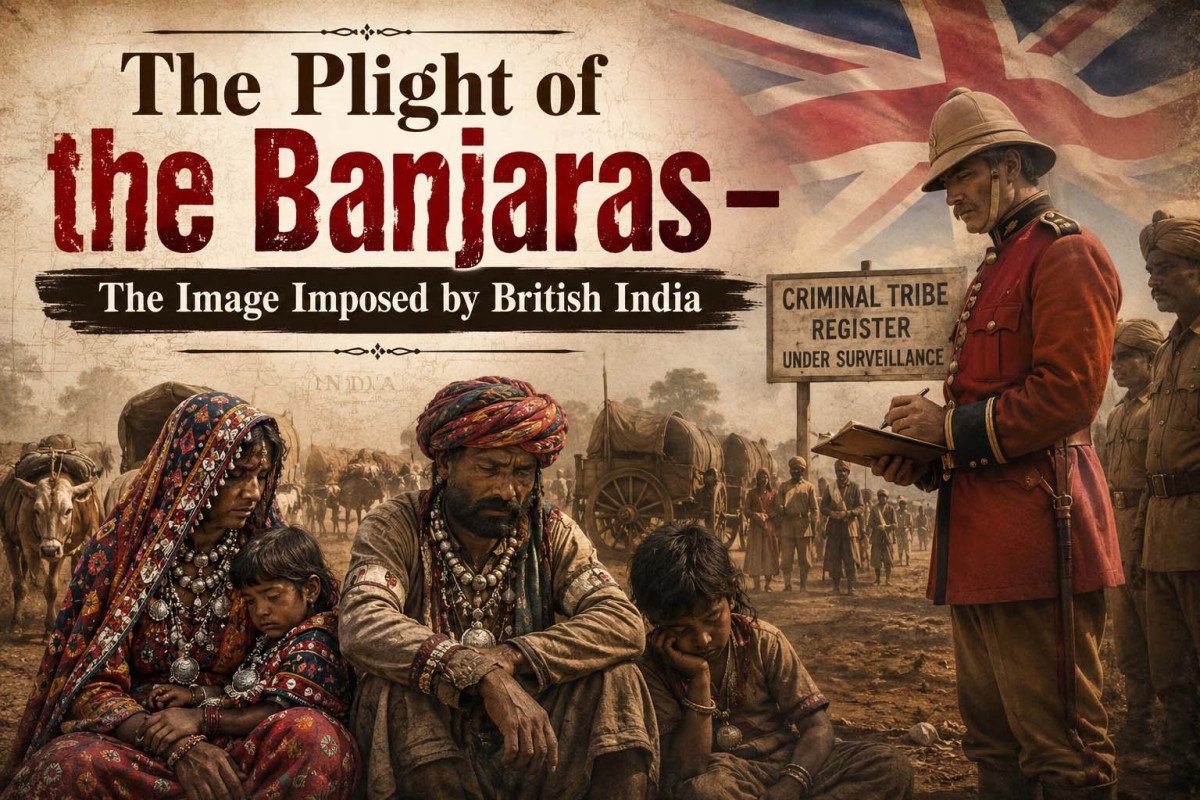
The Plight of the Banjaras – An Image Imposed by British India
Explore how the Criminal Tribes Act of 1871 shaped the social stigma faced by the Banjara community and why its impact continued long after the law was repealed.

A Symbol of the Real History Associated with Kalabhairava
A Story That Symbolizes History
A girl named Riya lived with her family in a residential colony. Since childhood, she had been afraid of dogs. Around ten stray dogs lived in that colony. They tried to protect their shelter, prevented other dogs from entering their territory, and often chased unfamiliar people and other animals that came their way. As a result, the residents of the colony developed fear and anger toward those dogs.
Riya also had a pet cat. Her father worried that the stray dogs might kill it. One day, while people were trying to chase the dogs away and frighten them, a small puppy became terrified and climbed onto a nearby building that was under construction.
It was nighttime. The puppy could not find its way down. Eventually, it fell from the first floor, breaking both of its legs.
Witnessing this changed Riya's mother's perspective.
She realized:
"This happened because of the way we treated it. If we had not frightened the puppy, perhaps this situation would never have occurred."
Instead of leaving the injured puppy there, she took it to a veterinarian for treatment. She began feeding it every day. The compassion that started with one small puppy gradually grew into caring for and taking responsibility for all the stray dogs in the colony.
Yet one strange thing remained.
Even after more than three years, whenever the puppy saw Riya's father, it would run away in fear.
Why?
Because once fear takes root, it leaves an imprint not only on the body but also on the mind.
That is the central message of this story.
A Symbol for Understanding Banjara History
During British rule, nomadic communities such as the Banjaras, Lambadis, and Lamanis were also forced to live under suspicion, surveillance, and social stigma. In particular, through the Criminal Tribes Act of 1871, many nomadic and other communities were classified as "criminal tribes," and strict restrictions were imposed on their movement, residence, and way of life.
This was not merely a law.
It was a social label imposed upon an entire community.
Punishing an individual for committing a crime is one thing. Treating an entire community as suspicious from birth is something entirely different.
The image and stigma created during British rule continued to affect future generations. Laws changed, but the suspicion created within society did not disappear so easily.
The puppy running away from Riya's father even after three years symbolizes this reality.
A wound may heal, but fear can remain.
A law may be repealed, but its social impact can continue.
Who Made Them "Criminals"?
A study of Banjara history makes it clear that the community has long been associated with India's ancient traditions of nomadic life, trade, transportation, and animal husbandry.
Historically, the Banjaras played a role in transporting goods between different regions of the country, caring for livestock, and trading salt and other commodities.
However, the nomadic way of life differed from the permanent administrative system that the colonial government sought to establish. As a result, controlling such communities became one of the objectives of British colonial administration.
Nomadic lifestyle → Suspicion
Suspicion → Surveillance
Surveillance → Stigma
Stigma → Social discrimination
If this cycle continues from one generation to another, it can take a very long time for a community to reclaim its history, dignity, and economic opportunities.
The Symbolism of Kalabhairava
In the Banjara tradition, spiritual figures such as Kalabhairava may be viewed not merely as symbols of fear, but also as symbols of time, justice, and the power to question injustice.
Therefore, the phrase "the real history associated with Kalabhairava" can be understood as a metaphor.
Time witnesses everything.
Who was branded as criminal?
Whose way of life was judged without being understood?
Whose culture was suppressed?
Whose history did not receive sufficient place in mainstream historical narratives?
Who continues to bear the effects of that historical injustice even today?
Seeking answers to these questions is, in itself, an effort to read history again.
Is Changing the Law Enough?
The Criminal Tribes Act was repealed in 1952. However, repealing a law alone does not completely remove social stigma.
For this reason, the concerns of Denotified, Nomadic, and Semi-Nomadic communities should not be dismissed as merely a matter of the past.
Issues such as:
- Educational opportunities
- Security of land and housing
- Employment
- Political representation
- Economic development
- Policies suited to nomadic ways of life
- Preservation of culture and language
- Recognition of historical discrimination
deserve comprehensive consideration.
What Did Riya's Mother Teach Us?
At first, she was afraid of the dogs.
Later, however, she did not simply judge the puppy's behavior. Instead, she tried to understand the fear behind it.
When the puppy was injured after falling, she did not punish it.
She arranged for its treatment.
She fed it every day.
Even after three years, when the puppy continued to run away in fear, she never asked,
"It's been so long—why is it still afraid?"
This is the lesson we should also understand when thinking about historically marginalized and disadvantaged communities.
After viewing a community with suspicion for generations, simply saying one day, "Now you are free," is not enough.
Fear requires trust to disappear.
Discrimination requires equal opportunity to end.
Humiliation requires respect to heal.
To address historical injustice, history itself must first be acknowledged honestly.
The Banjara Community Does Not Need Sympathy—It Needs Justice
The history of the Banjaras should not be viewed only through the lens of poverty, backwardness, or a nomadic lifestyle.
It is equally important to recognize their labor, their role in trade, their culture, art, social organization, relationship with nature, and their historical connections with different regions of India.
The image imposed during British rule is not the true identity of the Banjaras.
It was a historical circumstance created by a colonial system of governance.
Therefore, today's Banjara youth should learn about their past.
They should study their history.
They should document the oral histories preserved by their elders.
They should preserve their culture through proper documentation.
They should raise questions about their rights through constitutional means.
Because—
No community should have to spend generations living in fear like that frightened puppy.
A society that understands its history can overcome its fears and restore its dignity.
That is the path forward for the Banjara community.
Do not forget history—
Know it.
Do not spread hatred—
Demand justice.
Do not seek sympathy—
Claim respect.
That is the true re-reading of history.
That is the foundation of the Banjara community's renaissance.
Frequently Asked Questions
What's Your Reaction?
 Like
0
Like
0
 Dislike
0
Dislike
0
 Love
0
Love
0
 Funny
0
Funny
0
 Wow
0
Wow
0
 Sad
0
Sad
0
 Angry
0
Angry
0
















Comments (0)