

Maluki Banjaran: The Warrior Queen and Spiritual Icon of the Banjara Community
Discover the inspiring story of Maluki Banjaran, the legendary warrior queen of the Banjara community, known for her courage, spirituality, and leadership.

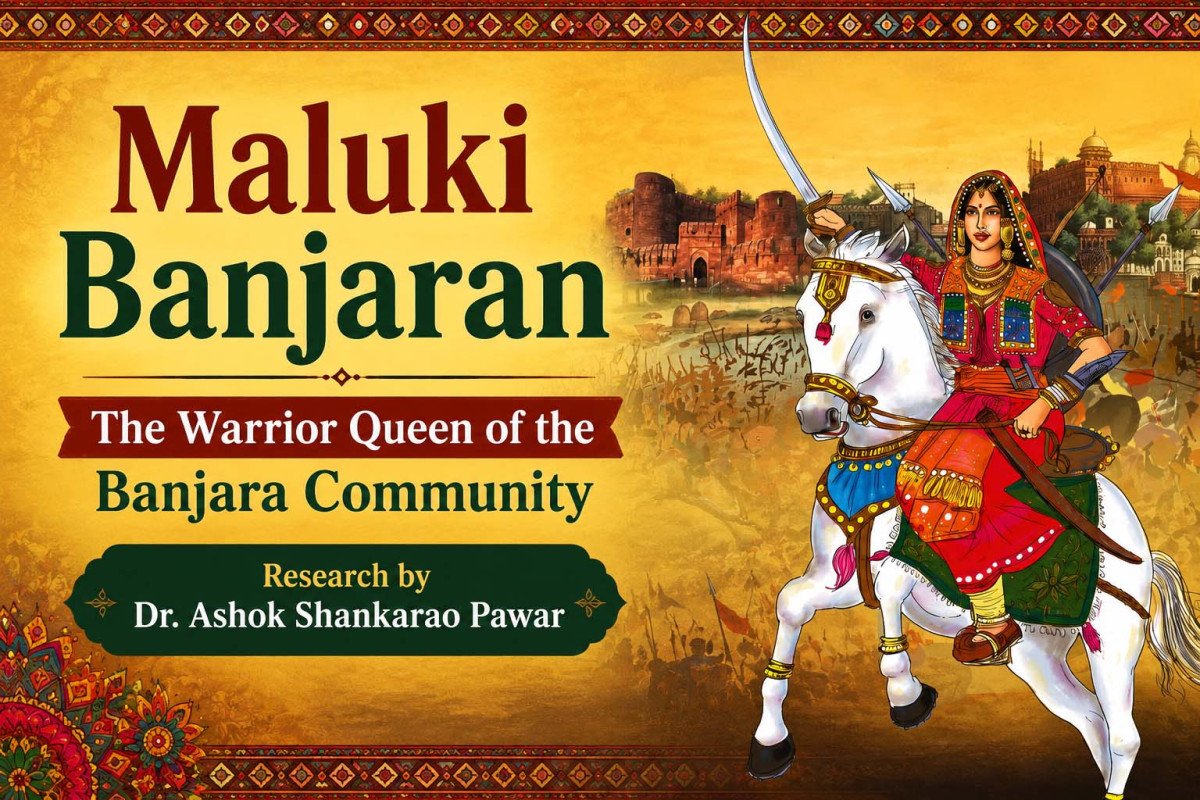
The history of the Banjara community is filled with stories of courage, sacrifice, trade, spirituality, and resilience. Among these inspiring personalities, Maluki Banjaran (Malluki Das Banjaran) occupies a unique place in Banjara folklore and literature. She is remembered as a fearless princess, a spiritual leader, a defender of her people, and a symbol of women's empowerment. According to Dr. Ashok Shankarao Pawar's research, Maluki Banjaran is regarded as one of the greatest heroines in Banjara history who combined bravery with wisdom and promoted peace over violence.
Although much of her life survives through traditional narratives rather than widely documented historical records, she continues to inspire generations of Banjaras across India.
The Banjara Community: Historical Background
Before understanding Maluki Banjaran's contribution, it is important to understand the community she belonged to.
The Banjaras are one of India's oldest indigenous nomadic tribes. Historically, they were famous for transporting grain, salt, cattle, bamboo, firewood, and other essential commodities across different kingdoms before the development of modern transportation. Their settlements, called Tandas, were governed by a community chief known as the Nayak, who handled both social and religious matters.
Banjaras speak Gor Boli (Lambadi), an Indo-Aryan language that traditionally has no script. The community is also known by many regional names including Lambani, Lamani, Sugali, Labhana, Vanjari, Brinjari, Gormati, and others.
Birth and Family Background
According to the source, Ballurai Binjarawat Pawar, a prominent Banjara leader, had thirteen children. His eldest son was Prince Maidas, while his youngest daughter was Malluki Das (Maluki Banjaran).
From childhood, her father trained her in qualities such as:
- Courage
- Leadership
- Fearlessness
- Self-confidence
- Protection of society
She displayed extraordinary intelligence and determination from a young age, preparing herself to serve and protect her people.
Education and Extraordinary Knowledge
Unlike many women of her era, Maluki Banjaran is described as highly educated.
The research paper states that she possessed knowledge of:
- The Vedas
- The Bhagavad Gita
- The Quran
- The Bible
- Music
- Dance
Her beautiful singing voice attracted visitors from distant places, and her wisdom impressed scholars and ordinary people alike. Her intellectual ability made her a respected personality beyond the Banjara community.
Spiritual Personality
Maluki Banjaran was not merely a warrior; she was also a deeply spiritual woman.
The paper explains that she drew inspiration from great Indian saints such as:
- Sant Kabir
- Tulsidas
- Meerabai
- Mahatma Basaveshwar
- Sant Dnyaneshwar
She believed that lasting solutions could not be achieved solely through warfare. Instead, morality, spirituality, wisdom, and justice should guide society.
The study compares her philosophy with Emperor Ashoka's transformation after the Kalinga War, suggesting that true victory lies in peace rather than destruction.
Defender of the Banjara Community
Maluki Banjaran is remembered as a courageous protector of her people.
According to the paper:
- She never feared powerful rulers.
- She remained dedicated to the welfare of the Banjara community.
- She continued struggling despite numerous hardships.
- She always placed the interests of her people above her own.
The research describes her as the first initiator of a freedom movement within Banjara society, portraying her as an early symbol of resistance and self-respect.
Philosophy of Non-Violent Resistance
One of the most remarkable aspects of Maluki Banjaran's personality is her preference for non-violent resistance.
The source explains that although she possessed tremendous courage, she believed unnecessary bloodshed should be avoided.
Instead of defeating enemies solely through war, she sought:
- Peaceful negotiation
- Unity among communities
- Protection of trade
- Welfare of sixteen Banjara clans
- Preservation of human life
The paper describes this approach as the Banjara policy of non-violent warfare, distinguishing her from conventional military leaders.
Relationship with Emperor Akbar
A significant part of the narrative concerns Emperor Akbar.
According to the research paper:
- Akbar admired Maluki Banjaran's beauty, intelligence, spirituality, and courage.
- Rather than engaging in prolonged conflict, Maluki promoted peaceful dialogue.
- Eventually, Akbar is said to have honored her instead of treating her as an enemy.
The article presents this episode as an example of wisdom triumphing over force.
Historical Note: This account is presented in the cited research paper and appears to rely heavily on Banjara oral traditions and community literature. It is not established as a consensus historical fact in mainstream academic historiography.
Hind-e-Ratna Copper Plate Honour
One of the most remarkable traditions associated with Maluki Banjaran is her receiving the Hind-e-Ratna Tamrapatra (Copper Plate Award).
According to the source, Emperor Akbar:
- Conferred the title Hind-e-Ratna
- Presented a copper plate (Tamrapatra)
- Bestowed upon her the status of a daughter
- Honoured her in the royal court
- Recognized her courage, spirituality, and leadership
The paper also states that she received ceremonial honours including royal dress, public processions, and widespread respect among the Banjara community.
Symbol of Women's Empowerment
Maluki Banjaran represents one of the earliest examples of female leadership within Banjara society.
Her life demonstrates that:
- Women can become spiritual leaders.
- Women can lead social reform.
- Women can defend their communities.
- Courage and wisdom are not limited by gender.
The study identifies her as an enduring role model whose story continues to inspire women in contemporary Banjara society.
Cultural Legacy
The memory of Maluki Banjaran survives through:
- Oral traditions
- Folk songs
- Community literature
- Spiritual narratives
- Banjara publications
- Cultural gatherings
She remains an important symbol of:
- Courage
- Sacrifice
- Justice
- Spirituality
- Community leadership
- Women's dignity
Her story reflects the values that have helped preserve Banjara identity through centuries of migration and social change.
Historical Importance
The research concludes that Maluki Banjaran's place in Banjara history remains secure because she is remembered simultaneously as:
- A freedom fighter
- A warrior queen
- A spiritual personality
- A social reformer
- A protector of her people
- A role model for women
The study also notes that the history of the Banjara community remains an active field of research and encourages further historical investigation into figures like Maluki Banjaran.
Conclusion
Maluki Banjaran occupies a special place in Banjara cultural memory as a fearless princess, spiritual thinker, and champion of her people. According to the research by Dr. Ashok Shankarao Pawar, her life symbolizes courage guided by wisdom, leadership grounded in compassion, and strength balanced with non-violence. While many details of her story derive from community traditions rather than broadly corroborated historical sources, her legacy continues to inspire Banjaras as an enduring example of bravery, justice, and women's leadership.
Frequently Asked Questions
What's Your Reaction?
 Like
0
Like
0
 Dislike
0
Dislike
0
 Love
0
Love
0
 Funny
0
Funny
0
 Wow
0
Wow
0
 Sad
0
Sad
0
 Angry
0
Angry
0














Comments (0)